Satchmo
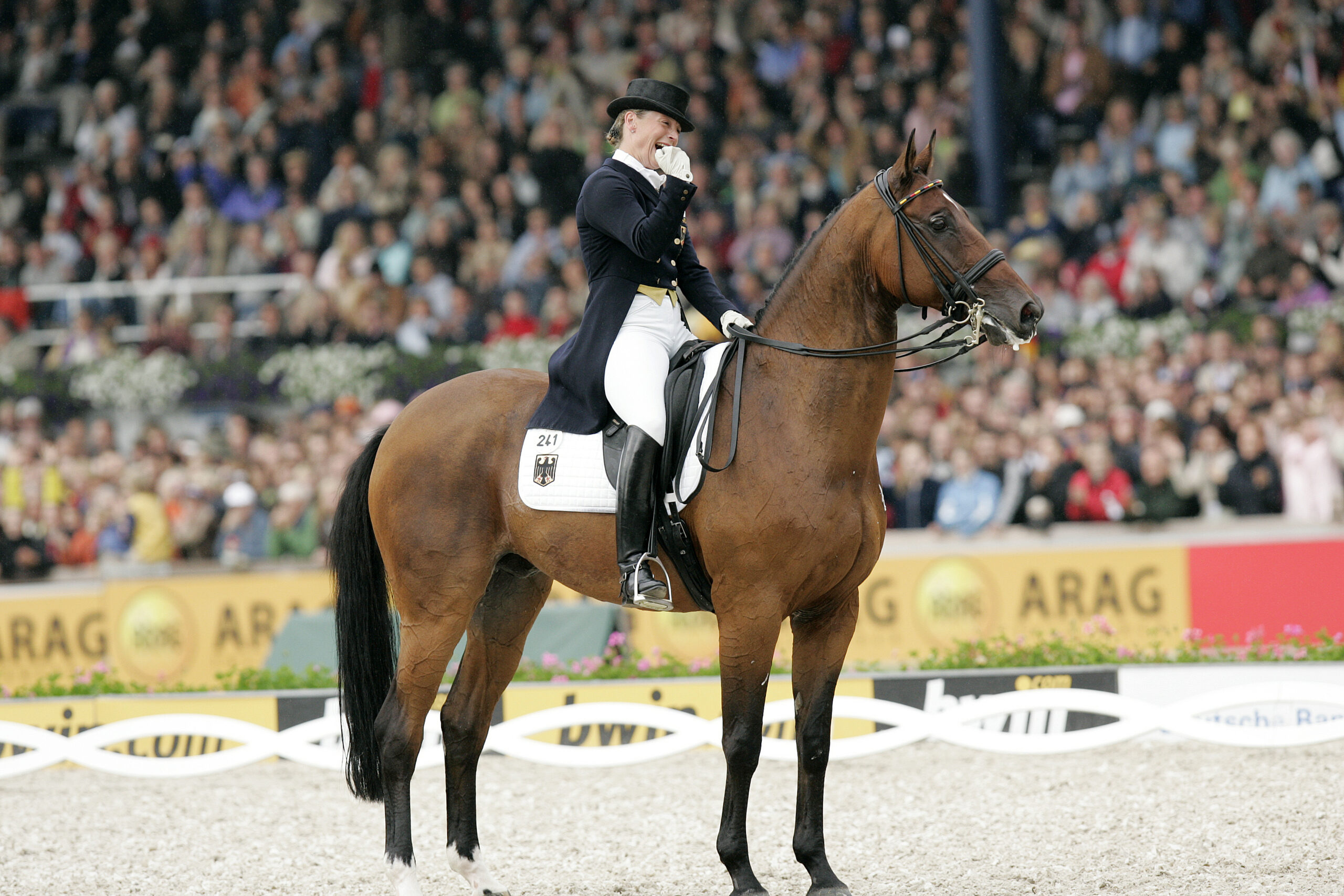
A picture that says more than 1000 words: Isabell Werth and Satchmo after the Grand Prix Special at the 2006 World Equestrian Games in Aachen. Photo: Toffi-images.de
- Name: Satchmo
- Geschlecht: Männlich
- Jahrgang: 1994
- Rasse: Hanover
- Vater: Sao Paulo
- Muttervater: Legacy
- Züchter: Albert Kampert
- Größte Erfolge: Double world champion 2006, two European Championship gold medals, three European Championship silver medals, team Olympic champion and individual silver medal winner in Hong Kong 2008
Satchmo was the horse that inspired Isabell Werth – in more ways than one. When he arrived at the Schulten-Baumer stables, especially in the literal sense, because the little bouncy horse with the exuberant temperament and the pedigree that could have made him a career in the show jumping ring was excellent at knocking down his riders.
Satchmo was discovered by Isabell Werth’s long-time mentor Dr. Uwe Schulten-Baumer at the Hanoverian stallion market. As an unlicensed stallion, he was quite expensive at the time at 70,000 marks. It was Paul Schockemöhle, among others, who bid against “the doctor” at the auction, but then let him go first. This is how Satchmo ended up in Rheinberg. He was broken in by the Baumgart family, who, according to Isabell Werth, quickly asked to be allowed to geld the Sao Paulo son with his strong character. When Isabell Werth got him under the saddle six months later, he was already a gelding. But even without all his masculinity, Satchmo was still a challenge.
“Then the flying began,” Isabell Werth recalls in her book “What kind of person is my horse?” about the early days with Satchmo. There was no horse she had fallen off more often than Satchmo. But it was this elasticity that made Satchmo such an exceptional dressage horse. He learned very quickly. At the age of nine, he was ready for Grand Prix and ready for his first championship, the 2003 European Championships in Hickstead.
Drama in Warendorf
In the run-up to the European Championships, the named pairs met at the national base in Warendorf for a training camp. It was here that Isabell Werth, in retrospect, blames the many difficult moments with Satchmo, which caused her many a sleepless night.
Satchmo slipped in the wash box and one of his hind legs fell into a crevice in the floor. When he was pulled out, he sustained injuries that had to be stapled. However, as the injury was only superficial, nothing was inflamed and Satchmo was also lame-free, he traveled to Hickstead despite this incident, was only walked, but could be brought to the start without hesitation from a veterinary point of view. He may not have been physically unwell. But Isabell Werth is convinced that he suffered a “psychological blow” at the time. In retrospect, the start was a big mistake.
The “Satchmo curve”
Hickstead was the beginning of what was to cost Werth the Olympic gold medal five years later: When turning away in the passage on the way to the piaffe, Satchmo blocked and refused to go on. This increasingly developed into “panic attacks”, as Isabell Werth describes it today. She blames this on the boxes that were provided in Hickstead as protection for the screens on which the spectators could read the scores. They were placed on the long side of the arena and Werth is convinced that they reminded Satchmo of the wash box in which he had injured himself.
All attempts to allay Satchmo’s fears failed. It’s easy to imagine that over time, not only did he panic when it came to piaffe, but so did his rider. There was no solution in sight. Could it be something medical after all?
Floating membranes
At least it was worth a try. Satchmo was examined at the Hochmoor Veterinary Clinic. He actually had a finding on his eyes: streaks, so-called floating membranes, which are actually a very common degenerative process in many horses and do not cause any problems. Actually. Because in Satchmo’s case, they were probably the cause of his failures. In any case, they disappeared for a long time after the aforementioned streaks were surgically removed.
In the same season, Satchmo won the World Cup qualifier in Stuttgart with record scores. He was back. And Stuttgart was just the beginning.
WORLD CUP 2006
There are rides that you never forget, even if you weren’t in the saddle yourself, but were just a spectator. One of these was Satchmo’s Grand Prix Special at the 2006 World Equestrian Games in Aachen, where the dressage arena had been moved to the large stadium for this special competition. Actually, Warum was not supposed to be Isabell Werth’s WEG horse. But he had submitted a yellow certificate at short notice. This was the big moment for his stable colleague, who had just returned to the sport after his eye operation.
It’s not often that a ride moves people to tears. But this was one of them. Satchmo danced through the Grand Prix Special with his own suppleness, elegance and light-footed nonchalance that took your breath away. It was the performance of his life and probably also one of the rides that Isabell Werth herself will never forget.
Today, it almost seems as if some riders clench their fists triumphantly after their ride to give the judges another signal. Back then, that was an absolute exception. But after this ride, Werth really had reason to do so. It was a triumph for Satchmo and for her. Confirmation that the many sleepless nights she had spent trying to understand Satchmo’s difficulties had paid off. She was beaming, waving, happy. Satchmo’s groom, on the other hand, who had witnessed the back and forth about the super talent up close for years, was in tears. Werth and Satchmo became world champions with this ride.
A year later, the pair won the European title in the Grand Prix Special. In the freestyle, they were beaten by Anky van Grunsven and Salinero. It was pretty clear who the favorites were for the gold medal at the 2008 Olympic Games in Hong Kong. In fact, it was only Salinero and van Grunsven who could challenge Satchmo and Werth for victory. But in the end, it wasn’t the pair from the Netherlands that cost Satchmo the only title he failed to win in his career. It was his old trauma.
Flashback in Hong Kong
A large screen was set up at the warm-up arena in Hong Kong, showing the rides from the last Olympic Games in Athens. What was probably intended to get the spectators in the right mood, scared Satchmo when a larger-than-life zoomed-in space under Martin Schaudt galloped straight towards him. He mounted immediately, wanted to turn back and almost fell, Isabell Werth recalls in her book. There was no sign of the shock in the Grand Prix. Satchmo delivered a wonderful test, won and thus played the lion’s share of the German team gold medal.
But the old demons returned in both the special and the freestyle. From a spectator’s point of view, this déjà vu was completely off-screen. Satchmo and Werth seemed to be clearly on course for gold until the gelding “jacked up” again before the piaffe, blocked and time seemed to stand still for a moment. Then the clocks started ticking again. Satchmo carried on as if nothing had happened and danced to silver – despite these interruptions. It was clear that if this hadn’t happened, Salinero wouldn’t have stood a chance against him.
Farewell and the end
In 2009 and 2010, Satchmo celebrated some more great successes. In 2011, Isabell Werth bid him farewell from the sport where his career had begun for the second time, so to speak – in Stuttgart’s Schleyer-Halle, where he had set a new world record for the first time six years earlier and, after two difficult years, showed all his critics that his time was yet to come.
Like most of Werth’s former show horses, Satchmo spent his retirement in the pasture in Rheinberg, side by side with his pony friend Kelly. He lived to be 28 years old.