Gigolo FRH
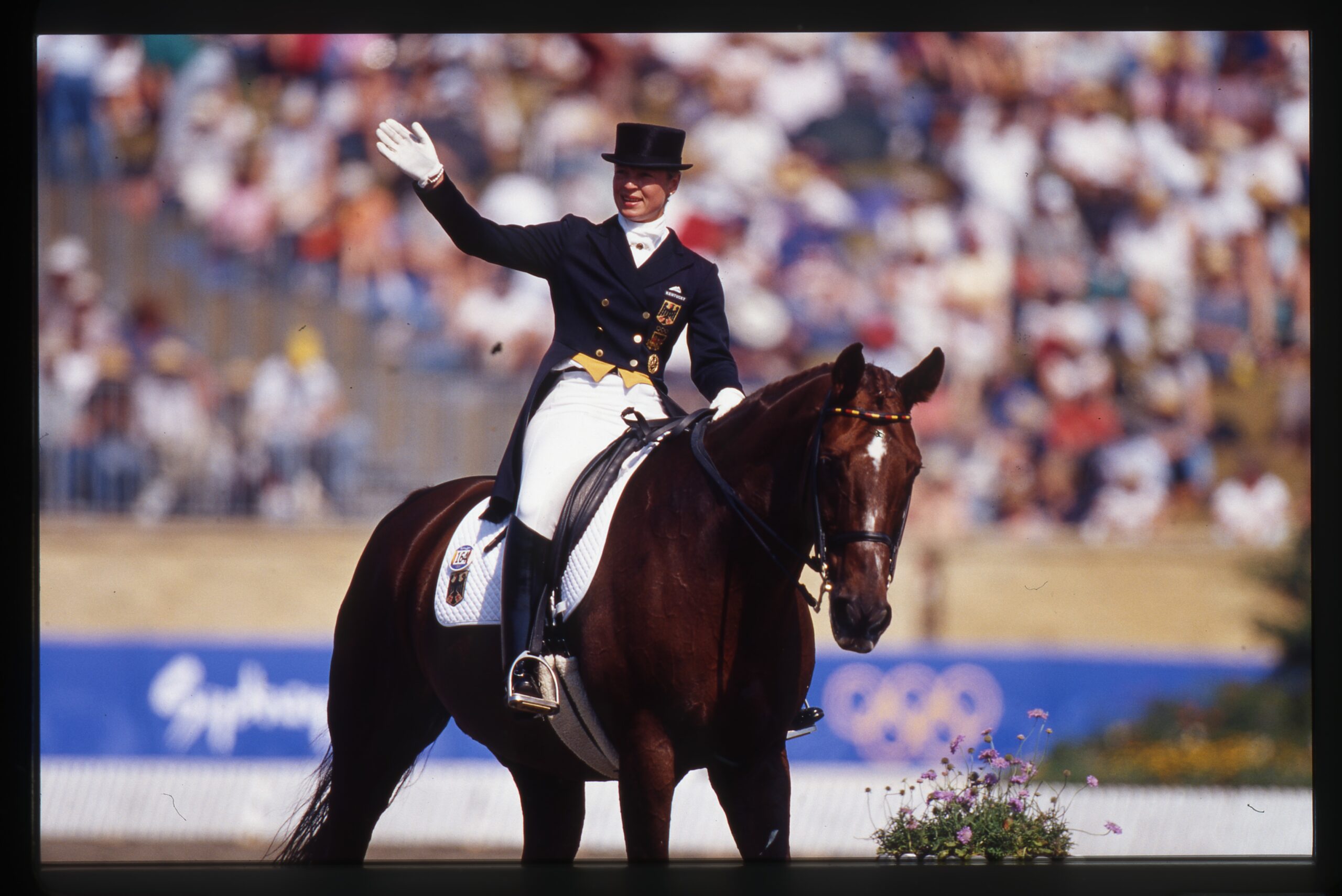
Isabell Werth and Gigolo at the 2000 Olympic Games in Sydney. It was Gigolo's third appearance under Olympic fire and the last competition of his incredible career. Photo: toffi-images.de
- Name: Gigolo FRH
- Geschlecht: Männlich
- Jahrgang: 1983
- Rasse: Hanoverian
- Vater: Graditz
- Muttervater: Busoni xx
- Züchter: Horst Klussmann
- Größte Erfolge: Four Olympic gold and two silver medals, multiple world and European champion, most successful dressage horse of all time
Gigolo FRH is one of the “key horses” in Isabell Werth’s career. He was the horse with which she made her breakthrough into top-class sport. He was her first Olympic horse. He was the horse that brought her her first individual titles.
The two met in 1989 at the stables of Dr. Uwe Schulten-Baumer Jun, the son of Werth’s mentor Dr. Uwe Schulten-Baumer Sen. The junior, a doctor by profession, no longer had the time to look after all his horses, wanted to reduce his stock and the large-framed Hanoverian dark chestnut gelding was one of the candidates he wanted to part with. Luckily for Isabell Werth.
High flyer
Although Gigolo had such a name, he was not exactly a dazzler or a ladies’ man with his rather large head on a long, thin neck, the lower neck of which was even more pronounced than the upper neck. But what he lacked in beauty, Gigolo made up for with his elasticity, his endless go and his unwavering willingness to perform. And with his intelligence.
When Werth got Gigolo, he was six years old and had just learned flying changes. He learned the entire Grand Prix program within a year. When Gigolo was seven years old, Werth and “the Doctor” were awarded the Otto Lörke Prize for training the best young Grand Prix horse. And the eight-year-old prodigy went on to win his first championship.
First title and lesson
The 1991 European Championships in Donaueschingen were Gigolo’s championship debut. Both he and his then 20-year-old rider were newcomers, but beat the Olympic, World and European champions Nicole Uphoff and Rembrandt. A sensation. The dressage world had two new stars.
The following year saw the Olympic Games in Barcelona, Werth’s first. Now she and Gigolo were no longer no-names, but among the favorites. However, this time they were unable to overtake the defending champions Uphoff and Rembrandt. In addition to team gold, they took silver in the individual classification, which was still decided in the Grand Prix Special at the time.
In her book “What kind of person is my horse?”, Werth writes that this was one of the most important lessons of her career: that you have to fight without tensing up. She wanted too much in Barcelona. This is how the mistakes came about. The lesson has sunk in. If there is one thing you can say about Isabell Werth, it is that she is at her best when she is challenged and under pressure.
The crown of all gold medals
She was able to prove this four years later in Atlanta. Now the big rivals were no longer Nicole Uphoff and Rembrandt, but the Dutch rider Anky van Grunsven and her Oldenburg gelding Bonfire. There was a freestyle competition for the first time at these Olympic Games. The individual medals were awarded based on the results in the special and freestyle. After the special it was still van Grunsven’s advantage. But in the freestyle, Isabell Werth and Gigolo were in great form and clearly outperformed their rivals – gold! It was Werth’s only individual title at the Olympic Games to date.
Four years later, Gigolo went to Sydney for his third (!) and last Olympic Games, indeed his last tournament. He crowned his uniquely long career once again with team gold and individual silver. He was later retired from the sport in Stuttgart’s Schleyer-Halle. To this day, he remains the most successful dressage horse of all time.
Retirement with friends
After his active career, Gigolo enjoyed his retirement in Werth’s paddocks for around ten years, together with the other senior riders in the stable. He died at the age of 26, shortly before his girlfriend Fabienne, who had given Isabell Werth her first World Cup Final victory in 1992.