Bolero – the buzzword for dressage
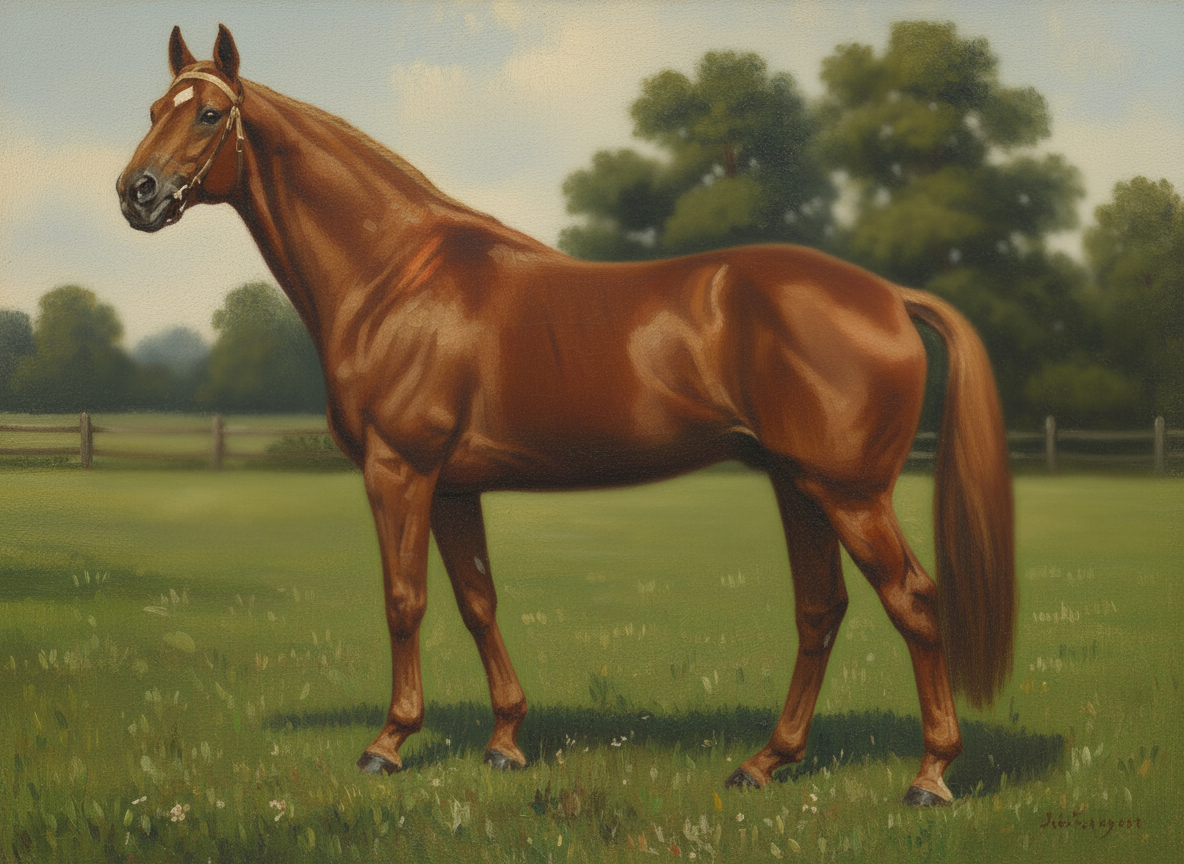
Bolero, one of the most important Hanoverian stallions at the Celle State Stud in Lower Saxony. KI
- Name: Bolero
- Geschlecht: Männlich
- Jahrgang: 1975
- Rasse: Hanoverian
- Vater: Black Sky xx
- Muttervater: Bleep xx
- Züchter: Heinrich Behrmann
Bolero, hardly any horse breeder thinks of a jacket or Maurice Ravel. Bonds, Bon Coeur, Bella Rose – the initial letter B stands for dressage. This is thanks to a Hanoverian stallion: Bolero. A line founder whose sire line is in full bloom today. And this despite a dry spell at the turn of the millennium.
But one thing at a time. In 1974, breeder Heinrich Behrmann did something that was not really done in the Hanoverian breeding area at the time: he bred a half-blood mare to a thoroughbred. Specifically, the 1970-born Baroness by the thoroughbred Bleep xx out of an Athos dam born in 1949 (!!). Behmann bred this mare to the private stallion Black Sky xx. The offspring of Black Sky xx had already made a name for themselves as distinctive dressage horses, but it had also become apparent that they were among the less talented candidates in the show jumping ring. The result of the mating was born in 1975: Bolero! Today, he is the stallion behind every horse that is successful in the dressage arena and begins with the letter B.
75 percent thoroughbred – just right for the Kehdinger Land
Bolero was licensed in Verden and came into the possession of the Celle State Stud in Lower Saxony. The state stable master decided to station the typey chestnut stallion at the Landesbrück station. At the very top of the Elbe estuary, in the town of Freiburg, and thus in the main breeding area for Hanoverians. There, Bolero met many mares who had the Hanoverian Grande as their sire.
Although Bolero was not one of the very best at his stallion performance test, coming 6th out of 30 stallions tested that year, he quickly developed into a mare magnet. The term “Bolero Boom” made the rounds. In the 1980s, Bolero’s offspring dominated the Bundeschampionate, which began at that time. And also the stallion markets. Bolero has sired a total of 47 stallions, and the handsome chestnut has only just turned twelve. This means that he was only available to breeders for nine breeding seasons. At auctions, his offspring, and soon also the offspring of perhaps his most prominent son, Brentano II, fetched high hammer prices.
Brentano II – Olympic horses, Bundeschampions, Bon Coeur & Co
Brentano II (breeder: Dr. Max Schulz, Stellenfleth) would later prove to be the founder of his own branch. Among others, he sired Brentina, who was successful for the US team at the Olympic Games, and her full brother Barclay, who was successful with Sven Günther Rothenberger, among others. He is also famous for a special “reconstruction of the East” campaign. When a delegation from the Celle State Stud in Lower Saxony visited the Neustadt an der Dosse State Stud after the fall of the Berlin Wall, they were given a portion of semen from Brentano II as a souvenir, which was used to inseminate Primadonna by Gotland and produce Poesie, who would later achieve world fame as the dam of the young horse world champion Poetin and the licensed full brothers Samba Hit I – IV. Poesie became even more important as the maternal granddam of the stallion Quaterback.
From the mouth of the Elbe to the whole world
Brentano II’s dam line contains only stallion names, the mere mention of which caused an appreciative murmur among horse people in the 1960s and 1970s: The dam Glocke is descended from Grande-Ferdinand-Marcio xx, all royal greats in Hanoverian breeding with Olympic horses among their offspring. Brentano II, winner of the 1985 licensing, second in his performance test and trained to Grand Prix level throughout his life, was active in Hanover’s western breeding area, Artland, from 1987. It was above all from Ankum that he laid the foundation for his nomination as “Hanoverian Stallion of the Year” in 2003. 29 of his sons were licensed.
Bundeschampion and founder of a branch in the Bolero line: Benetton Dream
His son Benetton Dream, born in 2004, Bundeschampion 2007 and “Hanoverian Stallion of the Year” 2024, was to be largely responsible for the continuation of this branch within the Bolero line. Initially, he came to the fore with his son Belantis, born in Neustadt an der Dosse, who was one of the most successful horses in Germany at a young age, Bundeschampion as a five-year-old and Vice World Champion as a six-year-old.
Benetton Dream’s son Bon Coeur (out of a Sandro Hit dam) was twice Vice Bundeschampion and was awarded the Weltmeyer Prize as a young horse and later the Grande Prize. He sired the young horse world champion Boa Vista FRH. His son Bon Courage, popular in the 2020s not only in his home breeding area, is the fourth generation to continue the Bolero line. His son Bon Esprit was crowned champion stallion by the Oldenburg stallions in 2022.
It’s all in the mix – Bolero and Grande
In addition to Brentano II, there are other important branches that have anchored the Bolero genes in dressage horse breeding worldwide. The Rhinelander Belissimo M was responsible for spreading the Bolero genes throughout Germany and the world. He is descended from Beltain. Beltain, in turn, is closely related to Brentano II, who was also born at Dr. Max Schulz, Stellenfleth. His dam Gänseliesel by Grande, full sister of the Celle state stud stallions Garibaldi I and II, is a daughter of Marbel by Marcio xx. She in turn is the great-granddam of Brentano II. Beltain has not been able to make a name for himself in breeding, but his mating with the Rhineland mare Roxa by Romadour II-Lucius xx produced a direct hit: Belissimo M.
“Bello” – “Bella’s” father and much more
Bundeschampion, stallion performance test winner, finalist at the World Championships for Young Dressage Horses and later competed internationally at Grand Prix level. His most famous daughter is Bella Rose, 2018 World Champion under Isabell Werth, 2019 European Champion and silver medal winner at the 2021 Olympic Games in Tokyo, where Germany won team gold. Many of Belissimo M’s offspring have gone on to compete at advanced (S) level in dressage, including at international level, including several in the junior/young rider camp.
Benicio – the bridge to the 21st century
Benicio, also Bundeschampion, was one of the most popular of the 82 licensed sons of Belissimo M. This is also reflected in the number of his licensed sons: 48 received a positive licensing decision. One of them, Bonds, was Oldenburg Champion Stallion 2015 and, following the example of his sire’s Bolero line, won many tests for young dressage horses as a young horse. He bred nationwide and already has over 30 licensed sons. In 2025, he produced Barnsley, the champion stallion of the Oldenburg licensing, who was sold to the Swedish stud Lövsta. However, the black stallion is currently at an Oldenburg breeding station. Just as some representatives of the Bolero bloodline are stationed in the north, such as Bon Bolero, who was proclaimed the main premium winner at the Oldenburg licensing in 2025.
But in Westphalia and Hanover, as well as at the DSP, there are always B stallions who successfully represent their breeding areas at Bundeschampionate and young horse championships, for example the 2024 Bundeschampion of three-year-old stallions, Bentheim NRW, who is the fourth generation of Bolero.
The Wittigs and their Breitling
One stallion, a grandson of Bolero, dominated the German Equestrian Federation’s (FN) breeding value assessment for a long time at the end of the 2000s: Breitling W. The W stands for Wittig, Wolfram Wittig, riding master, international trainer and, together with his wife Brigitte, an important aspect of Breitling’s success. Sire Bismarck, born in 1980 out of the then 26-year-old Duellant daughter Duellfarm, not only sired Breitling W when bred to Maja by Maat I, but also his full sister Meggles Biagiotti W, a successful Grand Prix horse, as well as several other successful children up to Grand Prix and advanced (S) level.
Breitlings – always ready for the Grand Prix
Breitling achieved 137 placings at Grand Prix level, was victorious 16 times and sired various Grand Prix horses, including those that stood far or right at the front at the World Championships for Young Dressage Horses, the Nuremberg Burg Cup and the Louisdor Prize. For example Blind Date, who won the European Championships in Aachen in 2005. The Breitling W son Burlington won the final of the Nuremberg Burg Cup under Charlott-Maria Schürmann. Gina Capellmann-Lütkemeier, the mother of Fabienne Müller-Lütkemeier, won World Cup freestyles in the saddle of Baldessarini.
Heike Kemmer and “Bonni”
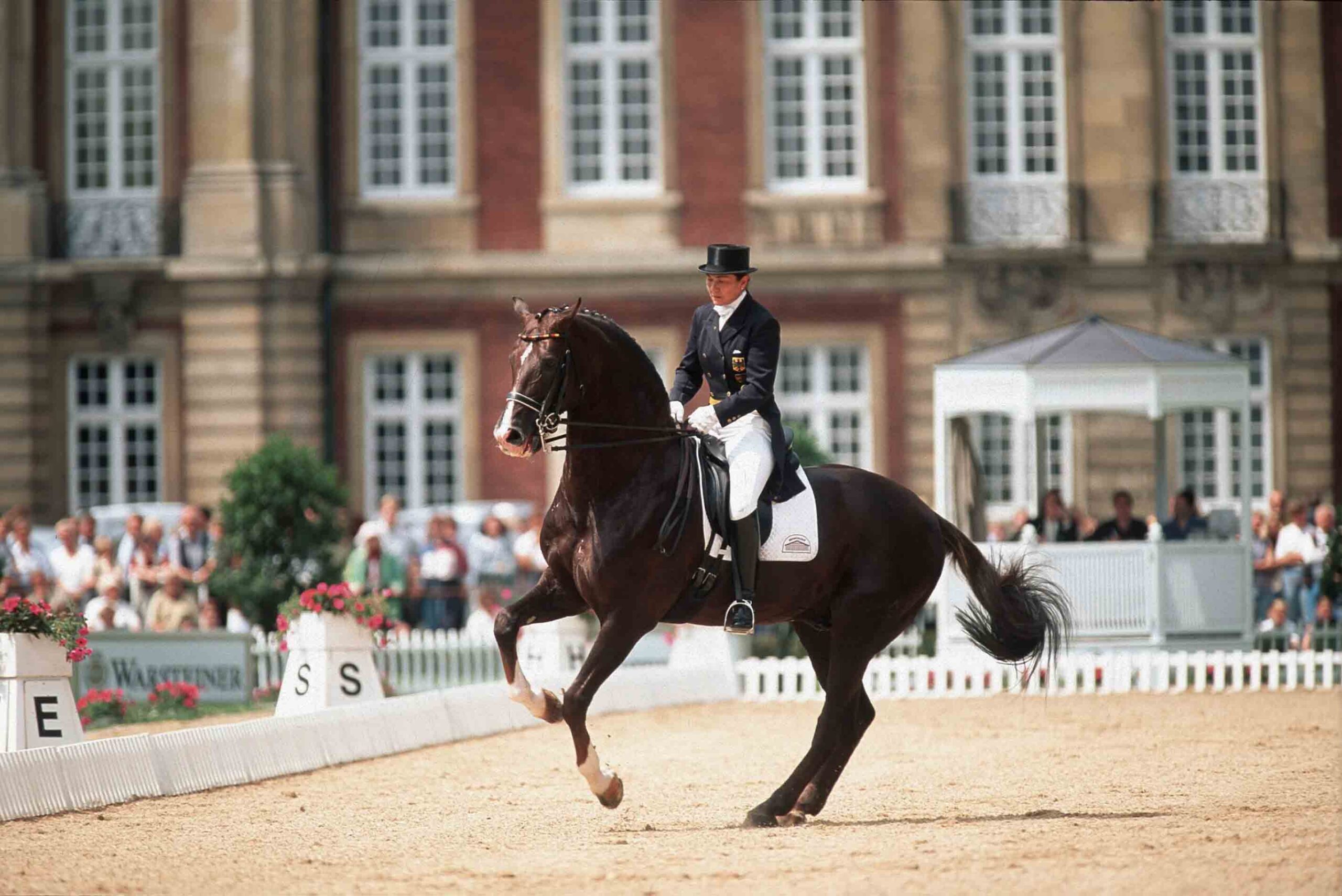
The most famous Bolero descendant did not come from any of these three formative branches: Bonaparte, a Hanoverian born in 1993, was just as you would imagine “a Bolero” to be: a handsome chestnut, beautifully shaped and strong-moving, although the front leg still showed a bit of the high blood content in action. Not that “Bonni” couldn’t move his front legs (and hind legs) impressively in the strong tempi, on the contrary! But compared to the dressage horses of the 2020s, he had a little less knee action. Heike Kemmer trained the chestnut from the very beginning. They were a pair for almost 30 years. The chestnut came to the Kemmer family at the age of seven months. Heike’s father had discovered him. Bonaparte was a Bolero grandson. His sire Bon Bonaparte himself competed at Grand Prix level, but was not one of the most popular stallions of his time. Bon Bonaparte was out of a Wendekreis dam.
Olympic champion and model student
“Bonni”, or simply “Bo” for short, was systematically trained by Heike Kemmer. He competed in the Nuremberg Burg Cup and then took off at Grand Prix level. The pair’s career peaked with two team gold medals at the 2004 Olympic Games in Athens and 2008 in Hong Kong. The icing on the cake was winning the bronze medal in the freestyle in Hong Kong. In addition, “Bonni” also brought Heike Kemmer team gold at the 2006 World Championships in Aachen, where the pair were the best in the victorious German team in the Grand Prix, which decided the World Team Championships.
A video of Bonaparte as a sprightly pensioner can be found here.
Once again Kemmer + Bolero = international top
A direct Bolero son had previously brought his rider medals: Beauvalais. The bay comes from the same family as Brentano II and Beltain and was also born into the Schulz-Stellenfleth family at the mouth of the Elbe. Heike Kemmer trained him up to Grand Prix level and presented him successfully. The large-lined gelding was sold to the Spanish millionaire Beatriz Ferrer-Salat, who won the silver medal with Beauvalais at the 2002 World Championships and the 2004 Olympic Games in Athens. The pair also finished on the podium at the European Championships. Beauvalais retired from the sport at the age of 18 and died in Barcelona at the age of 31.
All these horses would not exist if Heinrich Behrmann had not done something in 1974 that was not actually done back then – and thus secured himself and his Bolero their own chapter in the annals of Hanoverian breeding. And beyond its borders.