Show jumping club calls for new rules for show jumping at the Olympics
Show jumping club wants new Olympic rules, fair costs and cropped ears
 from Jan Tönjes
 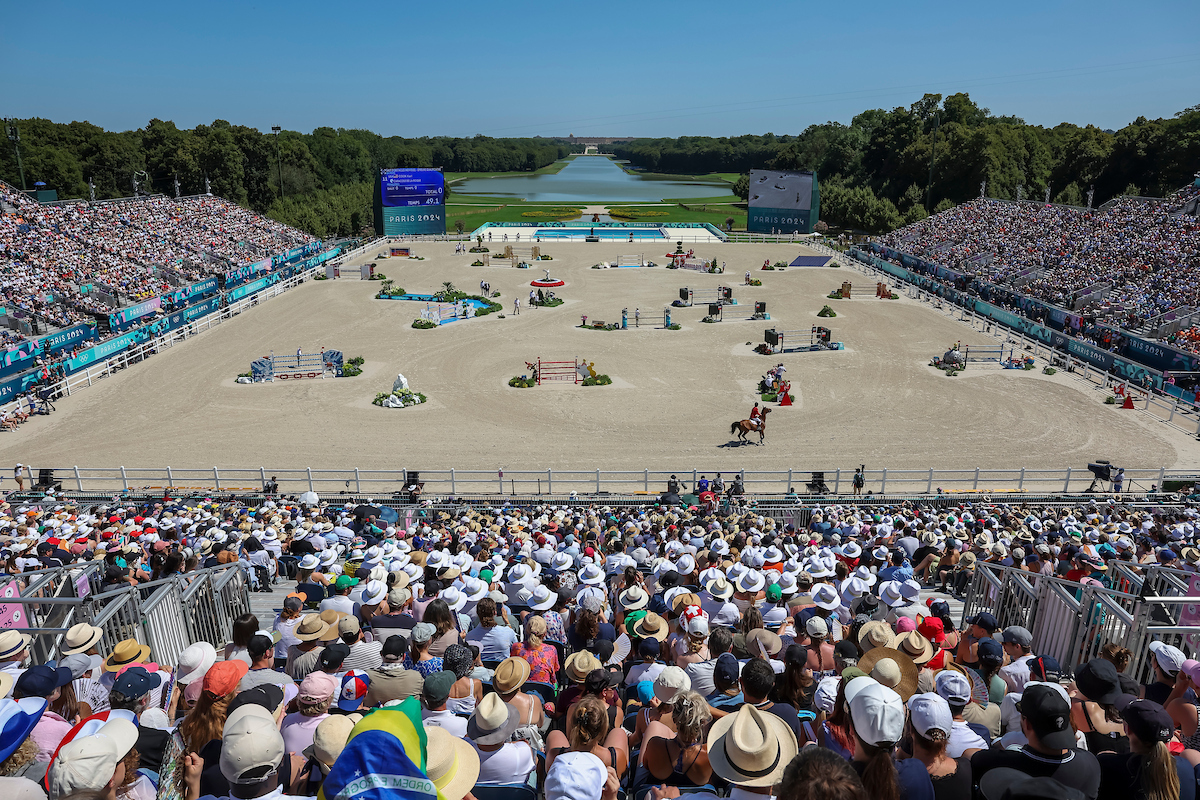 Summer Olympics in Paris 2024: the stadium in the Palace Park of Versailles. Photo: sportfotos-lafrentz.de/Stefan Lafrentz
 According to the current Olympic regulations, individual riders, i.e. those who are not part of a team, do not take part in the jumping competition for the team qualification. As a result, horses that have not yet completed a course under Olympic conditions start in the individual competition. The team riders’ horses, on the other hand, have already jumped one or two rounds at the highest level, depending on their results. From the IJRC’s point of view, this system leads to a clear competitive advantage for the individual starters.
Show jumping club sees sporting imbalance in show jumping at the Olympics
In order to create a level playing field, the show jumping club proposes that all individual athletes at the Olympic Games in show jumping must ride at least one round before the individual decision. Specifically, this should be done by participating in the first round of the team qualifying competition, which, according to current regulations, is only held by the team riders. The results of this round should count together with the actual individual qualification for the starting places in the individual final – and thus create a more balanced, transparent ranking.
This aspect should be discussed at the FEI Sports Forum in Lausanne next week, according to the Jumping Club (IJRC). Results from the Sports Forum can be discussed at the FEI General Assembly, which traditionally takes place in the last few months of the year, and possibly voted on as a rule change (if national associations have submitted proposals).
Show jumping club (IJRC) focuses on dialog with FEI
In parallel to the criticism of the Olympic format, the IJRC has renewed its Memorandum of Understanding (MOU) with the FEI, which has been in place since 2014. The agreement secures the club an official role in all consultations on future rule changes and reaffirms it as the only international organization representing the common interests of professional show jumping riders.
In this way, the athletes’ voice will remain an integral part of the regulatory and strategic process.
Additional costs for tournaments: IJRC insists on clear limits
Another key issue for the IJRC is the constantly rising additional costs at international tournaments. For months, the club has been pushing for obligatory fees – such as for manure disposal, electricity, parking, “fantasy costs”, “green fees” or VAT – to comply with a list agreed jointly with the responsible institutions (FEI, IJRC, AJO and E.O.).
Although a corresponding measure has already been adopted by the FEI, its entry into force has been postponed from the originally planned January 1 to April 1, 2026 – out of consideration for the concerns of individual interest groups. The show jumping club welcomes the compromise reached in principle, but criticizes the delay because it further increases the cost burden for riders and event organizers.
Further rule proposals: Nominations, animal welfare and coaching
In addition to the Olympics and cost transparency, the IJRC has proposed additional adjustments to the FEI, which will be discussed at the FEI Sports Forum and later at the FEI General Assembly. In Article 117.2 of the FEI General Rules, the Club is calling for the national federations to nominate athletes, i.e. riders – and not primarily rider/horse combinations as has been the case to date – for championships and major competitions. Justification: Entries are made via an invitation system in which the focus should be on the riders’ sporting qualifications.
Allow the ears to be removed again for hygienic reasons
The IJRC sees the demand for a more practical interpretation of the veterinary regulations on ear hair clipping as a contribution to animal welfare. In the club’s view, a blanket ban is too restrictive and is not in line with day-to-day horse husbandry. Correctly performed clipping is rather important for hygiene and health control, without there being reliable evidence that it is detrimental to the welfare of the horse. The proposal: away from a rigid ban and towards a flexible approach based on the actual welfare of the horse.
Legal situation in Germany regarding the removal of ears
In Germany, Section 6 of the Animal Welfare Act is interpreted as a ban on the removal of the pinna: The first sentence states: “The complete or partial amputation of body parts or the complete or partial removal or destruction of organs or tissues of a vertebrate animal is prohibited.” The passage on “removal or destruction of organs or tissues” is understood as a reason not to remove the hair in the horse’s ear, even if it is not explicitly tactile hair, such as that found around the nostrils and in the area of the eyes.
The future of coaching
During the “Dutch Masters” in ‘s-Hertoigenbosch, the IJRC hosted an event on March 12: President François Mathy discussed how new tools are changing training in equestrian sport at the “Future of Coaching Forum” with coaches, trainers and industry experts. The focus was on innovation, knowledge sharing and the changing role of coaches in a rapidly evolving sports landscape. In a press release, the IJRC describes this undertaking as a further building block in the show jumping club’s strategy to make Olympic show jumping more modern, fairer and more sustainable.