
2026 FEI General Assembly: Adjustments and Changes to the Jumping Rules

FEI Jumping Rules: Clarification of the Loop Reins Rule and More

No major changes, but a few adjustments to the jumping rules, which will be voted on at the FEI General Assembly.
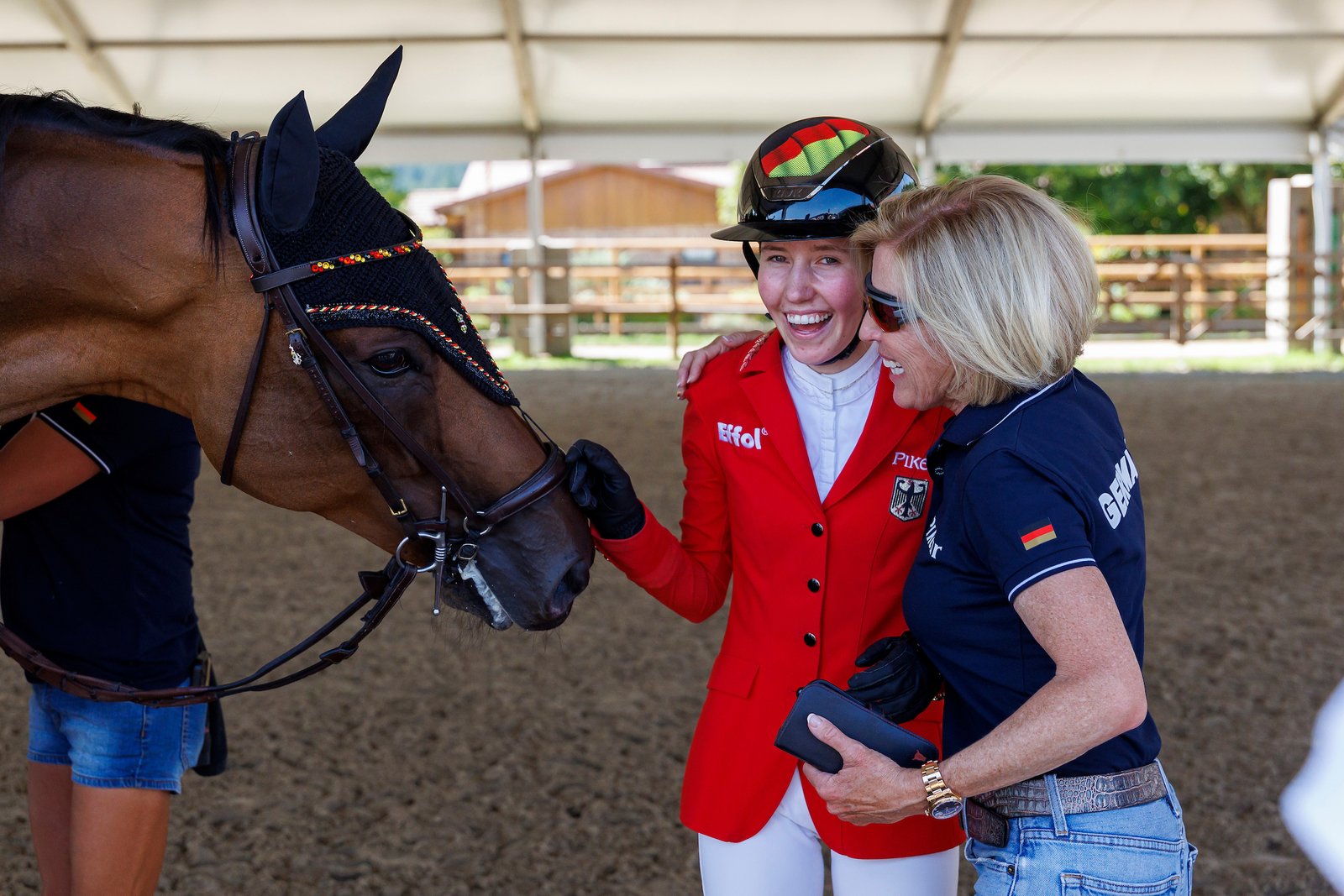
Stock photo: sportfotos-lafrentz.de No major changes, but a few adjustments to the jumping rules, which will be voted on at the FEI General Assembly. Stock photo: sportfotos-lafrentz.de
The show jumping rules were not completely revised until 2025. Therefore, only changes that were urgent or that corrected errors and inconsistencies were permitted this year. However, certain aspects are worth noting.

One of the key issues discussed during the 2025 overhaul of the FEI Jumping Rules was the change to the blood rule. It has been in effect since the beginning of the year. Since then, 416 Jumping Recorded Warnings have been issued. Twenty-four riders have been automatically suspended because they were caught with blood on their horses twice within a year; so far, none of them are from Germany, although 13 riders have received a warning. So the rule is having an effect. And it will remain unchanged for the time being—at least as long as work continues on a solution to standardize the regulations across all three disciplines.


The Horse Condition Task Force is currently developing a uniform blood rule for all disciplines. So far, it has agreed on five principles. A draft will not be submitted to the General Assembly until 75 percent of the members approve it. The new rules are set to take effect no later than January 1, 2028. Germany is pushing for earlier implementation so that there will be enough time to gain experience before the Olympic season.


New Equipment Rules Effective February 2027


The rules regarding tack and equipment are being moved from the discipline regulations into a separate document. For show jumping, the new rules will now take effect on February 1, 2027, rather than January 1 as originally planned, to give riders more time to adjust. Until then, the current rules will remain in effect.


Not much has changed. But one rule has been clarified: the one stating that riders are not allowed to ride on bare loop reins. This is how Christian Kukuk had prepared his mare Just Be Gentle for the World Cup show jumping event on Sunday in Verona in November 2025. A social media video of this went viral and sparked emotional reactions. But there was no clear FEI rule that explicitly prohibited riding with bare loop reins. Now there is.


In the Tack Rules effective February 2017, Section 4.11, “Draw Reins,” now states under


  • 4.11.2: Loop reins must not be used exclusively; they must be used in combination with reins attached to the bit. Loop reins must not be used with a bitless bridle.


    and under:


  • 4.11.3: When jumping with loop reins during warm-ups or on training grounds, the obstacles must not be higher than 1.30 meters.


The latter was not previously regulated at all.


Pony riders may also ride full-size horses


The most significant change for young riders comes from Germany. In the future, a pony rider will be allowed to compete on a full-size horse in classes for U25, Young Riders, Juniors, or Children, provided they are of the appropriate age. Doing so will not cause them to lose their status as a pony rider. The height of the obstacles must not exceed the limit for their age group.


The background to this is the 2025 revision. At that time, the rule prohibiting riders from competing in both the pony and U25 or Young Riders categories at the same venue in the same week was eliminated. However, the corresponding Article 305.3.3.2 was not amended. Germany had calculated that a 16-year-old could simultaneously be a pony rider, a junior, and—in their first year—a young rider as well as a U25 rider.


More Horses at Young Horse Competitions


Starting in 2025, riders will be allowed to enter four horses per competition instead of three. However, the total number of entries for young horse competitions (CSIYH) has not been adjusted. In the future, riders will be allowed to enter up to twelve horses in these competitions instead of nine, with up to four per age group.


CSIO with CSI up to three stars


Previously, only a CSI1* or CSI2* was allowed to be held alongside a CSIO. In the future, all CSI categories up to and including three stars will be permitted, again with separate competition venues. Horses from the CSIO are not allowed to compete in the CSI. The U.S. specifically wanted to allow CSI-U25 events as well, while Germany even sought to include CSI4*. The FEI has opened the category up to three stars because the CSIO must remain the main competition.


It also clarifies what constitutes a CSIO: at least three official teams from three different nations, including the host country’s team.




Anzeige
Anzeige
Anzeige
Advertisement


Rejected: the fee schedule


The Netherlands wanted to discuss the list of fees that event organizers are allowed to charge riders. One point of criticism was that value-added tax (VAT) is included in the list, even though the rates vary from country to country. Another point of criticism was the “large stall,” which in practice consists of two stalls.


Germany called for European organizers not to be subject to rigid caps, because the costs vary greatly depending on the tournament.


The FEI rejects the proposal, not because of the issue itself, but because the fee schedule is not part of the regulations. However, it is reviewed annually.


Whether the changes will be adopted will be decided on December 5 at the FEI General Assembly.


Similar posts

Following Christian Kukuk’s “Chageorge,” now “Party in de Hus” by Lara Tryba
Following Christian Kukuk’s “Chageorge,” now “Party in de Hus” by Lara Tryba Read More
Opglabbeek: Brianne Beerbaum’s First Victory in a World-Ranked Show Jumping Event
Opglabbeek: Brianne Beerbaum’s First Victory in a World-Ranked Show Jumping Event Read More
Simon Heineke Wins in Warsaw
Simon Heineke Wins in Warsaw Read More
WP Wehrmann Publishing