FEI Jumping Recorded Warnings
Blood rule in show jumping: Eleven more cases, two suspensions, (no) comment from the FEI
 from Dominique Wehrmann
 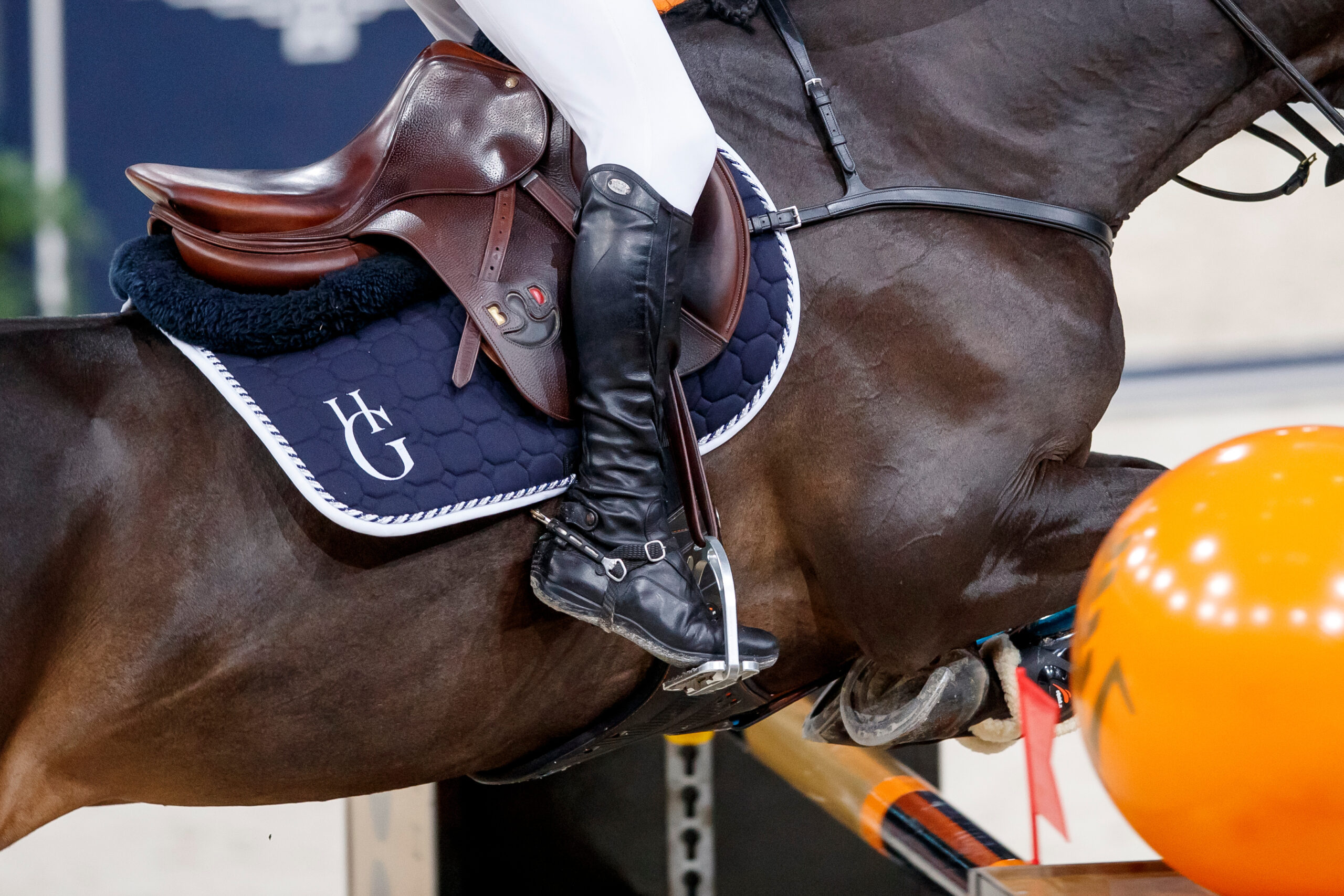 Symbolic image of spurs. Photo: sportfotos-lafrentz.de
 On January 13, we reported on 15 Recorded Warnings at two tournaments. Now, 14 days later, eleven more have been added.
Yaoyang Chen’s horse was injured at the CSI3* in Shenzhen-Guangming (CHN) from January 15 to 18. On the same weekend, the horses of Norway’s Martine Myhrer Dingeland in Oliva Nova (ESP), France’s Olivier Robert at the World Cup tournament in Leipzig and Great Britain’s Chloe Winchester at the CSI2* Vejer de la Frontera also suffered injuries that resulted in a warning. Yaoyang Chen was given another warning on the same weekend and is now suspended until February 18.
The following weekend, warnings were issued exclusively in Doha, from 1* to 5* level. The latter concerned the Italian Juan Carlos Garcia. In the one-star tour, Mohammed Rashid Al Amri (QAT) received a warning. Among the CSI3* riders, Seif Basem Ghabbour (EGY), Adel Keshavarz (IRI), Adam Tamer Hammouda (EGY) and Ali Osama Abdelghani (EGY) were affected.
In addition to the aforementioned Yaoyang Chen, another rider has also been banned: Ismail Osama El Borat (EGY). He is not allowed to ride until February 10.
The nature of the injuries
As stipulated in Art. 259 of the FEI Jumping Rules, “Signs of injury on the Horse” lead to a warning. The FEI did not comment on the type of injury in question in its response to a question, only explaining in general terms that it was a range of cases caused by the rider, the equipment or the tack.
Reference was once again made to the statement in the rule according to which warnings are issued to the person responsible (rider) in accordance with Art. 259 if “blood appears on a horse caused by equipment, bridles or by the rider himself” at an FEI event. Explicitly excluded are cases where, for example, the horse has grazed itself.
What happens when?
For a more precise classification, the FEI has now drawn up various scenarios that explain how the new rule is to be applied.
- If blood is visible in the spur area when riding off, a warning will be issued and the vet will be called in to decide whether the horse may continue to take part in the test and the rest of the competition.
- If the blood only becomes visible after the horse has left the course, a warning and a check by the vet, who in turn decides whether the horse may take part in further competitions.
- If a “small amount” of blood is visible on the horse’s mouth during the mandatory check after leaving the course and the steward and judge come to the conclusion that the horse has bitten its lip, there is no warning and no sanction. The veterinarian must examine the horse. The officials may allow the rider to wash or wipe away the blood.
- If the horse comes out of the course with spur marks that indicate excessive use of spurs, disqualification from the test and possibly the rest of the competition is mandatory. Here too, the ground jury will consult with the vet to determine whether the horse is fit enough to take part in the rest of the competition. If not, it will be disqualified. There is the possibility (“Possibility”) to impose further sanctions or to initiate proceedings for mistreatment of the horse. However, only the vet check has been added under the new regulations – the possibility of imposing separate penalties or initiating proceedings already existed before. Disqualification was also mandatory here.
The FEI has summarized here when a horse is or is not “fit to compete” despite blood.
Comparison with the case numbers for 2024 and 2025
In 2024, the World Equestrian Federation counted a total of 475,780 FEI starts. Of these, 83 riders were excluded due to blood in the spur area. That corresponds to 0.02 percent. Two riders were excluded twice within twelve months due to spur marks on their horses.
In 2025, there were 487,900 starts and 116 exclusions due to blood. This also corresponds to 0.02 percent. Six riders were found twice within one year.
Now two riders have been noticed twice within a month and on four weekends there have already been 26 Recorded Warnings due to blood on the horse, which, as mentioned, may or may not have been in the flank area. However, from the point of view of those responsible, the cases were obviously not so serious that they would have required immediate disqualification. At least that is what the rules say.
When asked about the sharp increase in documented injuries under the new rule, the FEI explained:
“Given the low number of competitions in 2026 so far, we advise against making general statements about trends or comparisons with 2025 figures at this stage. The FEI is monitoring the data development closely.”