Animal Cruelty: Abuse and Lacerations Not Limited to the Schockemöhle Lewitz Stud Farm—Horse Slaughterers in the Altmark and East Westphalia
It’s not just Schockemöhle—horse killers in the Altmark and East Westphalia
 from Jan Tönjes
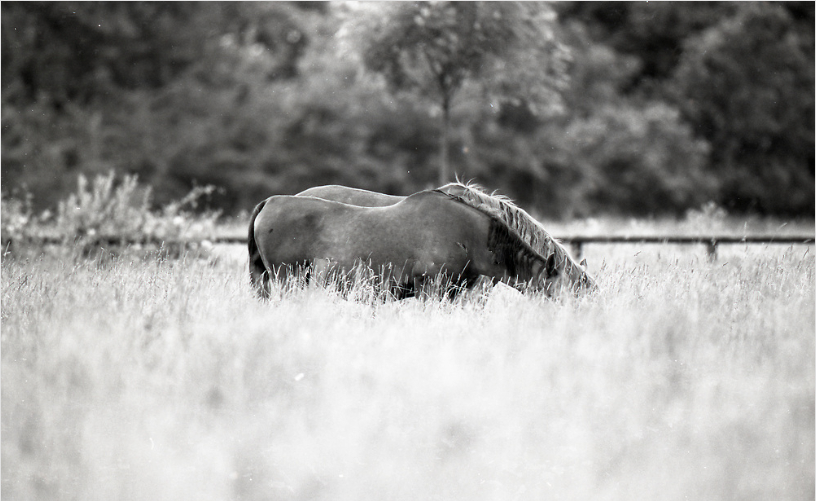 Horse in a pasture – stock photo. Photo: toffi-images.de
An attack took place back in July in a paddock in Kremkau in the Altmark region. A three-year-old horse was attacked with a sharp object. If the cut had been just a little deeper, the gelding would not have survived. The perpetrators must have struck in the late afternoon.
Thomas Schuppert, an active member of the local riding and driving club, returned from a training ride in his carriage in the early evening. The chestnut horse was standing in the paddock right next to his house, with a deep wound on its neck. At first, Schuppert thought it was just a normal pasture injury. But he couldn’t find anything that could have caused the horse to injure itself.
The veterinarian who was called to the scene said he had seen similar wounds in other places recently. He mentioned that he had recently been called to treat two foals just a few kilometers away. They, too, had cuts and were believed to have been attacked as well.
Motion detectors, cameras
Schuppert and his partner, Nikola Kammin, didn’t want to rely solely on the hope that criminals rarely strike twice in the same place. They installed motion detectors and a video surveillance system on their property.
While talking with other horse owners, Schuppert learned of another incident that occurred about 15 kilometers away. There, a horse’s nostrils had apparently been slashed with a utility knife. The owner decided not to file a report. The police, or so it was said, wouldn’t do anything anyway.
According to MDR, citing the agency’s spokesperson, Kim Marise Krumbach, the Stendal police department—which has jurisdiction over the area—has in fact received only a single-digit number of reports so far regarding horses that may have been injured with a knife in the western and eastern Altmark regions. According to the report, investigators learned of other cases from the newspaper. The problem: “That’s how we lose witnesses.”
A corridor stretching from Möllenbeck to Klötze
Meanwhile, a horse owner has created a map. It lists all the cases he is aware of, along with their locations and dates. The picture: With only one exception, the trail runs through a narrow corridor in the Altmark region, from Möllenbeck in the east to Klötze in the west, stretching from Brandenburg to Lower Saxony.
Schuppert recently read about yet another attack. He’s amazed that it keeps happening and that the perpetrator hasn’t been caught. His hope is that once all the cases—with their dates, locations, and times—are compiled, the perpetrator will at least start to worry that he might still be caught.
Horses Are Also Falling Victim to Attacks in East Westphalia
In East Westphalia
, in the districts of Höxter and Lippe, horses have been injured by unknown assailants since June 2026. A young horse died as a result in June. Among other injuries, it had suffered severe lacerations on its hind legs. The Pinto yearling had to be euthanized.
Other horses showed injuries to their necks, heads, chests, legs, and genitals. According to various media reports, a total of about a dozen horses fell victim to the alleged horse killers. No other dead horses have been reported since June.
At the end of September, the perpetrator(s) struck again. As a result, the police resumed their investigation.