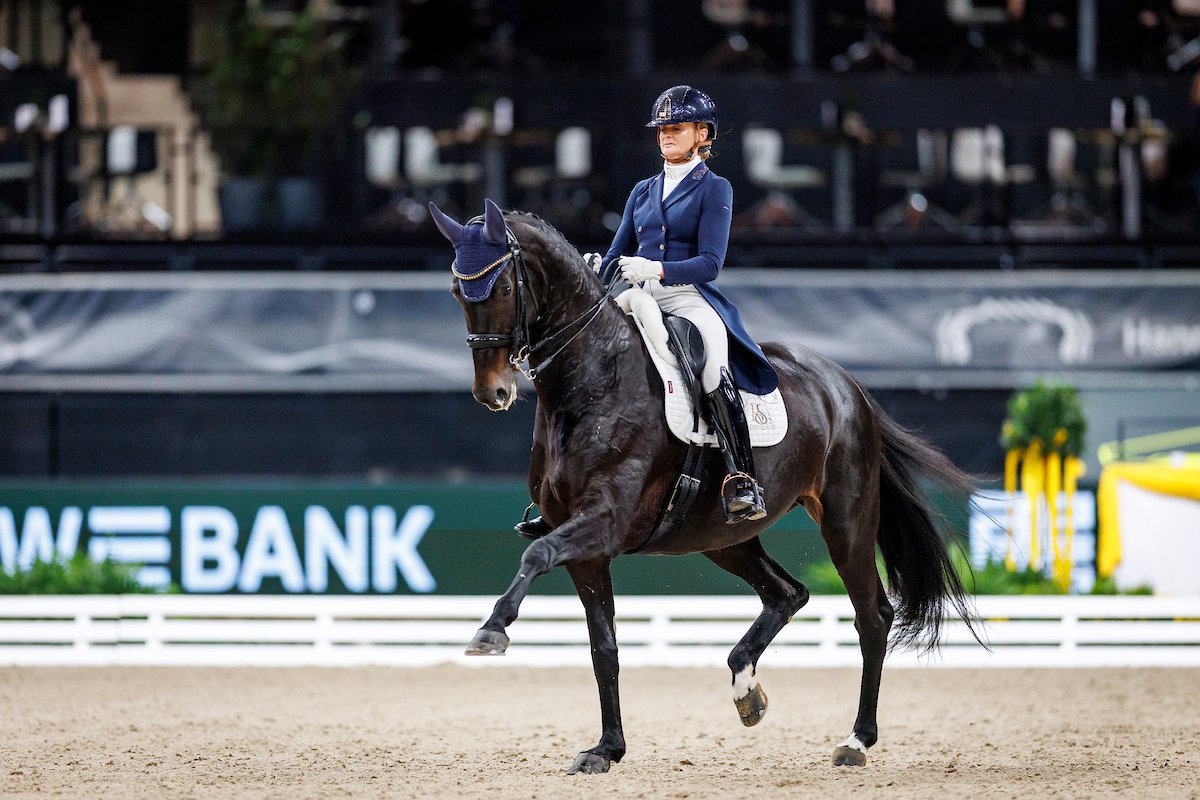

Viva Gold with young riders
Viva Gold’s introductory presentation wasn’t without its challenges either. The stallion hurried through the strong trot. The dark chestnut only began to move with momentum and rhythm once he reached the half-passes. A highlight was his strong walk. Viva Gold really set off “right on the spot,” taking long strides in front with a clear over-footing and ideal foot placement. The second piaffe didn’t come until the second aid, at which point the chestnut stallion lost his balance and slipped noticeably behind the vertical—a pattern that held true for all his piaffes today. His very centered pirouettes were awarded scores up to 9.5.
Even for the final piaffe, a second gentle cue was needed. At first, the 10-year-old seemed unsure whether he was competing in the Grand Prix or had already moved on to the freestyle. A score of 77.826 percent marked the pair’s tenth international victory this year. In Lyon, they had previously won once and placed second once.
Veterans Deliver the Goods
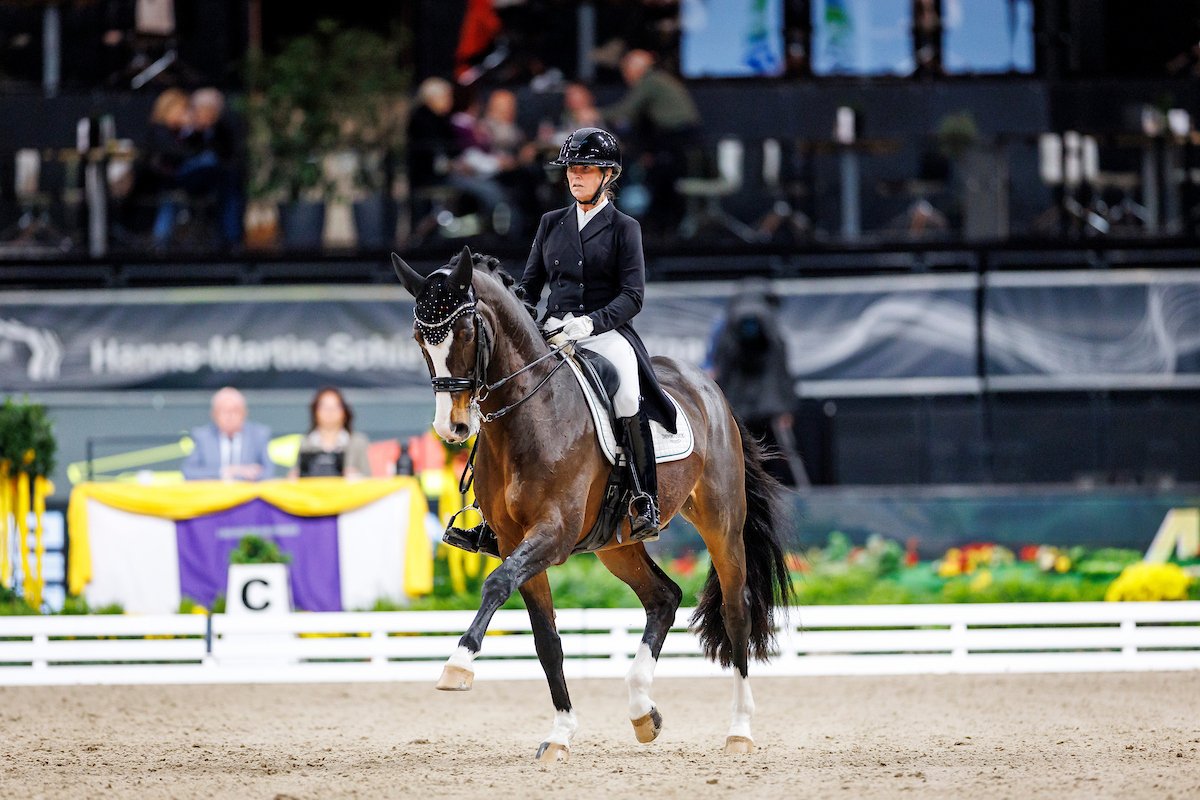
Belgian rider Larissa Pauluis performed the entire routine with her 16-year-old horse Flambeau—a routine the pair, with their extensive championship experience, has honed over their long journey together. The duo particularly impressed with their rhythmic alternation between piaffes and passages. However, they, too, struggled with the double changes. In the pirouettes—especially the first one, which was executed with more liveliness in the hind leg than the second—the pair managed to claw their way back up the standings to take third place (73.587).
Harmony, ridden by Susan Pape and Harmony’s Giulilanta
Susan Pape, riding for Great Britain, and Harmony’s Giulilanta were the first to enter the arena. They delivered a ride that, with the exception of the transition after the collected walk, was virtually unmatched in terms of the harmony between horse and rider. The chestnut mare demonstrated what it means to perform the piaffe on the spot: in time with the beat, actively, with beautiful self-carriage, and a silhouette just as one would wish.
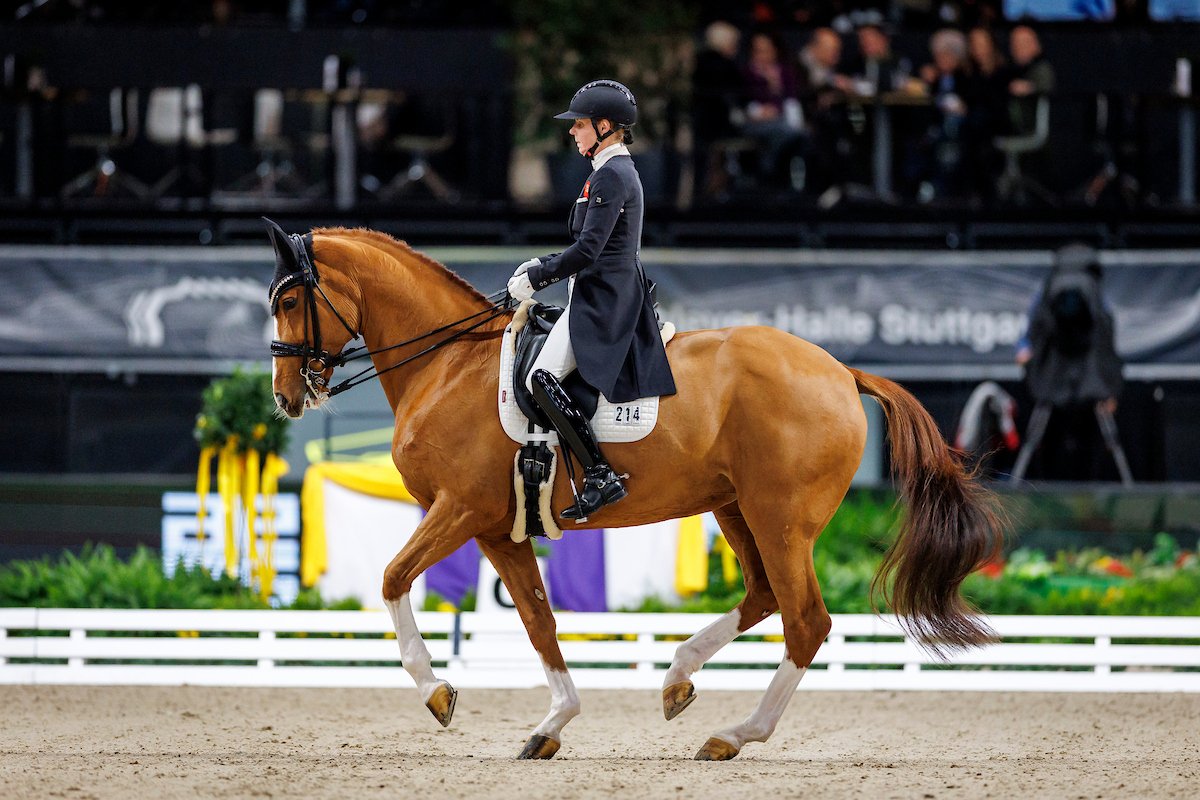
The Jazz daughter isn’t naturally blessed with the longest canter. But even here, Susan Pape showcased the chestnut mare’s strengths, particularly in her balanced pirouettes.
It’s a shame that the final score for harmony—which should really have been positively influenced by a calm seat and subtle aids—once again followed the formula whereby celebrity status and average scores for the basic gaits are evidently taken into account here (7.4). With a score of 72.13 percent, the two riders from Hemmoor near Stade placed fourth.
Belgium and Sweden
Unfortunately, the Belgian rider Wim Verwimp is not as naturally gifted with elegance in the saddle as others. But the way his half-Lusitano, Jedai de Massa by Don Juan de Hus, performs the piaffe and passage leaves little to be desired. Even though the dark bay sometimes moved his mouth a bit too much, he chewed steadily throughout—even during moments of exertion when other horses would bare their teeth. Imperfections in the canter sequence cost the pair points (71.565).
Sixth place went to Sweden’s Maria von Essen riding Invoice. After making mistakes in the single-change transitions, the black horse had clearly warmed up well as the test progressed. Warm to hot. On the final center line, the tension in the passage was already clearly evident. In the piaffe, the black horse pressed down hard on the bit twice and dipped his head. Maria von Essen, however, managed to hold on until the end of the test (71.543).
Mixed Results for the Germans
The second-best German was Frederic Wandres, riding Verrenberg—a horse still relatively inexperienced in the face of strong international competition, though he has already competed before international judges in Florida. Most recently, the gelding placed second in the Grand Prix in Motesice. Verrenberg has a tendency to lean heavily forward in the piaffe. The rhythmic engagement of his hind leg currently still results in a high croup. As he develops more strength, Wandres should be able to get the Vilancio son to work more “under” the rider in this exercise. 71.348 percent.
Moritz Treffinger has also secured a spot in the free dance; he plans to debut his World Cup finalist program, “Fiderdance,” for the first time. The pair made a mistake during the partner changes, and by the second pirouette, they seemed to have run out of steam—a severe lack of energy. With a score of 69.043 percent and a twelfth-place finish, the pair didn’t quite reach the level of performance they are capable of.
Tough break for the Werndl siblings
Jessica von Bredow-Werndl and her brother Benjamin had certainly imagined their debut in Stuttgart would go differently. After a strong start, both horses became unsettled by the atmosphere as the competition progressed, so they ended up doing practice laps. But these laps served as a learning experience. Both Kismet and Quick Decision became increasingly tense on the final center line. However, with calmness and praise from their riders, both were able to be coaxed into performing the required movements after all. Though not entirely tension-free, they were executed.
Grand Prix Results, World Cup Free Skate Qualifying, 2026 Stuttgart German Masters