Bonds in Gold, 2026 German Champion of Four-Year-Old Stallions
Bundeschampionat Gold for “Bonds in Gold”
 from Dominique Wehrmann
 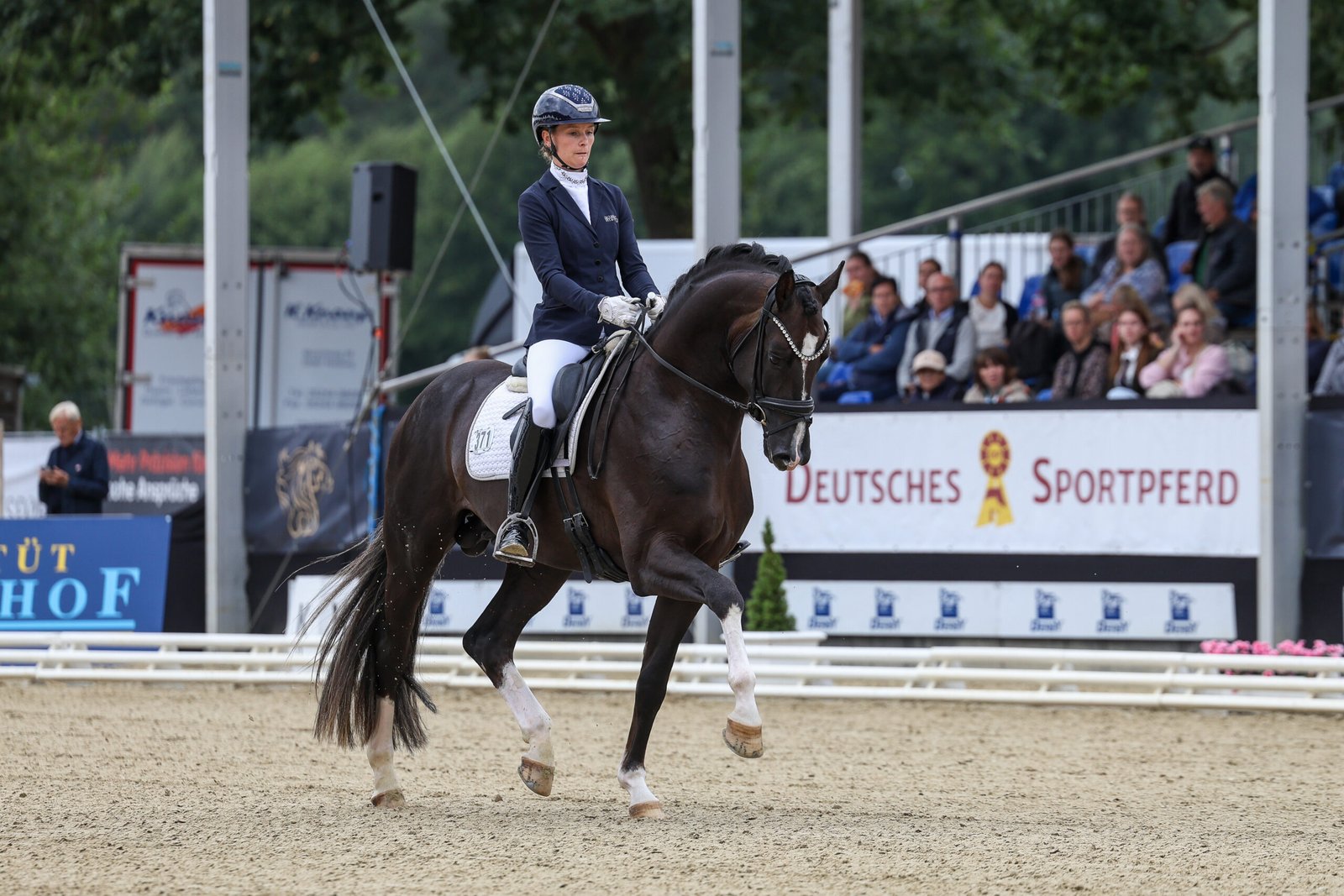 Sina Aringer and Pramwaldhof's "Bonds in Gold."
Photo: Rebecca Thamm
Sina Aringer and Pramwaldhof's "Bonds in Gold."
Photo: Rebecca Thamm It was an exciting finale at the 2026 National Championship for Four-Year-Old Stallions, and that wasn’t just because of the strong field of competitors, which included two champion stallions alone. It was also due to the new format for the four-year-olds—without a test ridden by an outside rider, but instead featuring a Class A dressage test in which the horses enter the arena alone.
This is particularly challenging because the test requires the horses to hold their position for much longer periods. Even yesterday, during the final for mares and geldings, it was clear that some horses still found this difficult, and that was confirmed again today with the stallions.
Not all horses enjoyed being alone in the arena. The winner of the qualifier, the Württemberg DSP stallion Be My Guest, got spooked at one point and tried to escape toward the warm-up area to join his fellow horses. At the last moment, his rider was able to prevent him from leaving the arena entirely. We will publish a detailed summary, including comments from those involved, in the coming days. Now on to the medalists.
Gold for Gold-Backed Bonds
Sina Aringer had qualified two horses for the final of the four-year-old colts, which were, accordingly, the first and last horses to compete. The fourth-place finisher was the first to compete, and the Qualification, Pramwaldhof’s Gold Bonds. The winning stallion of the DSP licensing and DSP Champion by Bonds-Goldberg is a horse that immediately draws everyone’s attention. This is due in part to his striking appearance with his dark chestnut coat, but above all to his potential for movement. Not only does he have impressive forequarters mechanics, but these are also complemented by a correspondingly powerful, sweeping hind leg. All of this is beautifully carried through the body, over the back, and forward into the hand—at least during the phases when he relaxed and achieved suppleness.
That wasn’t always the case today, and it became particularly evident during the walking exercise. One can imagine that he actually has good reach once he gets into a relaxed walk. Aringer, ever the professional, skillfully worked around the problem by breaking into a trot a little earlier on the short side. During the final turn onto the center line, the stallion broke free once, but Aringer quickly regained control of him, and the final halt went well.
Commentary on Bonds in Gold
Katrin Burger once again provided commentary on the scores today. She served as a judge alongside Wolfgang Egbers and Catrin Wingender. “A remarkable horse with remarkable movement,” Burger summarized the impression she and the judges had gained of C, as had the spectators. In the trot, they praised his relaxed, upward-swinging movement, his already good straightness, and his balance. However, they also noted that the stallion still tends to be slightly tight in his turns. Score for the trot: 9.0.
Although they noted the tension in the hindquarters, they still awarded an 8.0 for the clear rhythm and consistency in the “responsive” walk and trot.
While commenting on the gallop, Burger waxed poetic and once again highlighted the stallion’s already advanced training and straightness, as well as his charisma and expressiveness. The score of 10.0 said it all.
In terms of fluidity, they noted that the turns were becoming too tight. They said her core stability still needed improvement in this area. They also would have liked to see a bit more expansion of her frame when extending her steps. 8.8.
As for her overall impression, Burger put it this way: “An impressive horse with a great deal of potential for the future, 9.5.”
That gave a total score of 9.04 at the start of the competition. In the end, no other horse would surpass that score—not even the winner of the qualifying round.
Silver after deduction
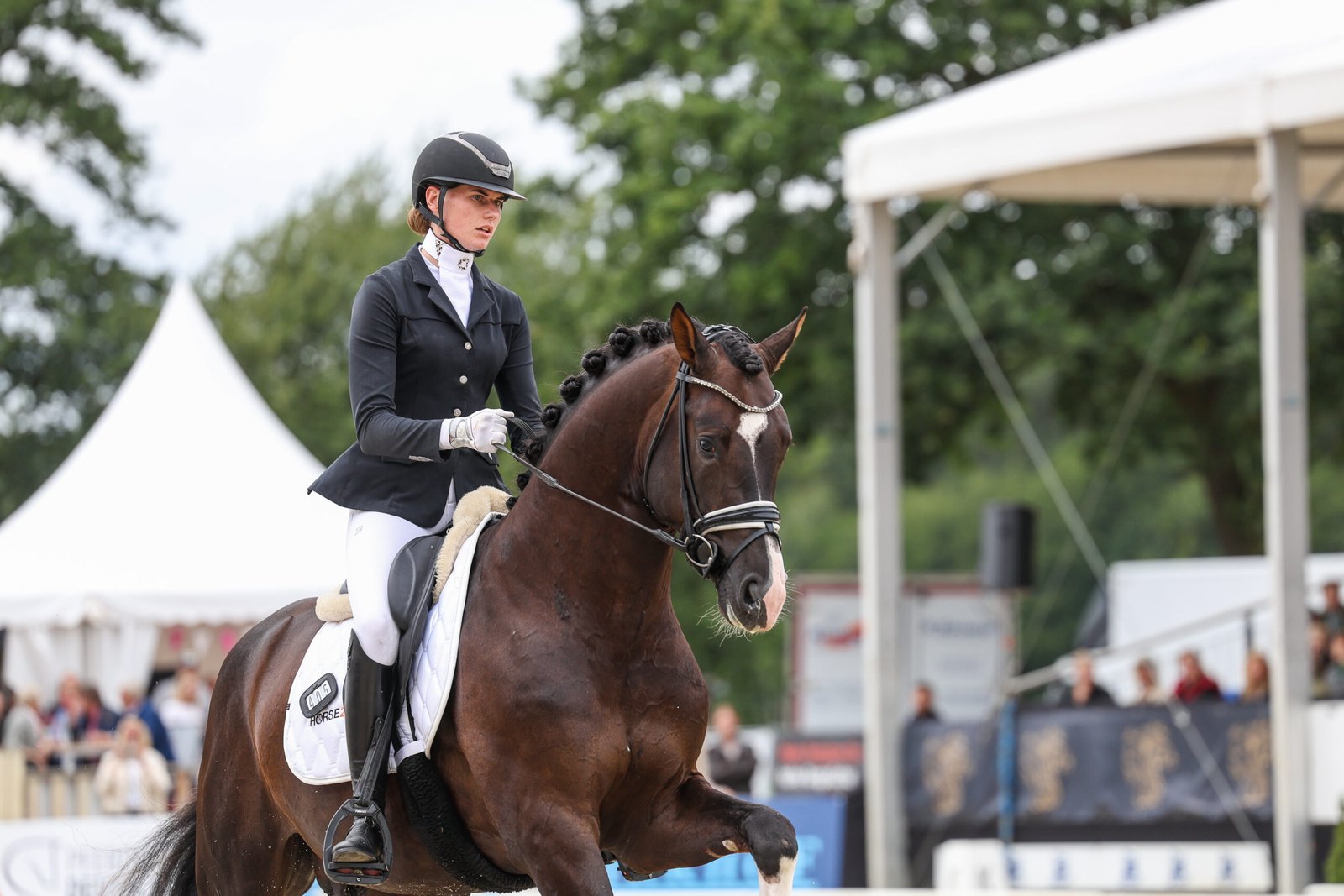
It took a long time for the trio of judges to finally agree on a score for the Württemberg State Champion and Qualifying Round Winner, Be my Guest. The son of Bonds Sezuan, bred by Zoe Sierks, is—much like the winner—a horse no one can overlook: tall, masculine, with a beautiful head, expressive eyes, and a magnificent dark chestnut coat.
He also moves impressively, especially from the front. My subjective impression at a trot: His hindquarters can’t quite keep up with his forequarters in terms of power, drive, and, consequently, connection. At a walk, Be My Guest sets off with great strides and doesn’t let anything throw him off his rhythm. Similar to the trot, the canter is clearly uphill and was even more pronounced today in the extended canter than it was in the qualifiers. There was a major disruption during the test when, as mentioned, the stallion broke away over his right shoulder on the left rein just before breaking into the canter on the circle at point A. He had presumably spotted something in the stands that startled him; in any case, he could not be stopped until just before the exit. Afterward, he continued the test as if nothing had happened.
A long discussion
: “
” How do you handle a situation like this, and how do you evaluate it? It took a while before Katrin Burger picked up the microphone to announce the scores and explain her reasoning. Given the three basic approaches, that probably came easily to her.
Trab: “Impressive mechanics as he moved through the uphill section; very hard-working and energetic. You got the feeling he was just waiting for instructions and then carried them out. 9.8.”
Step: “Well-executed, with good body control and good stretching, 8.7.”
Canter: “Impressive right from the start on the uphill section; transitions already excellently executed; maintaining a clean balance on the hind legs coming out of the medium canter (sic!). Leaves nothing to be desired, 10.0.”
Then came the evaluation of suppleness. This is where things got difficult, because despite all their enthusiasm for the stallion, the judges could not ignore the lapse. Katrin Burger put it this way: “The stallion was definitely balanced on the center line, had a closed mouth, and was confident in his self-carriage. The horse was always in tune with the rider—until he got startled once at the “X.” But we were coming from a very, very high score, and we believe that when you’re coming from a ‘very good’ to ‘excellent’ score, you’re still looking at a 7.5.” And that’s exactly what he received.
And as for the perspective—that earned a 9.5. That would have meant a 9.1 and thus the title—but 0.2 had to be deducted for straying from the designated line. So it was a silver medal with an 8.9 for “Be My Guest” and his Dutch rider Dionne Korinna in their first appearance at the Bundeschampionat.
Textbook-Perfect Riding of Young Horses
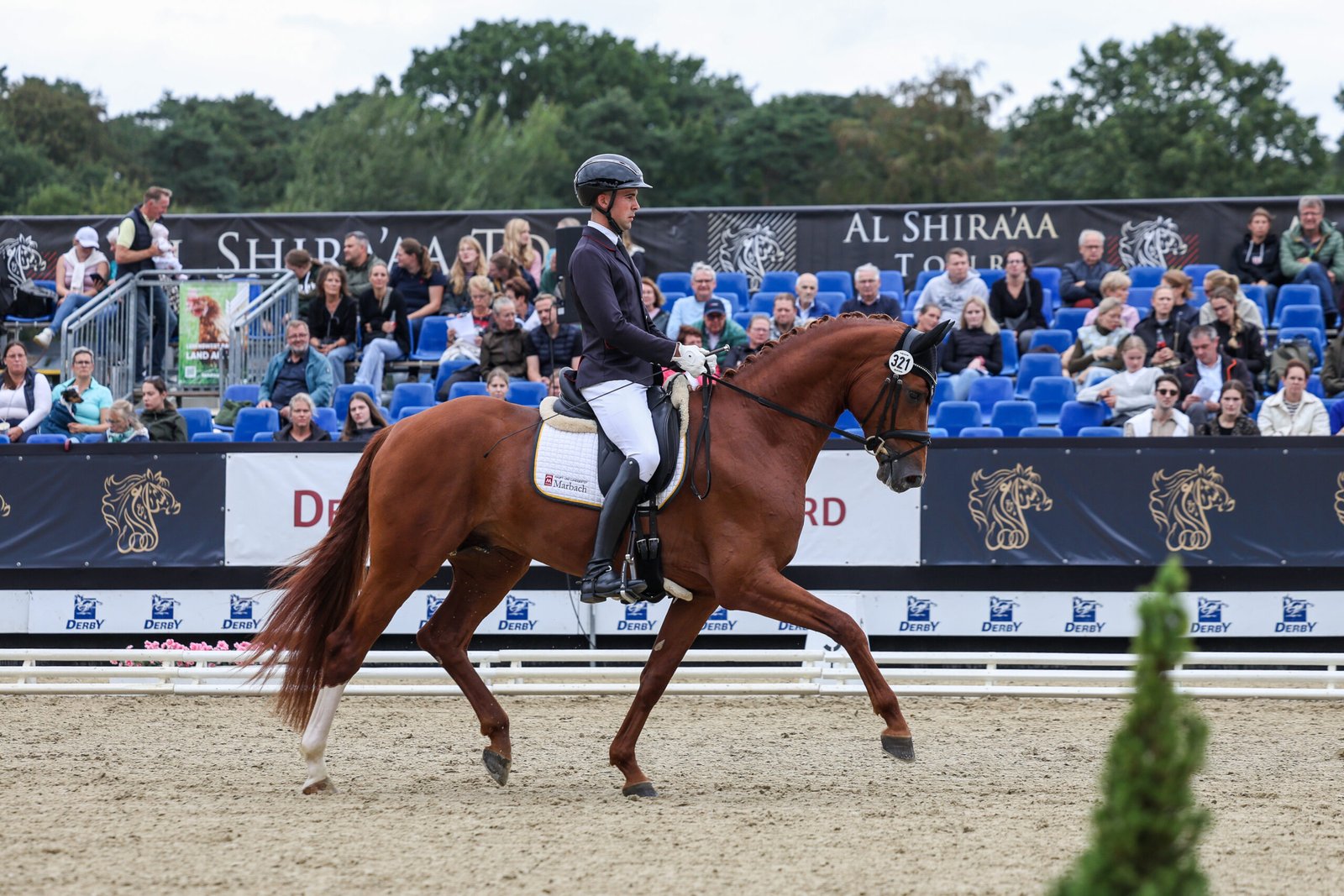
The bronze medal went to the Westphalian chestnut Danubio by Damaschino-Dimaggio, bred by Karl-August Schulte-Varendorff and ridden by Linus Keller for the Marbach State Stud. The chestnut has three good to very good basic gaits, but compared to the two stallions placed ahead of him, he still appears significantly more youthful in his overall presentation. And that’s exactly how Linus Keller presented him. If you’re wondering how to present a four-year-old horse in a way that’s appropriate for his age—this is exactly how!
Throughout the entire test, Danubio remained consistently within the appropriate parameters. He worked in a steady rhythm, loose and supple with good hindquarter engagement in all three basic gaits, moving forward into the hand over a supple back; he chewed on the bit with a closed mouth, and his expression always conveyed contentment and trust. When allowed to chew with the reins out of her hand, he stretched forward and downward in response to her yielding hand and could then be regulated almost seamlessly and brought back into a working posture without losing his balance. Absolutely fantastic! He quite rightly received a 9.0 for both responsiveness and perspective. Katrin Burger explained that the reason he didn’t receive an even higher score for responsiveness was due to slight balance issues on the centerline. She and her colleagues at C kept a close eye on these.
They would have liked to see a little more enthusiasm in the trot, but they also acknowledged that the rider had asked exactly what the stallion was capable of giving: 8.5. In the walk, they awarded an 8.7. In the canter, they would also have liked to see a slightly more powerful uphill movement; 8.5. Overall score: 8.74.
And behind her?
When Sina Aringer, riding the Westphalian stallion Zacolar by Zanetti-Escolar (breeder: Markus Schulze-Finkenbrink, owner: Mathieu Beckmann) as the last competitor to enter the arena, she already had the title in the bag, as she was still in the lead with Bonds in Gold. And Zacolar had placed second in the qualifiers, ahead of Bonds in Gold. In fact, the stallion also has the potential to win at least a medal. In trot and canter, he moves powerfully and supple both from the hindquarters and the forehand. He’s the type who always wants to lift off the ground and who also shows a good stride. However, today he was a bit stiff, especially in the first few strides. It also became even clearer today what had already been evident in the qualifiers: a certain restlessness in his mouth. In addition, he stumbled once in the canter, and he only hinted at letting the rein slip from his mouth during an extension. In her commentary, Katrin Burger attributed the restlessness in the mouth to the longer reprise in the extended seat. She and her colleagues also noted that the stallion displayed a “certain stiffness” in the neck today. His scores were 8.9 in the trot, 8.4 in the walk, 9.0 in the canter, 8.2 in responsiveness, and 8.7 for overall impression. Overall score: 8.64.
The second-place stallion in the starting field, the Oldenburg La Paix by La Vie-Sir Donnerhall (breeder: Dr. Katharina Paschertz, owner: Helgstrand Dressage), ridden by Vanessa Crnadak, did not have his best day today; he appeared stiff and lacking in suppleness. Although the rider tried very hard to guide him sensitively to the bit, he remained split in two and worked with his hocks leaning backward rather than under his center of gravity. When extending his stride, he also briefly lost his balance at the start. In the canter, the impression was somewhat better. The judges gave him a generous total score of 8.62. The stallion was absent from the award ceremony.
Thomas Schulze, riding the Hanoverian Salsero CF by Secret-Vivaldi—bred and owned by Dr. Christine Feichtinger—was pleased to finish sixth in the highly competitive final. He scored 8.32 here.
Similar posts