11:33 p.m.
Quotes from the press conference:
The whole routine was the best feeling in the world. Glamie goes all out. None of us were sweating, none of us were out of breath. It was so loud—crazy. Glamie thought, “This is all for him.”
I’m always afraid of Isabell. I know what she’s capable of.
Lottie Fry (GB)
To ride into that vibe—it was incredible; she didn’t put a hoof wrong. That audience—it was just wow!
Cathrine Laudrup-Dufour (DEN)
With scores like these—90 percent, 88 percent…—there was only one option: Full steam ahead!
Isabell Werth (GER)
11:23 p.m.
Conclusion
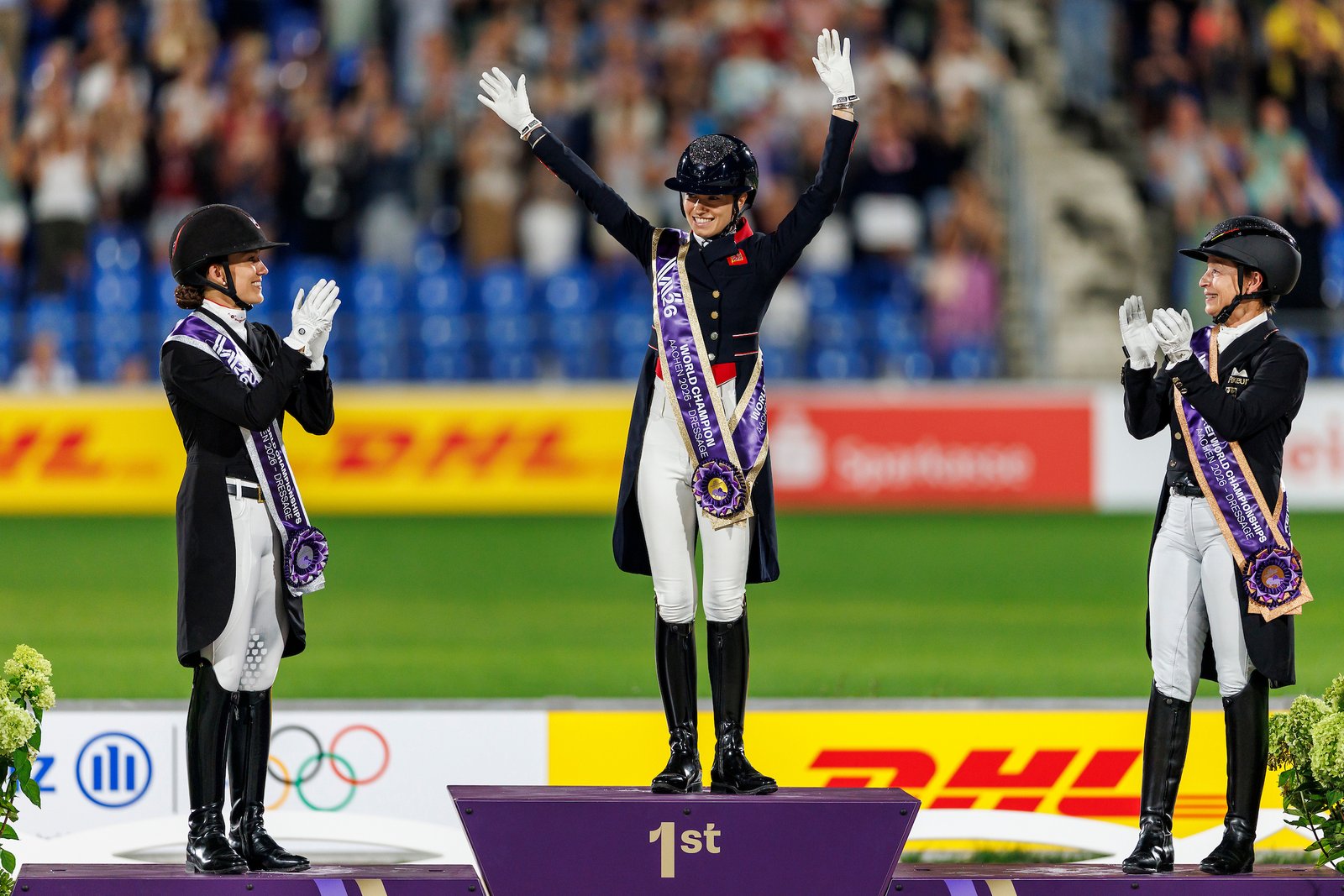
: Lottie Fry wins her second individual title at the World Dressage Championships in Aachen. Her freestyle performance with Glamourdale earned her the gold medal. It was a clear victory. Her score of 91.907 percent spoke for itself. Only one of the seven judges placed the pair in second place.
The silver medal went to Denmark’s Cathrine Laudrup-Dufour and Freestyle, who will have to wait a little longer for their first individual title. With a score of 91.326 percent, this pair was the only one to come close to the new (and former) world champion.
The bronze medal went to Isabell Werth and Wendy. They were one of three pairs in the “chasing group.” The pair scored 88.65 percent, marking Werth’s fourth World Championship bronze medal and her second in the individual competition. In total, Werth has won seven bronze medals at championships. The judges scored her between two and five.
Justin Verboomen (BEL) finished just behind him (88.439).
Germany thus concludes the World Dressage Championships with the team gold medal and two bronze medals won by Katharina Hemmer and Isabell Werth.
10:50 p.m.
Isabell Werth (GER) Wendy de Fontaine
“Stumblin’ In,” recently dusted off by DJ CYRIL and originally sung by Suzie Quatro and Chris Norman in the 1970s, plays during sections following the salute. A brisk trot acceleration on the center line. Then clearly defined passage-traverses to Kenny Rogers and Dolly Parton’s sentimental ballad “Islands in the Stream.” Then the first piaffe with a 90-degree turn, followed by a passage-traversal to the left and a trot-traversal to the right.
Evenly accentuated piaffes and passages. At a walk with a long neck, striding powerfully in the rear part of the arena. String accompaniment, and then—finally—performed with a velvety voice, “Mandy” or “Wendy” by Barry Manilow, accompanied by zigzagging canter half-passes and a powerful, fluid canter. Errors in the double changes; the audience murmurs. The single changes are flawless but short. The extended trot to conclude the routine is well-executed. In the final minute, Werth then showcases the piaffe and passage capabilities of the Danish mare, whom she took over from Andreas Helgstrand at the end of 2023. To the tune of “Stumblin’ In,” she moves into the grand finale: a 360-degree piaffe pirouette.
88.65 percent—that’s the bronze medal, just ahead of Justin Verboomen and Zonik Plus
10:36 p.m.
Carl Hester (GBR) on Fame
: Carl Hester starts by letting the horse show off his rocker side, then performs passage and half-passes to David Bowie’s “Let’s Dance.” The son of Bordeaux marches eagerly around the arena. David Bowie’s voice also echoes through the stadium during the walk. One would have liked to see a bit more suppleness in the walk. The performance continues at a canter to “Starman.” Double pirouettes are accompanied by the throaty “Ground Control to Major Tom.” The flying changes are executed successfully. A slight loss of momentum in one pirouette.
Every now and then, Hester changes gaits—sometimes at the front of the arena, sometimes at the back. To the tune of “Fame”—the Bowie song, not the movie—the transition into the piaffe doesn’t quite work at first.
But in the end, it’s back to “Let’s Dance” with passages and piaffes. And in the end, fame stands tall like a tree.
82.304 percent
10:25 p.m.
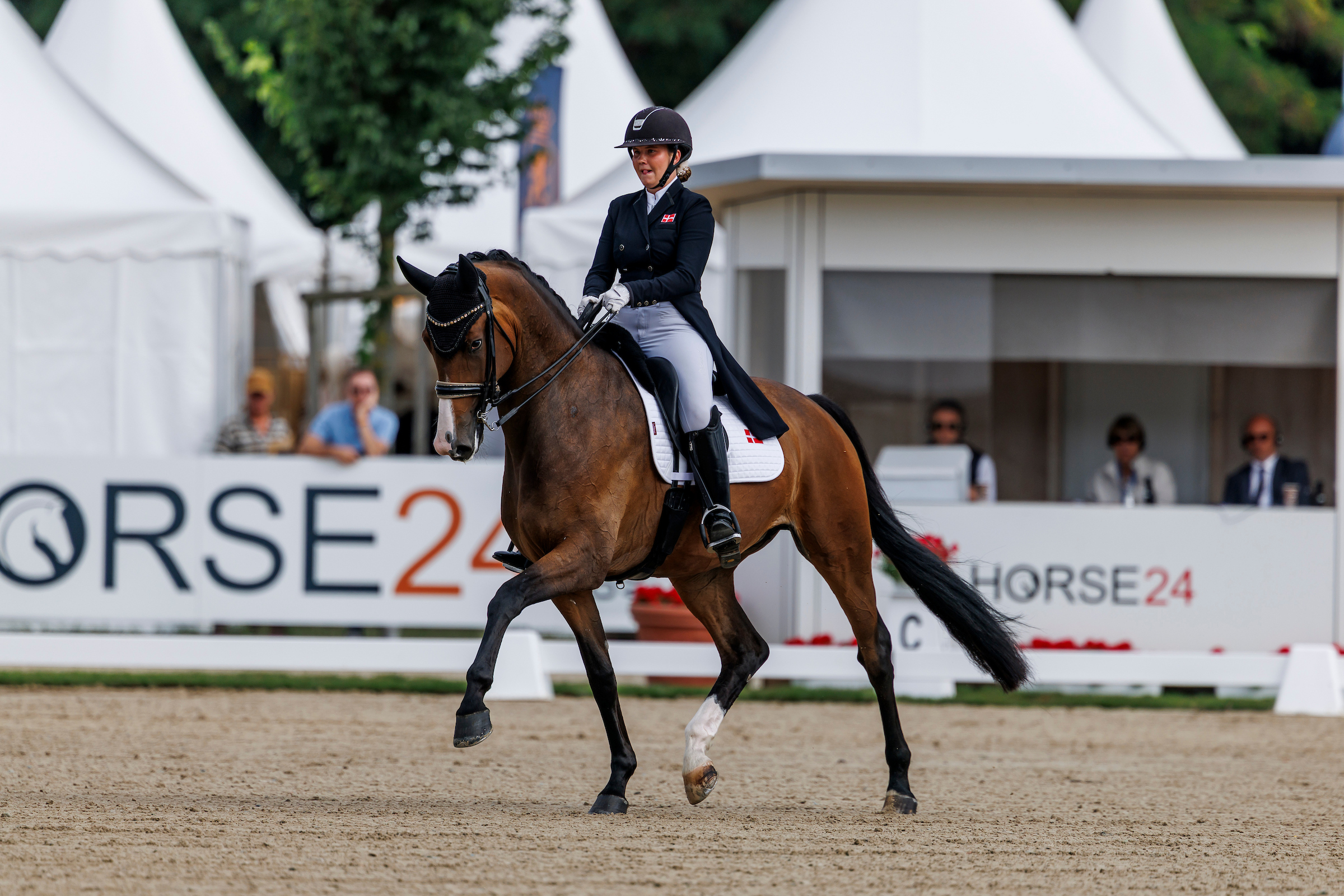
Cathrine Laudrup-Dufour (DEN) Mount St. John Freestyle
, passage up the center line, piaffe-pirouette with a 90-degree turn, “All Together Now” into passage traversals. There they are again—the ’80s. This was followed by lively traversals in collected trot and a wonderfully strong trot across the diagonal. “Together Forever” by Rick Astley accompanied the traversal shifts.
What a powerful stride—under the floodlights! And that feather-light anpiaffe. The pair literally glides into the canter pirouette, followed immediately by a strong canter. A very balanced and centered double canter pirouette. Two-time changes on the diagonal—with a brief hint of “Sledge Hammer.” Confident one-time changes, “Together” by Kylie Minogue, leading into canter half-passes.
“Harmony” is the headline. In a strong trot, Cathrine Laudrup Dufour shifts into high gear once again. Then, in a piaffe-pirouette,
As Starship’s “Nothing’s Gonna Stop Us Now”—the 1987 global hit—begins to play, the audience bursts into applause. The song was a number-one hit worldwide—which, given its lyrics, is fitting for a World Cup.
91.236 percent
10:14 p.m.
Charlotte Fry (GBR) Glamourdale
Is your tray table stowed? Are your seatbelts fastened? Welcome aboard “Glamourdale Airlines.” The freestyle program featured music tracks centered on the theme of flying. With that, she won the freestyle competition in Amsterdam with a score of 89.305 percent. Let’s see how things go today for the newly crowned world champions.
Latin rhythms, accompanied by an in-flight announcement: “Welcome aboard Glamourdale Airlines, enjoy the flight.” “We’re going to Ibiza,” the voice announces—so it appears to be a vacation flight. The pair opens with passages and, for the most part, diligent and steady piaffes. A strong trot, then a new song—Las Vegas sends its regards—”Fly Me to the Moon” accompanies smooth traverses at a trot.
Another change in music, back to Ibiza again, another passage and a 180-degree turn—piaffe—transitioning into a walk, accompanied by the strummed notes of “Leaving on a Jet Plane.” Relaxed, striding—great.
Wide-stride canter half-passes, “Fly like an eagle” into double changes across the diagonal. Double pirouette and strong canter “Leaving on a Jet Plane.” 15 single changes on the diagonal—also quite conservative in terms of choreography, but technically sound, uphill and straight—followed by a transition from double changes to single changes on the next diagonal.
Finale: the transition to a trot. “We are going to Ibiza”—into passage-traverses. Some members of the audience jump to their feet. The pair comes to a stop in front of the judges, perfectly timed to the last beat of the measure.
91.907 percent—a preliminary decision
10:02 p.m.
Justin Verboomen (BEL) Zonik Plus
So far, these World Championships haven’t been the tournament for this pair that took the world by storm in 2025. And now? Under the floodlights? A black stallion, a talent for the piaffe—that combination almost always works…
The piaffes—already featuring a 270-degree turn at an early stage—are executed better than in the Grand Prix and Grand Prix Special. Rich string music accompanies the pair’s half-passes. The passages are springy. But even in the piaffe pirouettes, a kick from the hind leg that points backward keeps sneaking in. And that’s something you really don’t want to see.
In the walk, the black stallion moves with a smooth gait, and his collected walk on the center line is also more precise. In front of the judges, Verboomen begins a piaffe, transitions into a piaffe pirouette, and from there moves into a canter. This is followed by a strong canter.
The pair looks better today than they did in the first two tests. Two-time changes on the circle line. Now the piano dominates the orchestration. The Belgian performs a sufficient number of one-time changes, though “only” on a straight line.
At the end of the canter sequence, he transitions from the pirouette into a piaffe and performs a one-handed passage along the center line all the way to the judges’ booths on the short side. The audience is thrilled.
88.439 percent
9:50 p.m.
Marieke van der Putten (NED) Zantana RS2 Old N.O.P.
Virtuoso piano accompaniment during the warm-up and also after the passage, piaffe with a change of direction, and traversal. That’s a real showstopper in the first 20 seconds. Zantana, the Oldenburg mare born at Paul Schockemöhle’s Lewitz Stud, is the second of three horses descended from Zonik. The mare, who shines with her mechanics, transitions to a more tactical walk after the opening trot.
At a canter, the routine begins with pirouettes and two-tempi changes on a curved line. The horse then moves forward along the diagonal into the next double pirouette. This is followed by one-tempi changes on a straight line.
Transition from the canter to the passage. Then a 360-degree piaffe at X, and, to the applause of the audience, continue in the passage until just in front of the judges.
The orchestra’s performance was seamless, though it lacked those final (positive) moments of surprise. Good use of space, but with many diagonal lines—one might say it was “a bit conservative.”
82.693 percent—second place so far.
9:26 p.m.
Daniel Bachmann Andersen (DEN) Flash Gordon
A good Grand Prix, but then a bit off form in the Grand Prix Special—Danish rider Daniel Bachmann Andersen and his Oldenburg horse Flash Gordon have a minor setback to make up for.
They pull this off right from the start, with Fuchs performing plenty of passages but also showing off piaffe-pirouettes—and everything else there is to present in terms of two-beat exercises. Interestingly, the collected walk comes off almost better under the floodlights than it did in the Grand Prix Special.
In the canter, the concept that was already evident earlier continues. Focused riding. Highlights are emphasized—for example, canter pirouettes—rather than wild sequences.
The fact that there’s still some tension in the Fox is evident in the single-horse turns, which start off smoothly at first. But then Daniel Bachmann Andersen has to work pretty hard to save them. It doesn’t work out—a mistake. Overall, the Dane has to use his hand significantly more often, but he makes a point of getting his hand back in position time and again.
However, the 360-degree piaffe-pirouette before the final bow—executed with fluidity and balance—shows just what else we can expect from this pair.
It was the horse’s third freestyle routine.
80.107 percent
9:16 p.m.
Maria von Essen (SWE) Invoice
He is one of the last offspring of Jazz in the sport and demonstrates what the Dutch breeding program’s signature stallion has always stood for: a talent for piaffes and passages. But ridden with finesse—not mechanically, but with a supple back.
A piaffe-pirouette with a lowered hindquarters and a change of direction flows into a strong trot. The lateral movements are supple and even. The music is seamless and orchestral. At times more powerful in the spirited gaits, then delicate—piano, strings—during the walk. Music from the musical *Les Misérables* accompanies the canter. During the pirouette, only a crystal-clear soprano voice, without instrumental accompaniment. “Do you hear the people sing?”
Technical note: During the two-step changes, the black horse lifts his hindquarters several times. Maria von Essen performed a pirouette with more than the allowed two full turns. That’s why the judges had to consult with each other. The jury has to reach a consensus first. This results in massive deductions—not only for the pirouette (no more than 5.5), but also for the choreography—which is a shame.
A beautiful freestyle performance without any gimmicks—and it’s great that even a woman who isn’t a millionaire can showcase her riding skills here in Aachen in front of more than 40,000 spectators.
After deductions: 72.168 percent
9:05 p.m.
Becky Moody (GBR) Jagerbomb
Did Becky Moody ever imagine this when Jagerbomb, the son of Dante Weltino, was born to her twelve years ago? Hardly. What a journey. At first, she wanted to sell the ugly duckling. Now he’s a World Cup champion and in the World Championship final.
“Sergeant Pepper’s Lonely Hearts Club Band”—the Beatles performing pirouettes and various changes of formation. A gallop to kick things off—great idea!
Then “All You Need Is Love,” and after an initial piaffe, the horse continues at a strong trot, with traversals—here, too, alternating between collected trot and passages, which then transition into a piaffe (“With a Little Help from My Friends”).
Then there’s a factual error—though it’s purely musical in nature: “Here comes the sun,” sing the Fab Four, even though the sun is actually setting. Well, let’s not split hairs.
“Love Me Do” leads into more trotting traverses. The ease with which Jagerbomb executes the exercises one after another is inspiring—it’s like a dance.
Suddenly, they’re back to a gallop. They transition out of the circle, starting with double changes and then, after X, single changes—spontaneous applause. These two are a model of harmony.
When they then transition into a fan-shaped pirouette to “Twist and Shout” and march off to “I Want to Hold Your Hand” at a brisk trot for their final bow, the stadium goes wild.
87.479 percent
8:55 p.m.
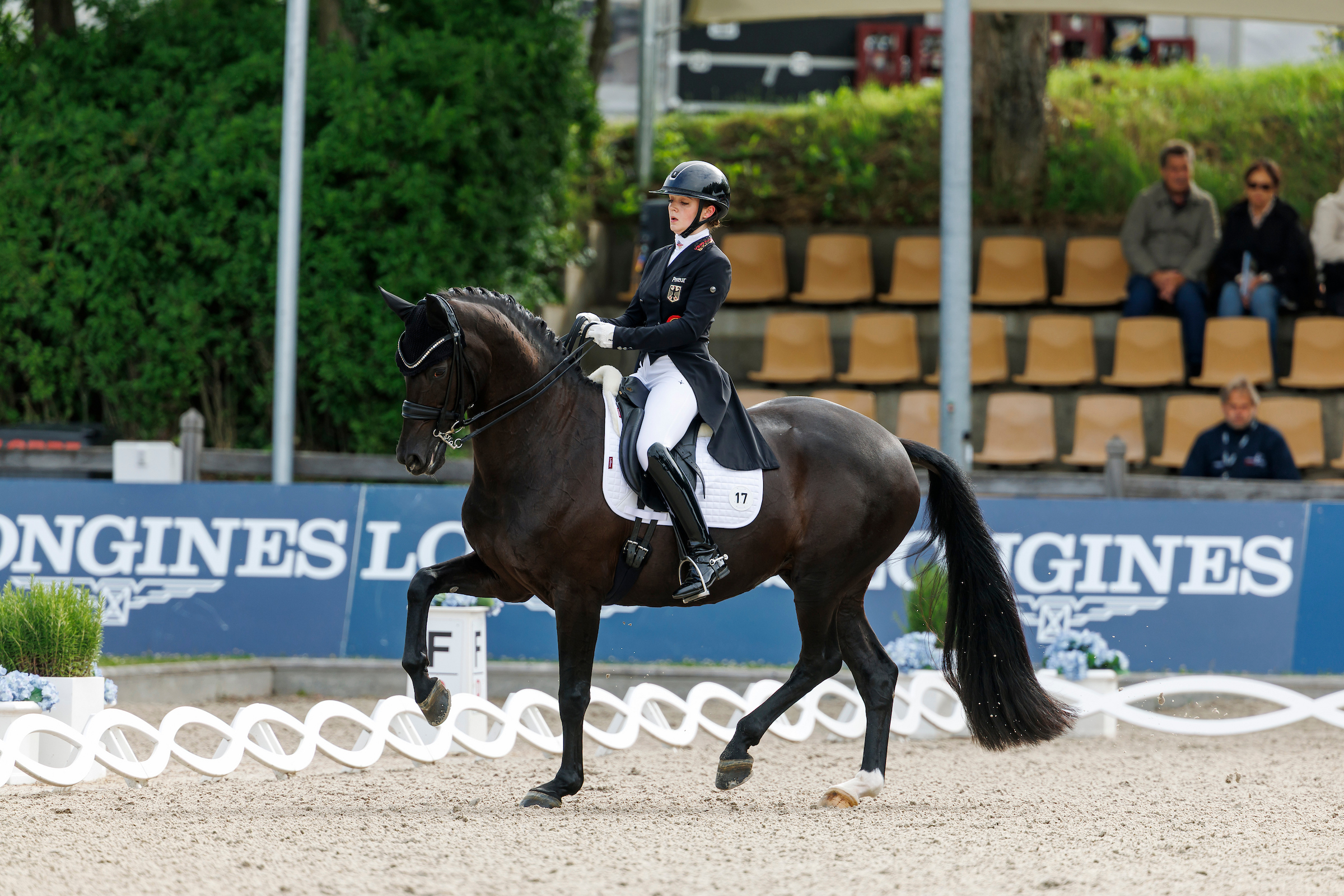
Raphael Netz (GER) Great Escape Camelot
A big round of applause welcomes Raphael Netz and “Camelot.” The pair enter the arena at a walk. They’ve set two “personal bests” in the arena in Aachen.
“How to Train Your Dragon,” the Celtic-inspired film score, accompanies passages with plenty of dramatic tension. A red sun-like orb above the stadium accentuates the pair’s performance. A highlight: the transition between traverses in collected trot and in passage. The latter culminates in a piaffe-pirouette in front of the judges.
In a strong stride, “Raphi” can keep his legs long. Double pirouette followed by a strong canter on one diagonal, then a double change and a pirouette on the next diagonal. The spacing is just right!
On the short side at point A, Camelot briefly picks up the pace. The changes are flawless but wobble considerably. At the end, the KWPN gelding performs his signature move once more: the passage.
80.946 percent—that’s the current lead!
8:43 p.m.
Nadja Aaboe Sloth (DEN) and Favour Gersdorf
A classic piaffe—steady and energetic—follows the opening salute by the Danish duo. Xylophone, beats, and a touch of synthesizer, accompanied by percussion during the traversals in the passage and collected trot.
This is followed by a strong stride along the circle. Now a saxophone may accompany the piaffe pirouette, which develops into a canter pirouette. We continue with two-time changes. The horse doesn’t even swish its tail. (Perhaps this is also because the gelding is feeling a bit dizzy, since each pirouette involves more than one full turn.) The transition from two-tempi changes to one-tempi changes fails. But that’s the only slip-up.
Passages, piaffes, and applause right up to the end.
Harmonious riding. Not exactly a showstopper, but a horse ridden with such finesse that you’d love to take a seat in the saddle.
For a World Championship debut, you get:
79.386 percent
8:31 p.m.
Sandra Sysojeva (POL) Maxima Bella
French chansons for the Polish pair, who also competed in the Olympic free skate final. Piaffes and passages—which the Millennium daughter can execute as smoothly as a wound-up music box—take center stage at the beginning of the free skate. A somewhat abrupt (musical) transition to “Mr. Sandmann, Bring Me a Dream,” with striking brass, heralds a powerful trot and, later, rather sudden half-passes.
The rhythm isn’t always clear in the four-beat measure. The joy of unexpected musical shifts is what defines this free skate. It makes you wish the orchestra could be allowed to play a few seconds longer.
The mare has the routine down pat. Double pirouettes followed by flawless changes of direction.
At the end, a pizzicato and a fan-shaped piaffe, then down the center line in the passage to X. The first time, the audience claps along in time with the music on the last line.
First impression: Music that would be enough for two freestyle routines. A technically sound horse.
80.175 percent, 77 percent from a judge—that’s when the people boo.
8:04 p.m.
Isabel Freese (NOR) Total Hope OLD
The son of Isabell Werth’s Weihegold and Totilas, who placed tenth in the freestyle at the Paris Olympics. Isabel Freese trained the black stallion. Now in the World Championship final.
A strong trot from the greeting, accompanied by piano. Then a quick transition to passage, accompanied by a rapper performing in the background. The black horse can do passage. Straight ahead with just as much expression as in the half-pass. The Norwegian rider also demonstrates this with plenty of cross-steps in the collected trot. Then a moment of alarm: Shortly after a piaffe on the short side, the black horse jumps back slightly. But the two quickly regain their connection.
The pair is unable to maintain the high scores they achieved in the first third of the routine.
In the canter, a pirouette comes very early on, followed by a strong canter and a two-time change. Traversals and similar sequences, first on the right lead and then on the left. A perfectly straight one-time change—scored above an eight.
To finish, he transitions from a left pirouette (canter) into a piaffe pirouette and passages with piaffe pirouettes to change direction. Here, Paul Schockemöhle’s black stallion resembles both of his parents.
A complex routine, harmonious sequences, beautiful choreography, and quite a few challenging elements.
78.021 percent
7:55 p.m.
Frederic Wandres (GER) Bluetooth OLD
Welcome to the 1960s: The Beatles’ “Love, Love, Love” for the entrance. But then, from the ’80s, Foreigner’s “I Want to Know What Love Is” for the first piaffe, which leans slightly forward. Passages and half-passes, alternating between collected trot, passage, and strong trot, define the first third of this freestyle. The pair is active throughout the entire arena. “Everlasting Love” accompanies their confident stride along the diagonal.
Then a canter. There’s a mistake during the two-time changes. A double pirouette, followed by canter half-passes. The right pirouette is executed quite large. A perfectly straight one-time change on the center line. Accompanied by the Motown classic “What Becomes of the Broken-Hearted.” Wandres uses the joker line for the two-time changes, and they go really well this time.
Then a trot, the Beatles again, and a 360-degree piaffe pirouette to go with it.
A minor mistake during the gallop, but in the end, it stirred up all the emotions in the packed stadium.
76.246 percent
7:43 p.m.
Simone Pearce (AUS) Will Marq
Yesterday, Simone Pearce found out that she’d be competing in the freestyle. The girlfriend of show jumper Martin Fuchs wasn’t prepared for this. A freestyle routine was cobbled together overnight. This will be her very first time riding Will Marq. After all, there wasn’t any time to practice with him.
After the opening salute, a powerful diagonal canter toward the judges. Good use of space. Drumbeats and somewhat ethereal-sounding vocals accompany extremely rhythmic piaffes, alternating with passages and traversals. Every now and then, the strings take the lead.
A strong stride from the piaffe. Even this horse, which is still relatively inexperienced in Grand Prix Sport, strides calmly. The low-hanging sun casts a long shadow behind the pair. A double change is followed by a canter pirouette. Like the double changes, the single changes are not quite in a straight line. The routine concludes with a 360-degree piaffe pirouette that is already quite polished.
It’s amazing not only how Simone Pearce was able to pull off a freestyle routine like that out of literally nowhere, but also how beautifully the bay horse moves across his back.
75.646 percent
7:32 p.m.
Dinja van Liere (NED) Mauro Turfhorst N.O.P.
At nine years old, the youngest horse at the World Championships has already delivered two fantastic rounds at this competition. Whitney Houston’s “It’s Not Right, But It’s Okay” is the first hit, accompanied by a passage. Executed smoothly, followed immediately by a piaffe pirouette with a 90-degree change of direction. In the piaffes, you can sometimes tell a little that this handsome stallion, a son of Zonik, is competing in his third test.
Transition from the trot half-pass into collected walk, followed by a relaxed, strong walk. Ellie Goulding, “Love Me Like You Do.” Then canter to “Bring Me a Higher Love” by Kygo. Two-tempi changes, classically on the diagonal. One-tempi changes to Pink’s “What About Us.”
Zigzag traverses in the final passage. The tail swings back and forth, everything flowing smoothly.
Conclusion: Frequent changes of tempo, but a nine-year-old horse that wasn’t pushed too hard. On the contrary—this handsome horse performs with ease, presenting the movements skillfully without too many “frills.”
A horse with a bright future! 79.00 percent
7:21 p.m.
Larissa Pauluis (BEL) Flambeau
A whole different caliber—that becomes clear right from the start. Just like the Eurythmics, she opens with a piaffe-pirouette and a passage-traversale. Larissa Pauluis won the World Cup final in Neumünster with this freestyle routine. Good use of space in the trot sections. A very relaxed, strong walk to the Communards’ “Don’t Leave Me This Way.” Canter, followed immediately by a pirouette, then straight into a two-tempi change, U2, “Bloody Sunday”—ah, the 1980s. (The Sturm und Drang era, even for specialist editors.) A one-tempi change on a curved line. Precise to the music: a strong canter, followed by a pirouette, on both hands. Passage-traverses with piaffe pirouettes to change direction at the end. Then “In the Name of Love” blares from the speakers.
Creative, technically complex. Music with a theme. The audience loves it. And so do the judges—at least a little bit:
76.432 percent
7:09 p.m.
Henri Ruoste (FIN) Tiffany’s Diamond by Tailormade Temptation
Powerful film score. Orchestra meets electric guitars. Top Gun—Tom Cruise sends his regards. Technically, a program that isn’t too demanding. A nice idea: an outside canter on the short side. Expressive piaffes, executed perfectly on cue.
75.468 percent
6:55 p.m.
It’s about to start. 18 pairs. And here, just to keep in mind, are the scoring categories. There is an A score and a B score. The A score is for technical merit, the B score for artistic impression:
A score
The following lessons must be presented:
- Collected stride (minimum 20 m)
- Strong walk (minimum 20 m)
- Right-hand diagonal in collected trot
- Traversal at a collected trot to the left
- Extended trot
- Traversal to the right in collected canter
- Traversal to the left in collected canter
- Strong canter
- Flying changes over two jumps (at least 5 in a row)
- Flying changes from jump to jump (minimum of 9 in a row)
- Canter pirouette to the right – coefficient two
- Canting pirouette to the left – coefficient two
- Passage (minimum 15 m on one rein) – coefficient two
- Piaffe (minimum of 10 strides in a straight line) – coefficient two
- Transitions from passage to piaffe and from piaffe to passage
- Salutes at the beginning and end of the test (one combined score)
B Grade
- Rhythm, Energy, and Flexibility – Coefficient Four
- Harmony between rider and horse – coefficient four
- Choreography, use of space in the arena, creativity – coefficient four
- Level of difficulty – Coefficient four
- Music and interpretation of the music – coefficient four
For technical errors, 0.5 percent is deducted per incorrect movement. Time penalties also apply: for exceeding or falling short of the time limit, a deduction of 0.5 percent of the total B score.