How do horses react to heat, and how should their care be adjusted? The current state of research
Heat Stress in Sport Horses: A Real Problem? Or an Overblown Issue? Fact-Checking the Issue
 from Dominique Wehrmann
 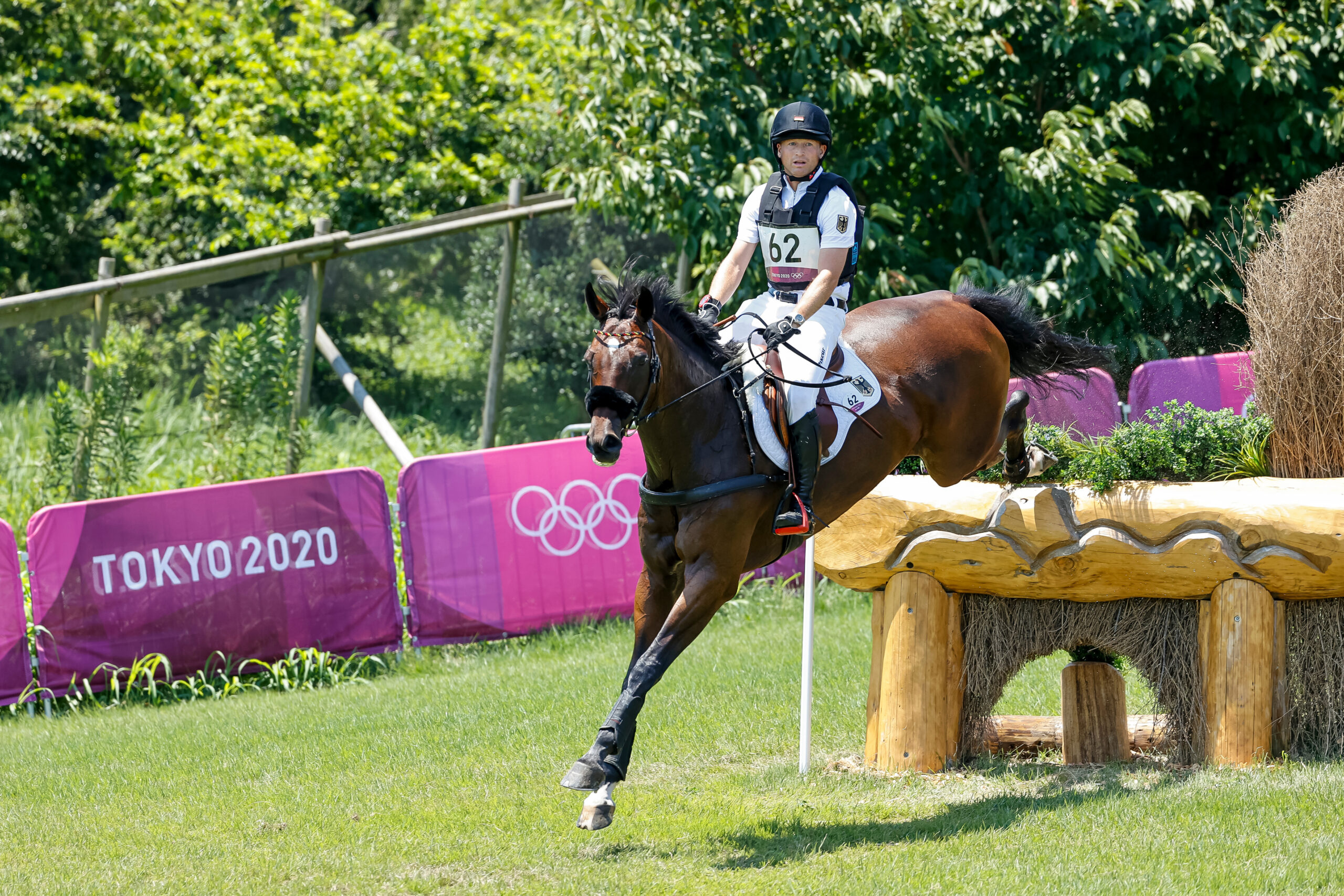 Michael Jung and Chipmunk at the 2020 and 2021 Olympic Games in Tokyo, respectively.
Photo: sportfotos-lafrentz.de
Michael Jung and Chipmunk at the 2020 and 2021 Olympic Games in Tokyo, respectively.
Photo: sportfotos-lafrentz.de Just how susceptible are horses to heat, anyway?
Horses are less well-equipped for heat dissipation than their proverbial endurance might suggest. Their ratio of body surface area to body mass is significantly less favorable than that of humans—which makes it more difficult for them to passively dissipate heat into the environment.¹ During intense exercise, the muscles produce enormous amounts of heat: core body temperature can rise by up to one degree Celsius per minute.²
A horse’s most important cooling mechanism is sweating. In addition to electrolytes, horse sweat contains the protein latherin, which helps distribute the sweat across the skin and thus promotes its evaporation—a clever biological trick that does not exist in humans.¹ During exercise, a horse’s sweat rate is actually significantly higher than that of humans. In addition, an increased respiratory rate and enhanced blood flow to the skin contribute to heat dissipation.
The normal body temperature range for a healthy, resting horse is 37.5 to 38.5 °C.¹ Important to know: During intense muscular exertion, horses can temporarily reach temperatures above 40 °C while still performing at a high level—this is not initially a cause for alarm, but rather a normal physiological response to exertion.³
Temperatures alone are not meaningful
Special attention must be paid when humidity is high: In such cases, the efficiency of evaporative cooling drops rapidly because the difference in vapor pressure between the skin’s surface and the ambient air decreases. When heat and high humidity occur simultaneously, the balance between heat production and heat dissipation can be disrupted—this is the key mechanism by which heat stress can develop in sport horses.¹
There are significant individual differences: age, fitness level, coat color and density, breed, and degree of acclimatization all have a major impact on a horse’s heat tolerance. Anhidrosis—a reduced or absent sweat production following chronic heat exposure—can also significantly limit the exercise capacity of individual horses.¹ According to veterinary assessments, older horses are particularly sensitive to muggy heat.³
At what point does it become risky for sport horses?
The standard used in scientific and sports organization circles is not simply air temperature, but the WBGT index (Wet Bulb Globe Temperature). It combines air temperature, humidity, wind speed, sun angle, and heat radiation into a single metric.¹ The index was originally developed for military use and adopted by the FEI for equestrian sports in 1996.¹
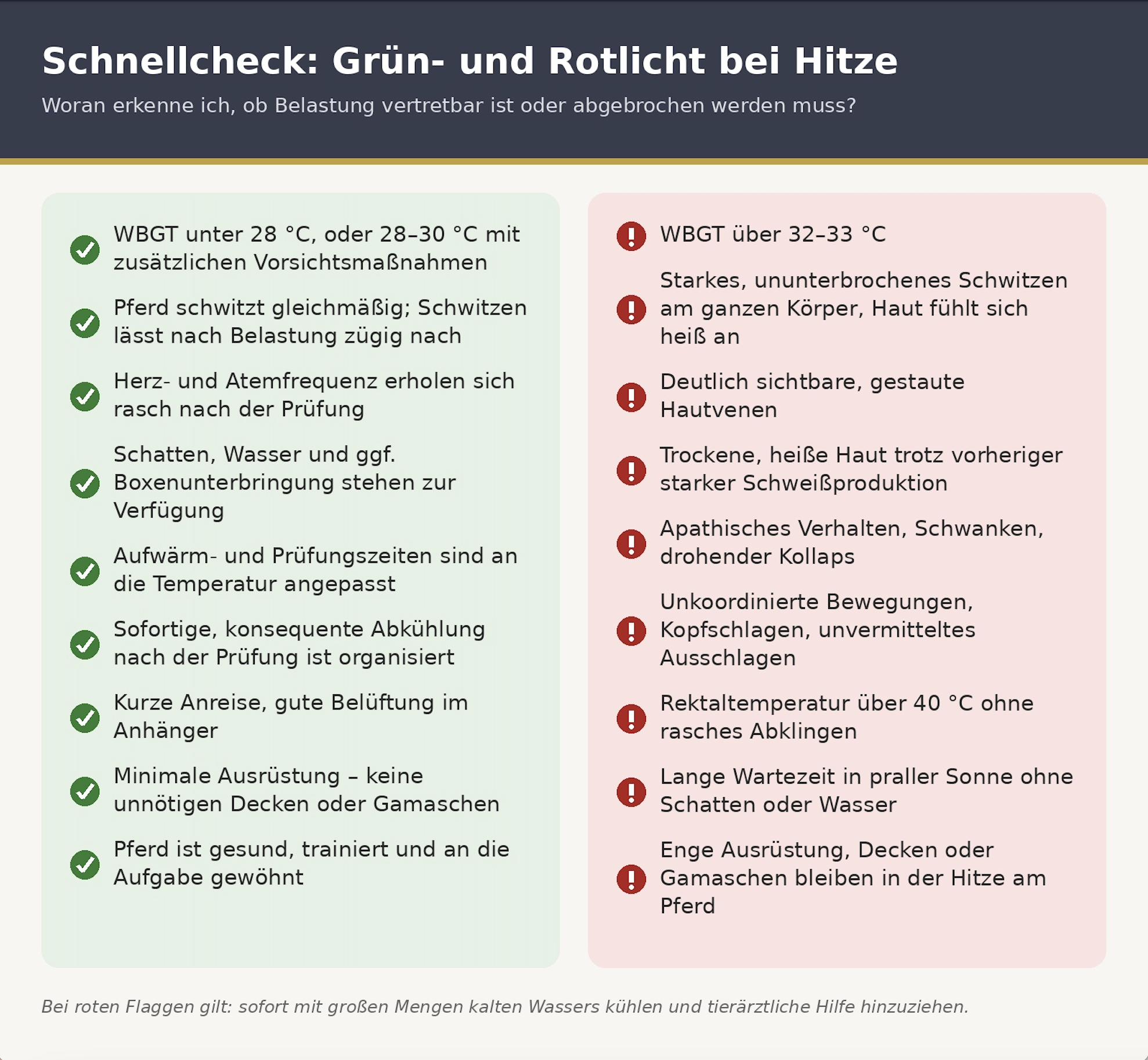
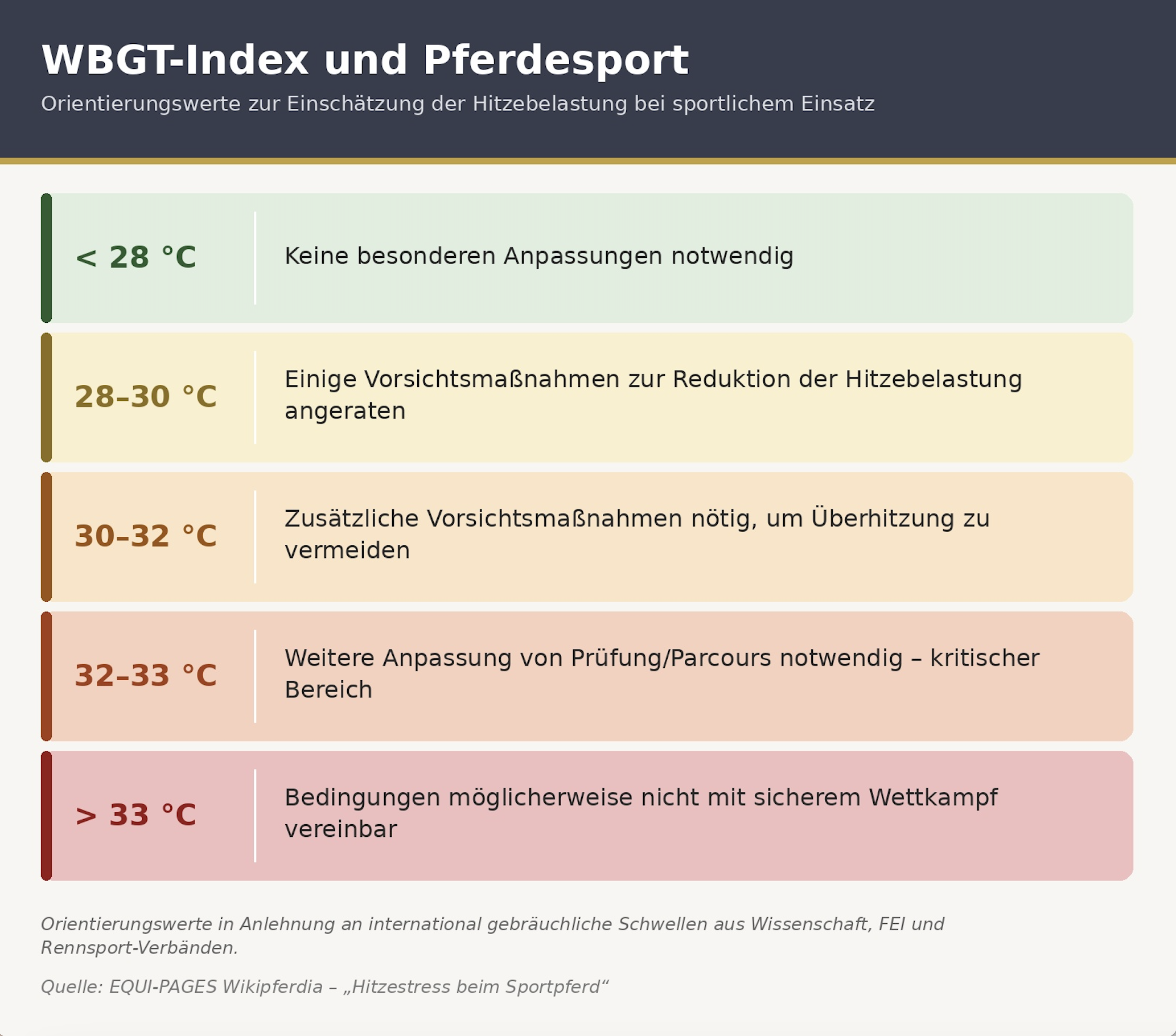 A specific figure from field research: In a large-scale Japanese analysis of horse races, a WBGT value above 28 °C was shown to increase the risk of exercise-induced overheating.⁵ As a rough rule of thumb, a combination of an air temperature above 30 °C and relative humidity above 90 percent is considered the threshold beyond which normal thermoregulation may be overwhelmed during intense physical exertion.²
Important to note: It is not just the absolute heat that matters, but the interplay of temperature, humidity, and the duration or intensity of the exertion. A short, low-intensity test—such as a single dressage exercise or a style jump—is significantly less critical than an endurance discipline or a cross-country ride, even with the same WBGT value.³
Even beyond the actual test itself, factors such as long waiting times on the trailer, inadequate ventilation during transport, and periods spent in direct sunlight are among the environmental risk factors.³
What specific health risks are there?
Research distinguishes between several forms of the condition, which vary in severity:
Heat stress and dehydration typically occur during prolonged exertion: significant loss of fluids and electrolytes through sweat, increased heart and respiratory rates, slowed capillary refill time, constipation, and muscle cramps. If left untreated, this can progress to muscle breakdown, kidney failure, liver damage, and laminitis.⁴
Exertional heat illness is a distinct, acute syndrome originally described primarily in thoroughbred racehorses. The primary focus here is not on fluid loss, but rather on the overheating itself, which involves the nervous system: behavioral abnormalities, disorientation, uncoordinated movements, and, in extreme cases, collapse.⁶ The condition can occur rapidly after the end of exercise and requires immediate, thorough treatment.
Heatstroke is characterized by rectal temperatures above 41–43 °C, apathy, refusal to perform, and dry, hot skin despite previous heavy sweating. Triggers can include overtraining in hot and humid conditions, inadequate ventilation—such as in a trailer—or an abrupt change in climate without acclimatization.²
Anhidrosis, or reduced or absent sweat production, primarily affects horses following chronic exposure to heat and humidity.²
Sunburn particularly affects horses with a lot of white on their faces, as well as the sparsely haired area around the nostrils.³
Risks associated with transport are often underestimated: Inside a trailer, the temperature can be 5 to 9 °C higher than the outside temperature. Inadequate ventilation, unnecessary equipment such as transport boots or tight fly rugs, and stress further increase the risk.²
Statistically, a horse’s older age, a longer duration or distance of exertion, a higher body weight, and a higher WBGT value increase the likelihood of an incident.⁵ ⁷ The absolute incidence of severe incidents is low, even in the extensively studied sport of horse racing: A large Japanese study found a prevalence of exercise-induced overheating of only 0.04 percent of all starts over a 20-year period, with a seasonal peak in the summer of 0.086 percent.⁸
The key classification for the “standard” tournament horse:
The most severe cases described in the literature almost without exception stem from contexts involving very high intensity and duration of exertion—namely, horse racing, cross-country riding, endurance riding, and elite competition under championship conditions—though it should be noted that at Olympic Games held in particularly hot locations, including those with very high humidity at times, such as Atlanta in 1996 or, most recently, Tokyo, there was not a single case in which a horse suffered harm due to heat.
A horse that arrives on a given day, competes in a single dressage or show jumping class, and then returns home is generally subjected to a fundamentally different, significantly lower level of physical stress. Veterinary experts accordingly emphasize that a healthy horse—one that is trained for its task and properly cared for—will not normally experience dangerous overheating when competing under conditions appropriate for the weather; such a condition is an extremely rare exception.³
For this group of horses, the real risks therefore lie less in the competition itself than in the surrounding conditions: transport, long waiting periods without shade or water, and—for older or less fit horses—performance expectations that are not adapted to the weather conditions.
Staying Safe on the Road in Hot Weather: What Really Helps
First, the good news: Research provides clear, well-supported recommendations for action. If you follow them, you can exercise your horse responsibly and compete with it even on warm days.
Before the tournament and during the trip: Ensure the trailer is well-ventilated, keep travel time to a minimum, and bring as little equipment as possible—remove transport boots immediately after the trip, and avoid tight fly sheets, as heat can build up underneath them.³
At the tournament grounds: If possible, use a horse trailer instead of a trailer; otherwise, park in the shade and unload the horse regularly to graze or be led in the shade. Make sure the horse drinks regularly—for horses that avoid unfamiliar water, bringing water from home can help. Shower the horse occasionally and apply sunscreen to white areas of the face and the nostril region. Adjust the warm-up time to the temperature: In hot weather, less warm-up time is needed, but walking breaks should be planned in.³
After the exam—active cooling is the most important strategy: Cold water (0–12 °C) is the gold standard. Continuously dousing the entire body with water that is as cold as possible is more effective than lukewarm water—and, contrary to a long-standing myth, has no adverse effects such as muscle cramps.¹ ⁴ ⁹ Where sufficient water and helpers are available, continuous dousing without intermittent draining of the water is even superior to a sequence of dousing, draining, and pausing.⁹ The combination of cold water and air movement from a fan further enhances the cooling effect.¹ ⁴
Acclimatization This is particularly relevant when a planned assignment in an unusually hot or humid climate is upcoming. Studies show that horses adapt physiologically after 14 to 21 days of repeated exercise in the heat: lower heart rate and body temperature under the same workload, and reduced fluid loss.¹⁰ Notably, in a study of Olympic horses, just 60 minutes of daily training over 14 days in a heated and humidified indoor arena was sufficient to achieve this adaptation—a method suitable for everyday use even beyond the laboratory conditions of elite sports.¹⁰ For recreational and amateur horses that compete only occasionally and in local tournaments, targeted acclimatization is usually neither practical nor necessary.
Conclusion: Knowledge brings security
The research is clear: Heat stress is a real physiological concern for sport horses that must be taken seriously—especially during endurance events, in high humidity, and when horses are unprepared.
However, research also clearly shows that this risk can be effectively managed using well-known, tried-and-true methods: monitoring weather conditions using the WBGT index, adjusting the duration of exertion, ensuring consistent cooling after the event, and keeping a close eye on your own horse. The fact that, at the Olympic Games over the past 30 years—even under the harshest climatic conditions and with the precautionary measures listed above—there has not been a single documented case of a horse suffering harm due to heat speaks for itself.
For the “average” competition horse, which travels to the event and returns home the same day, the most important factors aren’t the competitions themselves, but rather the logistics of travel, waiting time, and cooling down —factors that every rider has control over.
Sources
- Kang, H., Zsoldos, R. R., Sole-Guitart, A., Narayan, E., Cawdell-Smith, A. J., & Gaughan, J. B. (2023). Heat stress in horses: a literature review. International Journal of Biometeorology, 67(6), 957–973. DOI: 10.1007/s00484-023-02467-7
- Hodgson, D. R., Davis, R. E., & McConaghy, F. F. (1994), cited in Kang et al. (2023) and Australian Veterinary Association: Heat Stress in the Horse (Policy). ava.com.au
- Equestrian Sports Germany / German Equestrian Federation (FN): Heat at the Competition Ground—What Now? & Tips for Hot Weather (Interview with Dr. Henrike Lagershausen, Head of the Veterinary Medicine and Animal Welfare Team). pferdesport-deutschland.de
- Australian Veterinary Association (AVA): Heat Stress in Horses (Policy), including FEI references cited therein. ava.com.au
- Takahashi, Y., & Takahashi, T. (2020). Risk factors for exertional heat illness in Thoroughbred racehorses in flat races in Japan (2005–2016). Equine Veterinary Journal, 52(3), 364–368. DOI: 10.1111/evj.13179
- Brownlow, M. A., Dart, A. J., & Jeffcott, L. B. (2016). Exertional heat illness: a review of the syndrome affecting racing Thoroughbreds in hot and humid climates. Australian Veterinary Journal, 94(7), 240–247. DOI: 10.1111/avj.12454
- Trigg, L. E., Lyons, S., & Mullan, S. (2023). Risk factors for, and prediction of, exertional heat illness in Thoroughbred racehorses at British racecourses. Scientific Reports, 13, 3063. DOI: 10.1038/s41598-023-27892-x
- Nomura, M., Shiose, T., Ishikawa, Y., Mizobe, F., Sakai, S., & Kusano, K. (2019). Prevalence of post-race exertional heat illness in Thoroughbred racehorses and climate conditions at racecourses in Japan. Journal of Equine Science, 30(2), 17–23. DOI: 10.1294/jes.30.17
- Takahashi et al. (2020), cited in Kang et al. (2023) and Elliott, C. (2021). Clinical insights: Preparing for the Tokyo Olympics. Equine Veterinary Journal, editorial. DOI: 10.1111/evj.13446
- Munsters, C., Siegers, E., & Sloet van Oldruitenborgh-Oosterbaan, M. (2024). Effect of a 14-Day Period of Heat Acclimation on Horses Using Heated Indoor Arenas in Preparation for the Tokyo Olympic Games. Animals, 14(4), 546. DOI: 10.3390/ani14040546