Katharina Hemmer and Denoix Win the CDI4* Grand Prix in Hagen, Ahead of Werth and Viva Gold
Business Card Presentation by Katharina Hemmer and Denoix in Hagen
 from Dominique Wehrmann
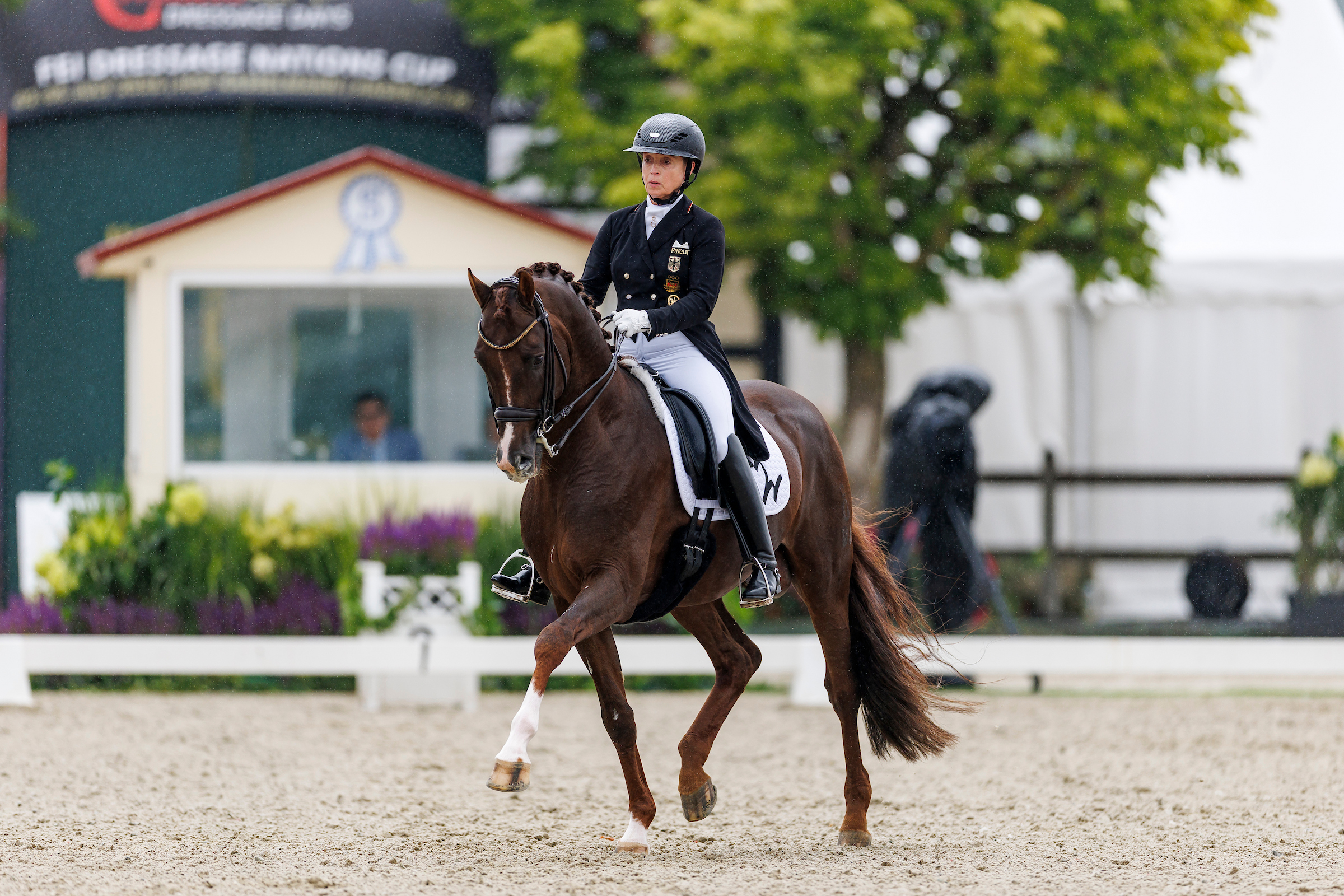
 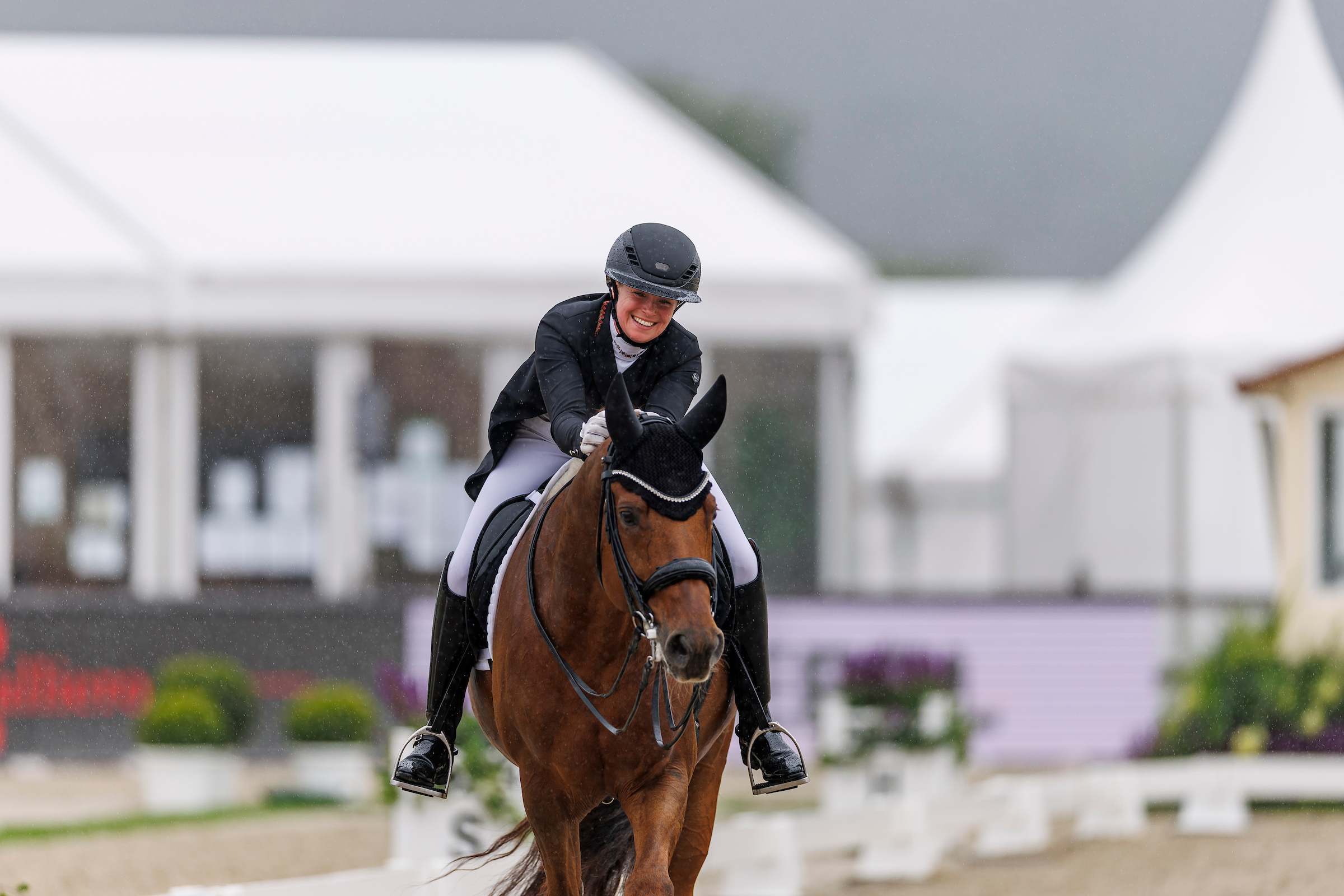 Purzel takes a weight off their shoulders—a crucial Grand Prix victory for Katharina Hemmer and Denoix in Hagen.
Photo: Sportfotos-lafrentz.de
Purzel takes a weight off their shoulders—a crucial Grand Prix victory for Katharina Hemmer and Denoix in Hagen.
Photo: Sportfotos-lafrentz.de As hot as it was last weekend, it was just as rainy at times today in Hagen a.T.W.. That didn’t bother Katharina Hemmer and Denoix. While others were getting stressed and making more and more mistakes, “Purzel” went about his rounds, completely unfazed.
The performance of the 14-year-old son of Destano from Oldenburg had been eagerly anticipated. After all, he had missed the German Championships in Balve, the first mandatory qualifying event for the World Championships in Aachen. But it was clear from the start that, with a strong performance in Hagen, a spot at the World Championships could still be within reach. The pair delivered that performance in today’s Grand Prix—the event in which the team medals will be awarded in Aachen.
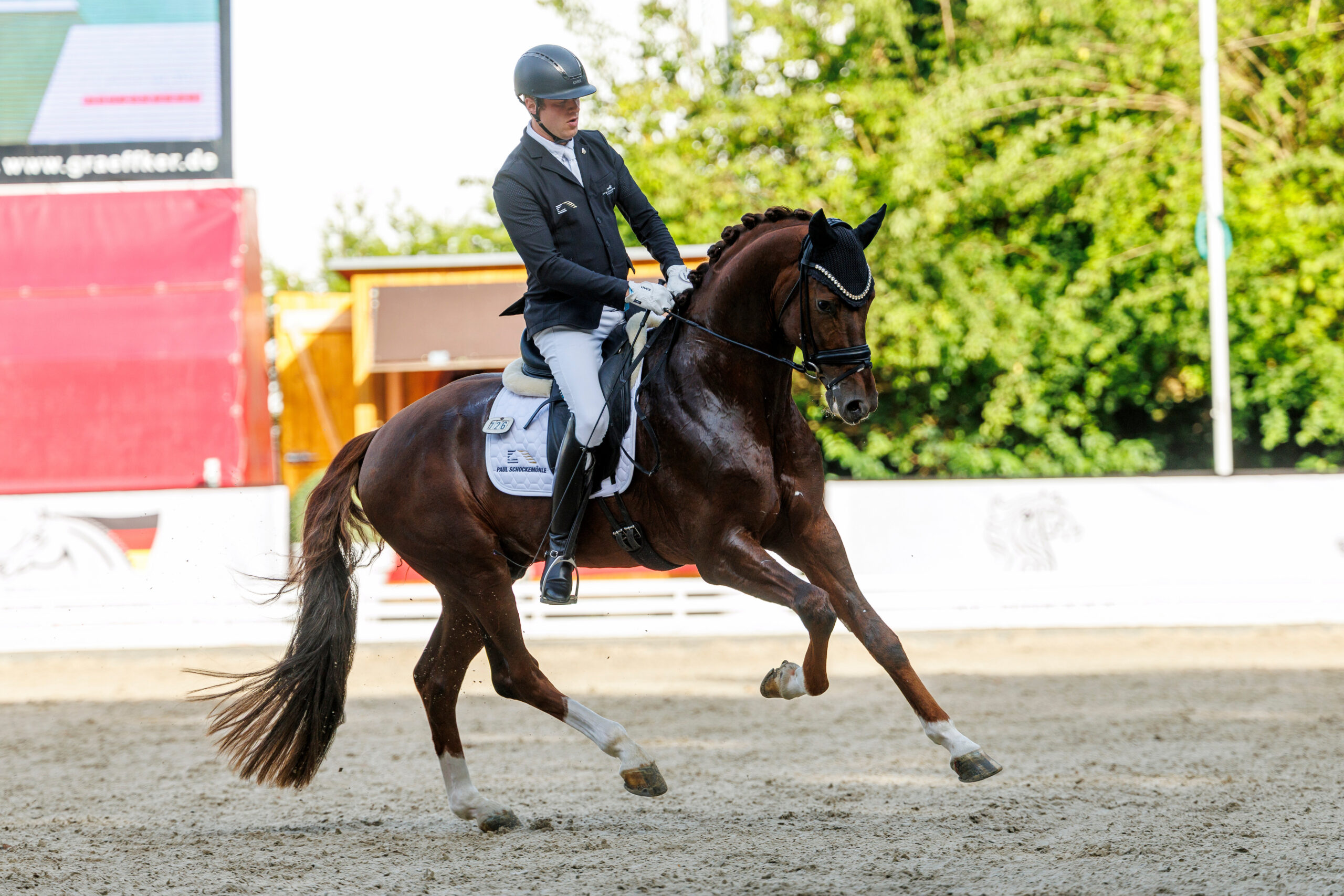
Denoix moved with ease and suppleness, even though Katharina Hemmer was far from taking every risk in the extensions. On the positive side were, for example, the well-executed collected walk, the responsive backing up, the sequence changes, the zigzag half-passes, and the pirouettes. Before the first piaffe, there was a slight tension, which led to a rhythm error. The piaffe went well, though. All in all, it was a very successful performance by the pair, and they fully deserved their score of 77.022 percent.
Weihegold’s grandson before Weihegold’s son
It hasn’t happened all that often that Isabell Werth’spiaffe-passage horse, Viva Gold, hasn’t taken first place on the far left of the podium at an awards ceremony. But today, he had to give way to Denoix. The judges awarded 76.239 percent for the performance, in which the rider’s hand occasionally caused the horse to move backward and the trot sometimes lacked evenness. Mistakes in the double-counting single changes and zigzag half-passes also cost her dearly. There is no doubt whatsoever about the extraordinary talent for the highest collection exercises that this ten-year-old stallion possesses. But here, too, one would have liked to see more suppleness in the back and throughout the body. Second place went to the son of Vivaldi out of Weihronce (by For Romance), a daughter of Weihegold.
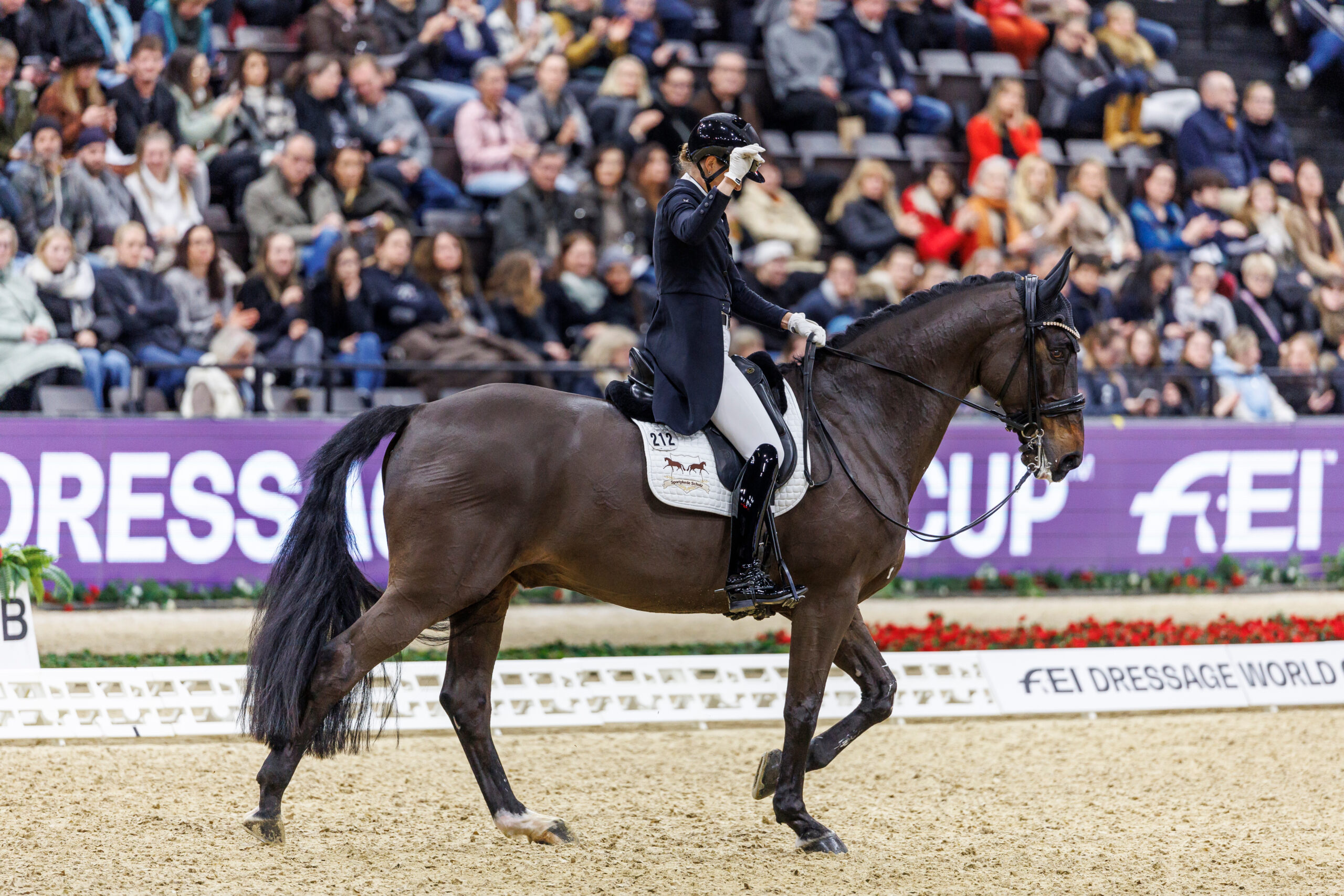
In third place was Total Hope by Totilas, a direct son of Weihegold, ridden as always by Isabel Freese, Norway’s top dressage export. As is well known, Freese has lived in Germany for a long time and is responsible for Paul Schockemöhle’s dressage horses. This includes Total Hope, whom she brought into the top ranks of the sport through victories in the Burg-Pokal and the Louisdor-Preis, and with whom she has already gained Olympic experience. Today, the pair scored 74.783 percent, earning points particularly in the canter. Highlights in the second half of the test were offset by moments when the stallion leaned on his forehand, became tight, and clearly resisted.
Other pairs that stood out
Raphael Netz and Dieudonné were delighted with their fourth-place finish. “Raphi”—who will be stepping in tomorrow for Charlott-Maria Schürmann and Dante’s Pearl in the Nations Cup with Great Escape Camelot—executed the first part of the trot test with excellent extensions, flowing half-passes, and beautiful passages. In the piaffes, the gelding is starting better than before, really taking weight onto his hindquarters and bending his hocks. This is still somewhat at the expense of his activity, but that’s likely just a matter of strength. He’s well on his way. Unfortunately, tension crept in during the canter sequence, which was particularly noticeable in the single changes. The left pirouette went well, while the right one could have used more hock flexion and weight-carrying; in the zigzag half-passes, more collection and bend would have been desirable. All in all, the pair scored 72.283 percent.
Lisa Müller and her Hanoverian stall ion D’Avie —a son of Don Juan de Hus—delivered their best performance of the season so far, not just in terms of scores, with a round that earned 71.261 percent. Müller succeeded in presenting the stallion with a cohesive and nearly flawless performance. One area for improvement is the piaffe and passage, where D’Avie does actively spring from behind but does so with a high hindquarters and leaning on his forehand. Overall, one would have liked to see the kinetic energy flow more smoothly from the hindquarters to the forehand through his body.
The latter is something that can be said of Dr. Svenja Kämper-Meyer and Amanyara M, as well as Tobias Nabben and Forster. However, in the case of Kämper-Meyer and her homebred Ampere mare, one would have liked to see a more supple topline. Forster performed a very beautiful trot sequence with piaffes that were extremely well executed by classical standards. However, his halt before the backward movement was open, and he failed to follow through once during the single changes. Overall, one would have liked to see in the canter sequence the same weight-carrying ability and hock flexion that the gelding displays in the piaffes. With scores of 70.782 and 70.5 percent, they placed sixth and seventh.
Behind them, Benjamin Werndl and Quick Decision took eighth place with 70.304 percent. Werndl made a concerted effort to repeatedly open the horse’s neck and get the gelding to move forward, which he succeeded in doing at times—for example, during the extended canter with a noticeable widening of the frame and a very successful transition back onto the hind legs. However, the Quaterhall son’s mouth was still frequently open and restless. The pair also executed the pirouettes and the final line very beautifully. The first two piaffes lacked energy and were at times not securely balanced.
You can find all the results here.