Interview with master rider Martin Plewa on the importance of training in equestrian sport
Martin Plewa: “Training is the most important criterion for the positive development of sport”
 from Dominique Wehrmann
 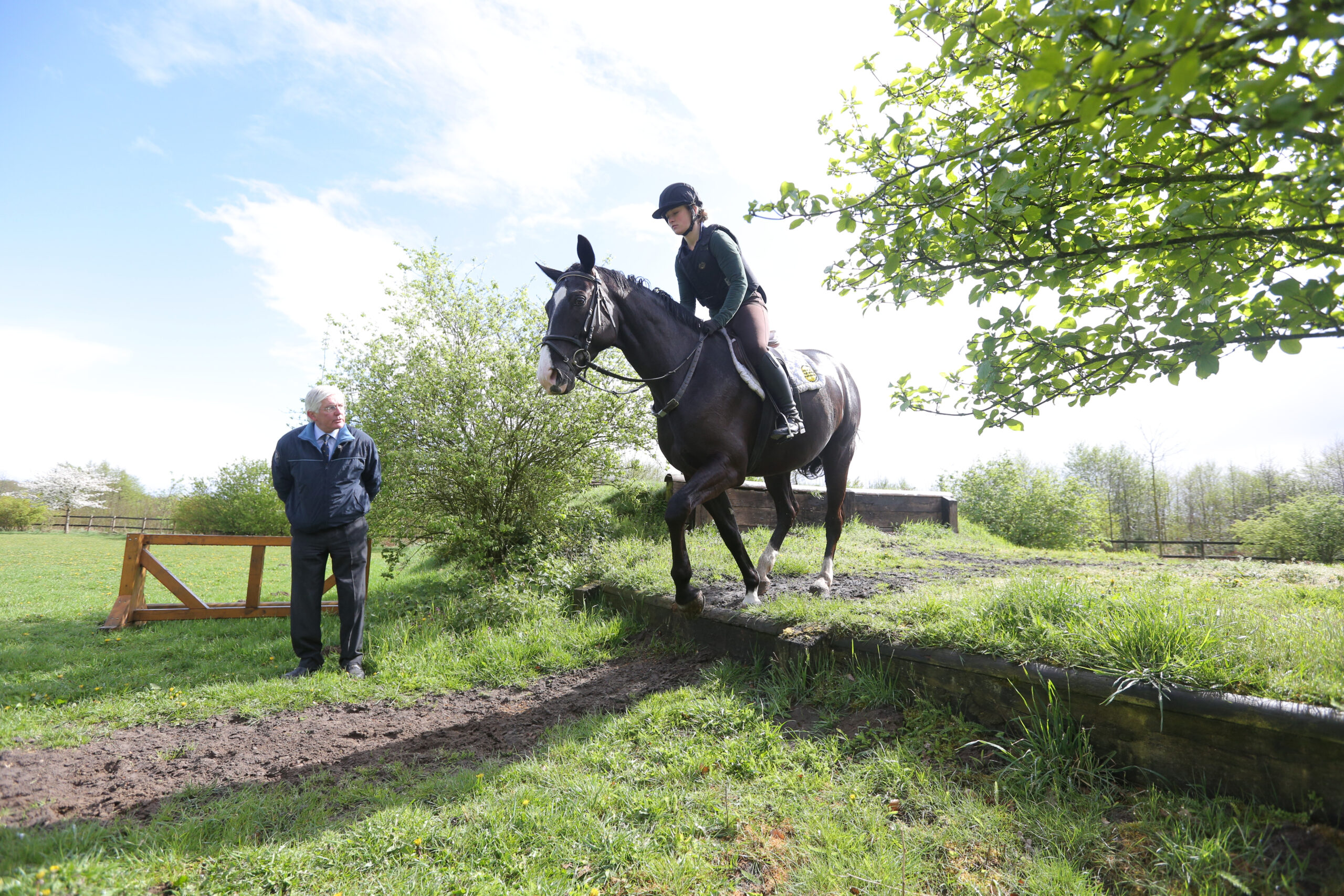 Martin Plewa not only talks about good training for horse and rider, he also practices it. Photo: sportfotos-lafrentz.de
 EQUI PAGES: You mentioned at the “Hot potatoes” forum how important the topic of training is. Do you see a need for improvement here? If so, where and, above all, how?
Martin Plewa: I firmly believe that education and training are the most important criteria for ensuring the positive development of equestrian sport in the future. We do have very good guidelines with an undisputedly excellent riding theory that is based on the nature of the horse. However, we find it extremely difficult to ensure that they are correctly applied and implemented across the board at all levels of equestrian sport. In my opinion, this even applies to top-level sport.
I believe that many riders or trainers do not meet the requirements for horse-friendly handling out of malice, but due to a lack of knowledge of the horse’s needs, including in training and in sport. As a consequence, this can be at the expense of the horse’s welfare and the desired goal of harmony between rider and horse cannot be achieved.
The question of how is not easy to answer, but I would like to mention a few aspects: The subject of riding theory has unfortunately become increasingly less important in examinations (e.g. for riding badges, trainer qualifications) due to new APO regulations; a rethink is urgently needed here.
At shows, incorrect riding should be addressed more clearly, especially the increasing tendency to use the hands and reins to achieve a certain, usually incorrect, head-neck position of the horse. This incorrect riding from front to back is accepted everywhere as a matter of course with the result that horses’ heads are pulled down and necks are made tight.
Tournaments in particular must contribute more to training: e.g. with good judges’ commentaries, commented good riders before dressage or style jumping or additional teaching demonstrations comparable to some seminars of the FN or the national associations. Tournaments to multiply the correct training.
Training could also become more important in our association (the FN, editor’s note). The training department has just been downgraded as part of internal restructuring. It is no longer an independent department, but subordinate to the Sport Department. Unfortunately, the Training Committee was also abolished more than 20 years ago. This committee regularly prepared analyses on all areas of equestrian sport and helped to counteract undesirable developments in good time.
Tournaments to multiply the right training.
Riding yesterday and today
What was different in the past than today?
“In the past” is an elastic term. When I think back to my basic riding training, starting in the mid-1950s, I was very lucky to learn from my father and other excellent horse people, usually (like my father) former officers, who all had a uniform view of correct riding. As far as I remember, this also applied to the judges. Most of them still taught according to the training scale of the 1937 riding regulations, in which contact was only the fourth point and bridling the seventh. After that came collection and development of uprightness.
With this in mind, it is easy to understand why bridles or auxiliary reins were never used in the first place and why a great deal of time was taken to correctly place a horse on all aids. “Standing on the aids” and “letting the reins out of the hand” were the first two basic exercises of dressage riding (see 1954 guidelines); if you couldn’t do that, you couldn’t ride dressage.
Another positive aspect at the time was that every club actually had a riding instructor who was responsible for making decisions about competitions or riding badge tests. The so-called state riding and driving instructors, who regularly visited the clubs to check the quality of training, were also valuable. Today, such tasks would be at least as important as those of the national trainers.
Can you please explain in more detail what the two “basic exercises of dressage riding” were all about?
The principles of “standing on the aids” and “letting the reins out of the hand” apply both to the rider’s training and to the horse’s basic training.
The “leaning on the aids” was carried out from the fully yielded reins both at the halt and at the walk. When carefully picking up the reins, the horse should accept the aids with confidence by increasing the pressure on the leg and not lift itself out. When the reins were lengthened, the horse was expected to drop its neck more.
These exercises in succession took instructors like Mr. Stecken or Mr. Brinkmann hours of work until the desired contact (as trusting contact with the rider’s hand) was established and could be continued in trot.
I still ask my students to do this today, but they now succeed immediately. In clinics, I have to convince many riders of the value of these exercises.
What common misconceptions do you see?
In my opinion, there are misconceptions about the way some horses are ridden in the solution phases. The guidelines don’t mention “setting low” or “riding forwards and downwards”; forwards and downwards only refers to the neck in the stretching position.
There are also some obvious misunderstandings about the execution of parades when they are ridden with hands working backwards alone. In my opinion, the culture of riding with a curb bit has also been pretty much lost. This is often practiced incorrectly and taught incorrectly or not at all.
There are also undesirable developments in the shape of the seat, e.g. a distinctly backward position of the upper body in dressage with sometimes painful impairments of the horse’s back activity or “taking a seat” in the saddle in jumping, even with the upper body upright.
I also often experience misconceptions in connection with the horse’s natural behavior, whereby I am particularly annoyed by a false humanization that blames the horse.
Good trainers versus bad trainers
How can I as a rider recognize a good trainer for myself – or for my horse?
The essential trainer skills are technical, social and communication skills and he must be a credible role model in every respect, even if he rides himself. In addition to teaching in accordance with the guidelines, I also expect “horsemanship”, i.e. the trainer must be able to adapt to each horse individually and make age-appropriate demands that are appropriate to the horse’s stage of development. A horseman always considers the horse’s welfare, which takes priority over the expectation of success. Even if difficulties arise during training, I expect that the goal of harmony is never lost sight of. The student is taught that the horse always gives “honest” answers to rider input. If something doesn’t work out, the horse should never be “blamed”, but instead work with the help of the trainer to find a solution to the problem that is appropriate for the horse.
What are alarm signals?
Alarm signals for the rider are when he becomes increasingly insecure and his actions become less and less precise, perhaps even rougher. It is essential to avoid physically and mentally overstraining the horse. A horse’s muscles must develop positively during training so that it finds it increasingly easy to work under the rider and its level of satisfaction increases. You are on the wrong track if the horse loses its willingness to walk, demands ever greater input and shows recognizable negative expressive behaviour (lack of ear play, open mouth, tail flicking, raised lower lip, tense gait muscles, etc.). Unfortunately, too few breaks are often taken (at a walk with reins held out!), which overstrains the horse’s ability to concentrate and the muscles, e.g. of the neck.
Talking to each other instead of about each other
To what extent were trainers, frontrunners and coaches networked in the past? How did the different departments fertilize each other? Or was there only a barracks tone and cadre obedience?
As far as I have been told and remember, there was an almost daily exchange of experiences between the training officers in the military riding schools. As far as I know, the civilian riders of the time also followed the training paths of the cavalry school, for example. At the time of my training at the DOKR, there were always joint discussions as a matter of course and I received unsolicited advice and corrections from the trainers at the time (e.g. former General Viebig, former Lieutenant Colonel Hans-Heinrich Brinkmann and others) and the top riders there (e.g. Winkler, Meyer, Merkel, von Buchwald and many others). It was no different later at the Federal Training Center (with former General A. Stecken, show jumper H.-W. Johannsmann and many others).
Isn’t there a need for even closer cooperation today (info stewards, social media, social license) in order to prevent failures from occurring in the first place due to a different mindset of the active participants?
Full agreement! A jolt must go through the heads of all horse people! We cannot allow ourselves to overlook riding that is not suitable for the horse. All riders at all levels, but also all judges, stewards and trainers must be aware of this. If we don’t get to grips with this, we will lose more and more credibility as animal welfare activists, who are obviously the people who have the greatest interest in the welfare of the horse and the continuation of equestrian sport.
However, I also think it is important to highlight particularly positive examples and comment on them accordingly, so that the public is aware that we also take our “Ethical Principles of the Horse Lover” very seriously, which state, among other things, that improper handling of horses “must be punished”.
The Xenophon association, in which I am involved (as a member of the supervisory board, editor’s note), has been awarding prizes for particularly horse-friendly riding at tournaments for many years and is also the initiator of the animal welfare prize at the annual national championships. By highlighting positive examples, we can also counter the trend in the so-called social media, where equestrian sport is often maligned.
Don’t riders today have to be so well versed in training that they are empowered to argue well and correctly? Or can they?
For me, part of the training of riders is that I increasingly impart knowledge to them in connection with the lessons, so that on the one hand they can understand and follow the instructions and assistance of the riding instructor, but on the other hand they also have enough knowledge about the nature of the horse and how to handle horses to be able to argue accordingly if necessary.
I recommend every rider and trainer to read the “WertPferd” and “Bildungsfaktor Pferd” studies carefully in addition to the guidelines and ethical principles, which can be found on the FN website, now “Pferdesport Deutschland”.
Ähnliche Beiträge