World Cup Dressage Final 2026: Rules, riders, interesting facts - who will Raphael Netz and Moritz Treffinger meet?
10 things about the World Cup Dressage Final in Fort Worth/Texas
 from Jan Tönjes
 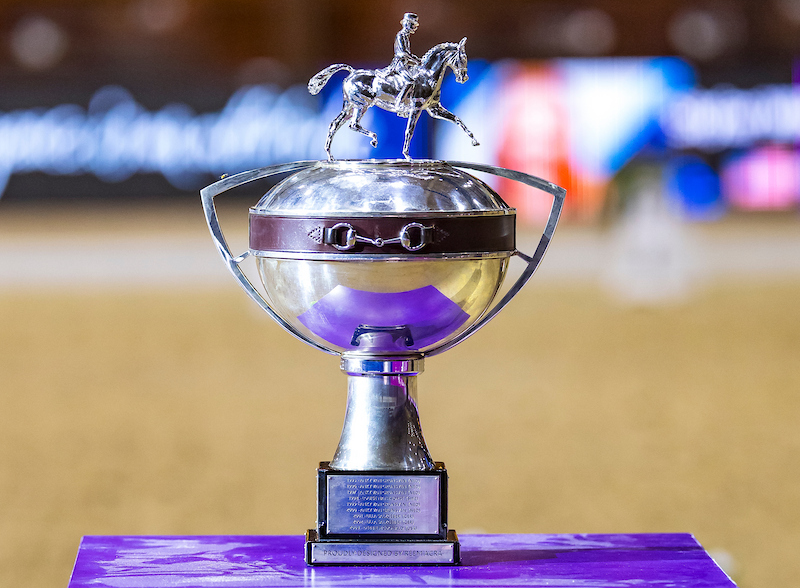 Cup World Cup Dressage Final. Photo: sportfotos-lafrentz.de
 Fancy a little game of association? What terms come to mind when you hear the word “Texas”? Cowboys, steaks, barbecue or BBQ, canyons, desert? Maybe Dallas or oil? This year’s World Cup show jumping and dressage finals will take place in Texas, more precisely in Fort Worth, also known as “Cowtown”. The city was founded in 1849 and soon experienced a boom because it was a central location on the Chisholm Trail, where millions of cattle – longhorns, which still adorn the city’s coat of arms today – were driven towards the slaughterhouses. Fort Worth was one of the leading cities in the meat industry in the second half of the 19th century. The city has one million inhabitants and is located next to Dallas. The cities share an airport.
1) Where will this year’s World Cup Dressage Final take place?
Riding takes place in the Dickies Arena. The multi-purpose arena was inaugurated at the end of 2019, has 14,000 seats on three levels and is located on the Will Rogers Memorial grounds. Rogers (1879-1935) was a cowboy and entertainer and is a legend in the USA. The Dickies Arena also hosts rodeos (Fort Worth Stock Show & Rodeo) and the PBR World Finals (Professional Bull Riders) – a total cowboy feeling. Fort Worth is hosting a World Cup Finals for the first time.
2) Who is riding dressage at the World Cup Final?
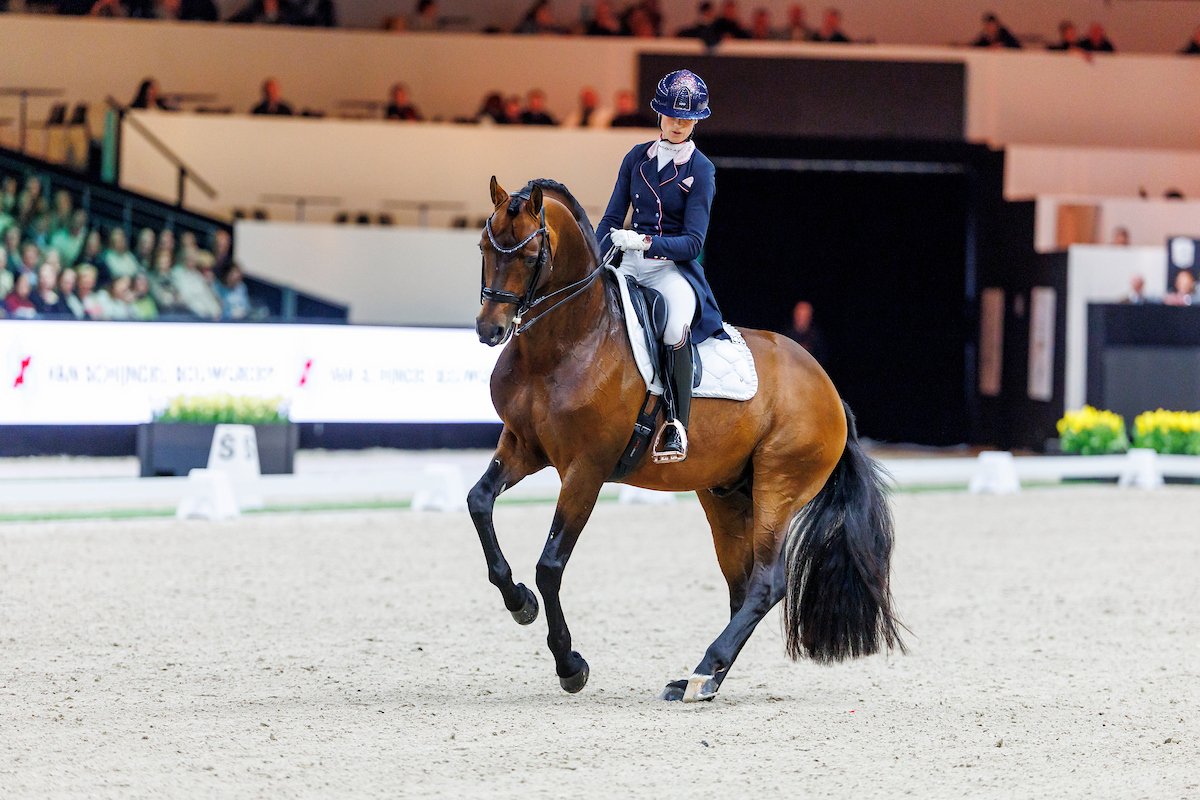
After several cancellations, there are still 16 pairs competing. Four of these horses competed in the Olympic freestyle final in Paris 2024, including the Swede Patrik Kittel with Touchdown by Quaterback. The pair won the final in Riyadh 2024.
Also taking part are Britain’s Becky Moody and the home-bred Jagerbomb by Dante Weltino, Sandra Sysojeva (POL) and Maxima Bella by Millennium and the KWPN stallion Indian Rock. The latter was ridden by Emmelie Scholtens (NED) in Paris, now Christian Simonson is in the saddle of the black stallion – and with great success.
3) Our boys in Texas: Raphael, “Raphi”, Netz and Moritz Treffinger
Both have already been U25 European champions and both have advertised the dressage sport with their good riding during the winter season: Raphael Netz and Moritz Treffinger. This means that two U30 riders will be competing in Texas. But both have more experience than some of their competitors. Both were already successful internationally at pony age.
“Raphi” and “Dieu”
This is the second World Cup Dressage Final for Netz, who has just turned 27. He actually wanted to ride Great Escape Camelot, with whom he finished fifth in 2024. However, a hoof ulcer after the Johnson son tore off an iron prevented him from competing. “Raphi”, as he told us in the podcast ERZÄHL MIR WAS VOM PFERD, had also compiled all the necessary transport documents and blood samples for his second horse, the Baden-Württemberg horse DSP Dieudonné, just to be on the safe side. This enabled him to switch from Camelot to the Dante Weltino son three days before departure. Dieudonné has already broken the 80 percent barrier three times in the freestyle. He finished each of his last two starts in the Western European League with a new personal best. Netz has an extended chance of a podium finish.
His freestyle has “Man in Black” as its leitmotif. There are also other classics from the 1980s, such as “Can’t touch this” and “This how we do it” – the audience should like that.
Moritz Treffinger and Fiderdance
At the age of 22, Moritz Treffinger is the youngest starter at the World Cup Dressage Final. He has taken the stallion Fiderdance by Fidermark with him from Gestüt Bonhomme, where he has been working as a rider for almost three years(EQUI PAGES visited him for a home story). The Oldenburg chestnut stallion has already competed in a World Cup final with Australian rider Simone Pearce.
Moritz’s freestyle is also musically set in the 1980s and 1990s. At the beginning, “In the air tonight” by Phil Collins dominates. Later, Kylie Minogue, the Fugees and Modjo join in.
4.) OLD(ie): Sir Donnerhall II OLD – 20 years young
The oldest horse in Fort Worth will be Sir Donnerhall II. The Oldenburg stallion, bred by Maik Kanitzky, was “built” in 2006. 20 years old, the bay qualified for the World Cup Final for the fifth time with Morgan Barbançon (FRA). At the stables, he only goes by the name “Gus”, after the little mouse in Cinderella, because Sir Donnerhall was simply too long to pronounce, as Morgan Barbançon once revealed.
5) How is scoring done?
All pairs must complete a Grand Prix. The prize money in this competition is 25,000 euros. The winning pair receives 7,000 euros. In this Grand Prix, the main aim is to achieve the minimum score required to take part in the final, i.e. to ride the freestyle. That is 60 percent. What sounds simple has not worked before. The pairs from other leagues, such as the Pacific League, Seerena Ireland and Royalty R from Australia or participants from other, non-league regions, have perhaps not yet seen such large arenas. However, this is not the case for Ecuadorian Julio Mendoza Loor with Jewel’s Goldstrike. The pair are familiar with the large stadiums in the USA, such as Ocala and Wellington, and also competed at the Olympic Games in Paris.
6.) 275,000 euros to be won in the freestyle competition
The freestyle competition is worth 275,000 euros. 150,000 of this will be distributed on the podium. The winner receives 60,000 euros, the runner-up 50,000 and 40,000 euros for third place.
7) Who judges the Dressage World Cup Final?
Following the cancellation of Elke Ebert, there will be no German judge at the World Cup Final. Christof Umbach (LUX) is the chief judge. He will sit at C in the freestyle. He will be joined by Francis Verbeek van Rooij (NED), Magnus Ringmark (SWE), William Warren (USA) and Alice Schwab (AUT).
Dr. Evi Eisenhardt (GER), Liselotte Fore (USA) and Andrew Raplh Gardner (GBR) sit on the Judges Supervisory Panel (JSP), which may intervene in the ongoing assessment in the event of incorrect judging of technical aspects – for example a mistake in the flying changes not seen by the judge.
8) Which lessons are particularly important?
In the freestyle, there are fewer lessons that are included in the assessment with a double score. For example, the walk, which is multiplied by a coefficient of two in the Grand Prix and Grand Prix Special, is “only” included in the single score. In total, there are four movements that are multiplied by a factor of two: the canter pirouettes to the left and right, passage (at least 15 meters straight ahead) and piaffe (at least ten steps on the spot).
9) When do you ride?
Fort Worth is seven hours behind German time. When Germany goes to the table at 12 noon, it is five o’clock in the morning in Texas. For dressage fans who want to follow the livestream on Clipmyhorse, this means short nights. On April 9th, Thursday, the Grand Prix will start at 7 pm local time, which is 2 am on Friday in Germany. And the decisive freestyle is scheduled for April 11, i.e. Saturday in Texas at 7 pm. Kürfans should therefore set their alarm clocks for Sunday, 2 am.
10) Where are the results?
If you are looking for the current schedule and results, you will find them here.
Podcast tips
ERZÄHL MIR WAS VOM VFERD, the podcast with Anja Nehls and Jan Tönjes, dealt with the World Cup Final in three episodes.
“Company World Cup with Raphael Netz” – once Upper Bavaria-Texas and back