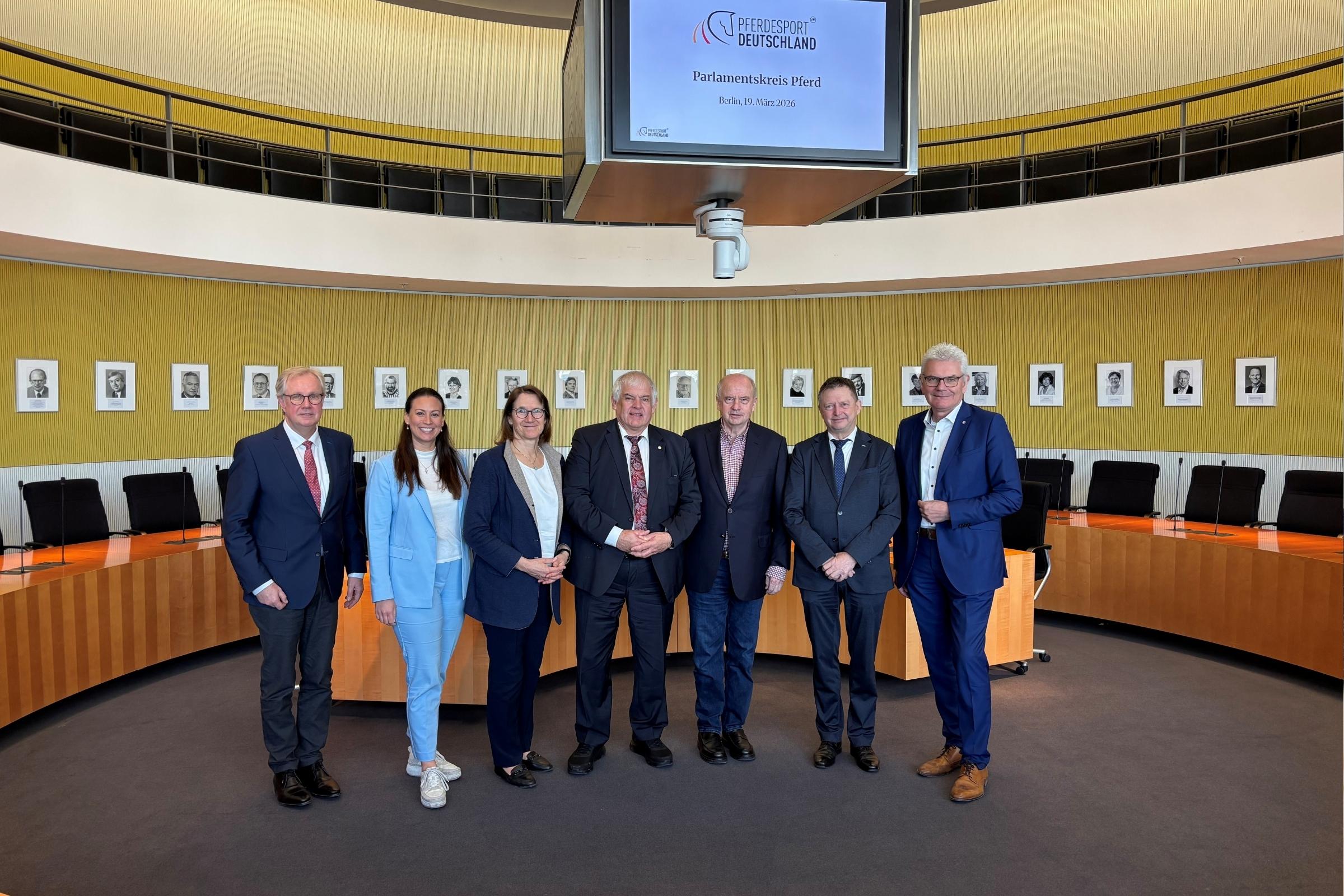
The FN delegation consisted of two people: President Martin Richenhagen and Dr. Klaus Miesner as Board Member for Breeding. In Berlin, they met members of the Bundestag Dieter Stier (CDU), Dr. Franziska Kersten (SPD), Hermann Färber (CDU), Artur Auernhammer (CSU), Caroline Borsbach (CDU) and Johannes Winkel (CDU) for the parliamentary group on horses.
GOT – “complete questioning” required
A central topic of the discussion was the scale of fees for veterinarians (GOT), which has posed problems not only for individual horse owners but for the entire sector since the 2022 amendment. The future of horse keeping in Germany is at risk as a result. Martin Richenhagen explained: “We are seeing the increasing financial strain on horse owners, which is leading to significant declines in breeding and sport.” Dr. Klaus Miesner demanded: “We now need a clear political commitment and the legislative will for a complete review of the GOT.”
Step by step, the horse should “finally be classified as a farm animal with legal certainty at European and national level”. “Because,” says Dr. Klaus Miesner, “many legal requirements must be met when keeping horses in the same way as other farm animals, but with the GOT the horse is incomprehensibly no longer a farm animal”.
Realism in dealing with the wolf
After the Bundestag approved the inclusion of wolves in hunting legislation, Miesner and Richenhagen thanked the MPs for their political support in this matter. At the same time, they demanded that the reasonableness of herd protection measures must be appropriately assessed and, especially with regard to “problem wolves”, the assessments must be realistic and taken into account accordingly in the ongoing legislative process.
Political support for genomic selection databases
Genomic selection, which is set to play an increasingly important role in horse breeding, was a major topic of discussion. Dr. Klaus Miesner explained how far development in this area has progressed and that genomic selection will be important for mating decisions with regard to the health and resilience of horses and thus also the sustainability of breeding. However, this requires reliable data. According to the FN, political support is needed to build this up. The data is particularly important with regard to health characteristics in order to further develop breeding in a “targeted and responsible” manner.
Yes to the Olympics
Germany’s bid to host the Summer Olympics was also discussed. The FN made it clear that it very much welcomes this step. In the association’s view, the bid is an important signal for the future of equestrian sport in Germany and long-term sport promotion is also of great social importance in non-Olympic sports.
Speaking of social importance – the role of the horse within society, but also as an economic factor, was also emphasized once again at the meeting.
Exchange desired
According to FN, Richenhagen and Miesner went on to emphasize that there should be regular exchanges on topics such as those discussed at the current meeting in Berlin. The aim is to achieve “practical and legally secure solutions”. This is also important in terms of competitiveness within the EU.
In fact, Equestrian Sport Germany and the Parliamentary Circle for Horses had agreed to continue the exchange.