Commentary on the innovations at the Bundeschampionat
The innovations at the National Riding Horse Championships – an analysis
 from Dominique Wehrmann
 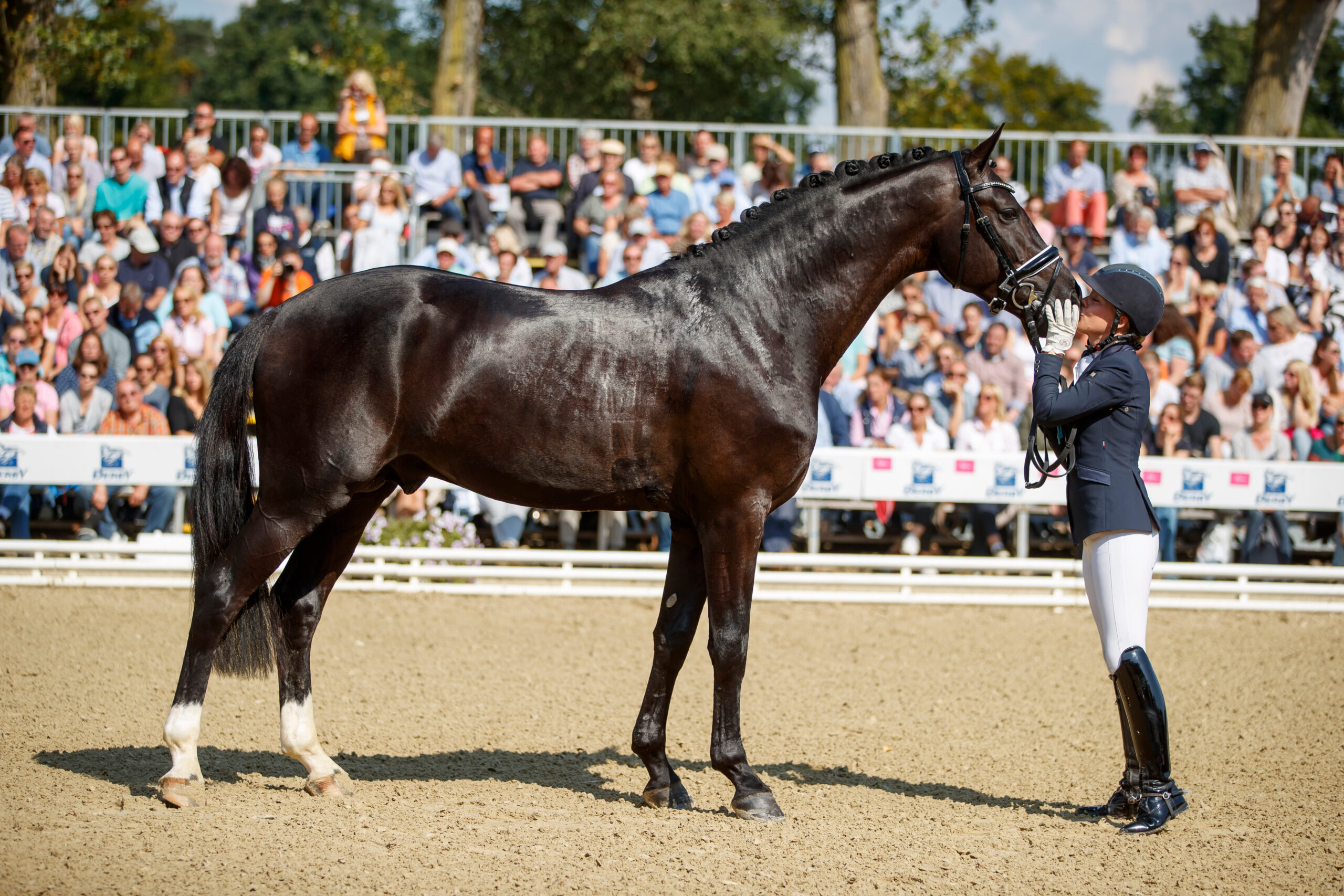 Secret with Jessica Lynn Thomas at the 2017 Bundeschampionat. photo: sportfotos-lafrentz.de
 Only one test for three-year-olds, an advanced (A) level dressage horse test in the final for four-year-olds instead of the external rider test, the abandonment of pre-examination in hand – these are indeed drastic measures that the working group set up at the first “FN Young Horse Summit” has decided on. According to the FN, aka Equestrian Sport Germany, the aim is to “prepare young horses for their sporting careers in an even more age-appropriate and gentle way”. I asked myself whether these measures are suitable for achieving this goal and came to a mixed conclusion.
Should the exams for three-year-olds generally be abolished?
The three-year-olds. An eternal topic. For years, there have been calls to abolish the tests for three-year-olds at the Bundeschampionat. There is a conflict of interest here. Breeders and breeding associations have economic reasons for showing their youngest horses under saddle at the “Showcase of German Horse Breeding”. After all, horses are also bred to be sold. And that is a good thing. After all, there are far more riders than breeders in Germany and if everyone bred just for themselves, the demand for horses could not be met.
So it is actually in the general interest to present young horses in the best possible way. And from the seller’s point of view, it makes sense to tackle this sooner rather than later in order to keep the cost pressure down – which at best also benefits the buyer if he has to pay less for a three-year-old who has not yet had so much money spent on him than for a four-year-old. So: Yes, there are understandable reasons for continuing to allow three-year-olds to compete at shows and the Bundeschampionat – especially as it is only a tiny fraction of the total population that makes it here anyway.
In fact, there are some examples that prove that the horses do not necessarily suffer lasting damage – Weihegold OLD, for example. Or Desperados FRH. Or Damon Hill NRW. Whether young talents one day become medal winners or “only” regionally successful sport horses or whether they disappear into oblivion is rarely decided by the question of whether they went to the Bundeschampionat as three-year-olds, but rather by what their training path looks like up to that point and beyond.
It is debatable whether horses are not “still babies” at three years of age and should be put out to pasture, etc. But there are now studies that have found that moderate early training is actually more beneficial than detrimental to the health of riding horses – it’s all about the how. This brings us to the next point.
Only one instead of two starts for the three-year-olds
How can you present three-year-olds in front of a large audience in a horse-friendly way? Hardliners say: not at all. The FN says: by only letting them go once. I ask myself: What difference does it make whether they go once or twice if, for example, three-year-old (and also four-year-old) horses with a wrong bend that is clearly visible to non-judges get a 9.0 in the rideability score? It is easy to see from the incorrectly trained musculature and the corresponding head and neck attitude that these horses have been trained incorrectly to date. It would probably be more sustainable in terms of horse welfare to signal more consistently that you don’t want to see a certain type of riding and thus hopefully make the horses’ everyday lives more positive.
Now the FN has emphasized in its communication on the new regulations that the characteristic “rideability” will remain as a partial score, “but with a special focus on the age-appropriate fulfillment of the criteria of the training scale”. This is a phrase that regular onlookers at the riding horse arena can say by heart. Klaus Blässing repeats it year after year at every riding horse and riding pony test at the Bundeschampionat weekend. So this is nothing new. But talking is one thing, acting or judging is another …
It is certainly less stressful for the horses if they only have to walk once. At the same time, they have to “work” immediately. There is no second chance. Will this lead to more drastic measures in the preparation? Possibly. In any case, they will be spared two more days in the stable tent, which is a real stress factor, especially for most stallions.
Four-year-olds – no more external rider test, but an A dressage horse test instead
It’s a pity that the external rider test has now been abolished for four-year-olds too! That was my first thought. Because that was actually the most interesting part of the whole championship. It was completely understandable for the three-year-olds. Not all, but many of them showed that they were tired and exhausted by their third appearance in the arena. For the four-year-olds, the change of rider seemed reasonable, even if the horses are in the arena once more and this is certainly also a stress factor for them.
But from a spectator’s point of view, it was very interesting. Here you could see whether the horses really have quality or whether they were “made” by a strong young rider. Some horses also underwent an amazing transformation for the better when, for example, a rider like Carina Scholz was in the saddle. With the abolition of the third-party rider test, the Bundeschampionat has been deprived of a further element of objective assessment, which sometimes turned the judges’ verdict in a different direction. This has always been understandable and has led to the right horses coming out on top. But admittedly, it is easier on the horses without a change of rider – but it shouldn’t have done them any lasting harm either.
As far as replacing the second test for young riding horses with an advanced (A) level test for young dressage horses is concerned, this seems to be the right step and should also ensure more equality of opportunity, which is not always the case when, for example, a large horse with a lot of scope has to walk behind a stocky youngster. And anyone who thinks that a dressage test for young horses should not be expected of four-year-olds – the same is required in terms of content as in a test for young riding horses.
Friends, where are you?
It is questionable whether omitting the standing grandstand between the warm-up arena and the test arena will contribute significantly to horse welfare. So that the four-year-olds don’t have to go into the arena alone in their class A dressage horse test, the next horse could have been sent into the arena with them, as was customary in the sport test.
Otherwise, this conversion measure could just as easily cause more unrest among the horses. Even now, some horses pull very energetically towards the exit when they walk along the long side of the judges’ tower on the left hand side. If there is no longer even a visual boundary and the mates can be seen on the other side, it remains to be seen whether this will lead to even more horses leaving the arena prematurely.
No more conformation assessment – why?
Another measure for both age groups: Patterning by hand is no longer necessary. I ask myself: Why? The Bundeschampionat is supposed to be the “showcase of German horse breeding” and judging a horse from a breeding perspective involves looking at it without a saddle. Instead, the quality of the conformation should now be judged under saddle and taken into account in the overall impression score. But if the judges in previous years have already given a horse standing in front of them with four differently shaped hooves a score of 9, how are they supposed to judge the quality of the conformation when the horse is in motion? And at the pre-sampling, not only the judges but also the spectators were able to get a more comprehensive picture of the horses, both in terms of conformation and interior – which is not entirely unimportant for a breeding event where you can see the direct results of matings as well as future sires.
Removing the pre-judging from the program seems less like a pro-horse measure and more like a pro-schedule measure and to spare the judges’ souls, because these were the occasions when the impartial judges had to put up with whistles – and sometimes rightly so.
But as FN Breeding CEO Dr. Klaus Miesner said: “We will evaluate very carefully whether the measures we have decided on have the effects we want.” We are curious.
Ähnliche Beiträge