LPO changes 2026: End of wheel spurs, new bits and more options around the nose
LPO changes 2026: From the end of wheel spurs to explaining bridles
 from Jan Tönjes
 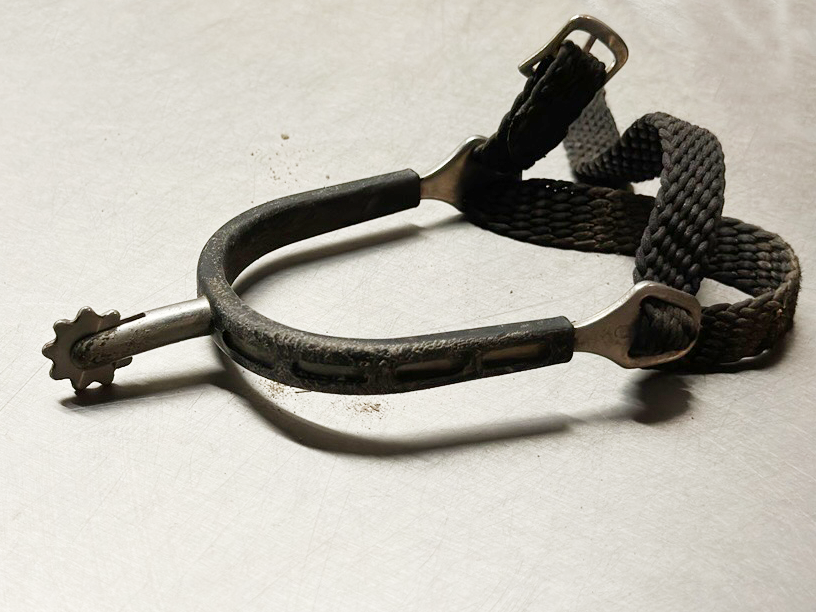 Wheel spurs with spikes are no longer allowed at tournaments since January 1, 2026 Photo: EQUI PAGES
 The fact that the 2026 LPO amendments also allow colored saddle pads in dressage was crucial news for some competition riders. But even more relevant are the modifications to the 2024 Performance Testing Regulations (LPO) that affect animal welfare.
No longer “on the ball” – disarmament of wheel spurs
Wheel spurs with prongs have had their day at tournaments. In general, spurs with a maximum length of “4.0 cm, measured from the boot (including freely rotating wheels, if applicable, without prongs” are permitted. This means that wheel spurs are only permitted at tournaments with a vertically or horizontally movable disk. This also applies to the variants with a movable ball at the end of the spur. In addition, permitted spurs are now eleven percent shorter. Anyone who is not so good at arithmetic should definitely measure: The length is now limited to 4.0 instead of the previous 4.5 centimeters – measured from the boot.
A look into the mouth – LPO change 2026: Bits
Anyone who rides their horse on a curb bit now has a more clearly defined choice of bit materials. There is explicit mention of “different” materials, “e.g. metal, rubber, plastic, leather”. These can also be combined. The material of the bridle is also no longer limited to “metal and/or plastic” as before.
In addition, flexible curb bits are now also permitted for curb bits. In the case of side pieces, i.e. upper and lower beams, fixed but now also “rotatable around their longitudinal axis” suits are permitted. The definition has been clarified.
Jumping – larger selection of bits
Since January 2026, jumping curb bits and Baucher bits have been permitted in all show jumping and cross-country classes from novice level. This also applies to show jumping and cross-country classes from novice level.
It is clearly defined how the reins are attached to the Pelham in accordance with the rules, “in the bar from the middle to the lower ring or a pair of reins in the middle ring”. How the jumping curb bit, which, unlike the Pelham, does not have any elevators, is to be correctly buckled is also one of the innovations in the edition of the LPO that has been in force since January 1, 2026:
– the cheek piece must be buckled in the upper, small ring
– prescribed rein attachment: one pair of reins in the large ring or in one of the smaller rings/half rings or slots
– if a chin chain is (optionally) used (see illustration c.) Pelham): movable chin chain; chin chain pad mandatory made of leather or soft rubber/plastic; chin chain hooks must be freely movable; shear straps permitted
– bit plates permitted
– permitted with broken centerpieces and bar centerpieces
– a combination with Hannovian noseband is not permitted
What is hidden in this list: The chin chain, which reinforces the effect of the Pelham on the lower jaw, also has the function of ensuring the position of the bit in the intended place. According to experts, without a chin chain, the Pelham bit could exert undue pressure on the corners of the mouth “in the heat of the moment” if the rider were to apply a lot of pressure by hand.
“I have no idea what I strapped in there…”
From class M** in show jumping, in M cross-country tests as well as in the two partial tests cross-country and eventing from class M onwards, the following still applies: Anything goes as long as the bits conform to the riding theory (guidelines for riding, driving and lunging) “and comply with the principles of accident prevention and animal welfare”. However, a crucial sentence has been added to the regulations: “Bridles must be justifiable in function and mode of action by the participant upon request by the judge”.
Wrap bits?
Latex bandages are becoming increasingly popular in the horse’s mouth. Anyone who thinks they need to wrap the bit of their bridle with it is welcome to do so. However, the specified bit thickness including the latex wrap must be maintained. Very important: In tests where bar bits are not permitted, the latex must not cause the broken snaffle bit to become a bar.
How do you feel about the noseband?
Since last year, there has been an international measuring wedge that checks how much space there is between the noseband and the horse’s nose. In other words, a stop has been put to “slammed” nosebands. At German shows, which is new in 2026, the measuring wedge “may” be used to check the noseband. Otherwise, the “two-finger rule” still applies (“one to two fingers for an English or combined noseband”).
If you want to do without a noseband, you can omit any form of noseband from show jumping tests from class M**, cross-country tests from class M, cross-country and jumping in eventing tests from class M. This is not new, but here too the sentence has been added stating that the function and mode of action must be justifiable.
Focus on the horse’s leg in LPO amendment 2026
Little has changed with regard to leg protection. It has been added to the general explanations that combinations of permissible leg protection are permitted. Bunion protection is permitted in presentation ceremonies and in the warm-up arena of all types of dressage competitions. The addition that the coronet band must remain free has been deleted.
In show jumping competitions, you can generally compete with pads that do not restrict the hoof mechanism. Since New Year 2026, show jumpers may be bandaged on the hind legs under the gaiters. The sentence excluding this until 2025 has been deleted. “Gentle underlays without compression effect” with tape attached to the hoof are now also expressly permitted in all show jumping competitions. The same applies to fetlock straps.
Hoof boots are no longer permitted in familiarization (including jumping), riding horse and aptitude tests as well as aptitude tests with cross-country terrain
Protection of the sensory organs in the LPO 2026
The use of nose nets/nose covers has generally been less restricted since January 1, 2026. The same applies to ear protection. However, the field of vision and ear clearance may not be restricted. Ear protection may now also be connected to the noseband again. Only the fly mask remains taboo if you want to overcome jumps in the warm-up arena. The following also applies here: “It must be possible to assess the horse’s expressive behavior”.
Nose tapes are permitted in all performance tests.
Auxiliary reins
A sliding ring martingale is now permitted in competitions under the rules of the WBO (competition regulations) in lead rein and riding competitions.
The regulations can be read in detail in the “mark-up version” of the LPO equipment catalog. Here the changes are highlighted in red (mark up).
Pony-friendly design
Sometimes the change of one verb in a set of rules can make a big difference: “If horses and ponies start in a class E to class M* class. E to class M* (previously it said “shall”) the distances in combinations and/or distances with up to five canter jumps must be adjusted for ponies.”