Vocal aid allowed in dressage in the UK
Braaav, my fat man – vocal assistance allowed in the UK!
 from Jan Tönjes
 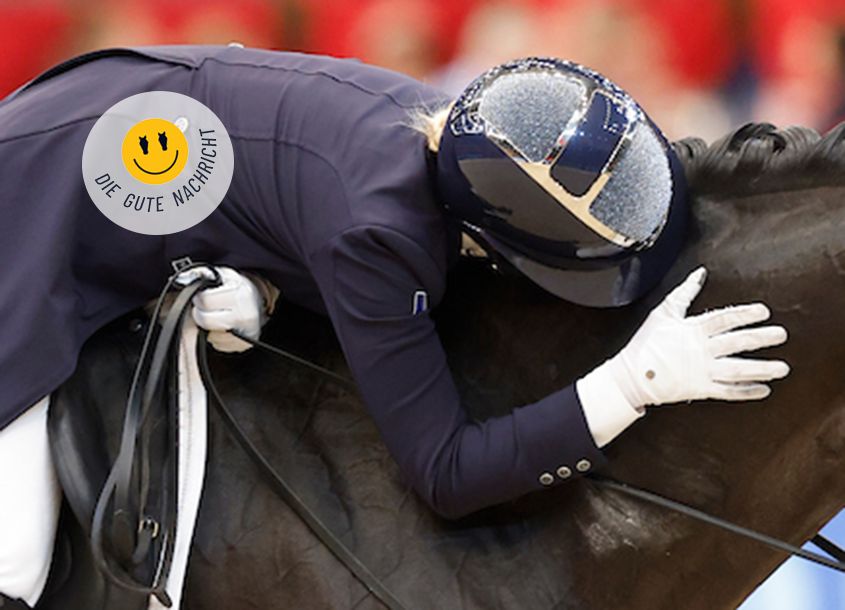 Good news from Great Britain: Vocal aids have been permitted in dressage there since January 2026. Photo: toffi-images.de
 It is impossible to imagine equestrian sport without voice aids, just like weight, leg and rein aids. Videos of training rides and cross-country rounds in which Olympic champions Jessica von Bredow-Werndl and Ingrid Klimke motivate their horses with their voices are almost legendary. What is OK in training is frowned upon in dressage competitions. At least in this country. In Great Britain, things have recently changed.
Vocal aid allowed in the UK
In the United Kingdom, it has been permitted since January 1st to use a clicker and voice aids to calm the horse, even in competition. The responsible institutions, British Dressage and the British Riders Club, agreed on this last year. “With immediate effect, riders may now use discreet vocal aids in their dressage competitions to provide support by means of natural aids – such as tongue clicking. However, the use of the voice must remain unobtrusive and must not distract or disturb other riders, horses or officials,” says the British Dressage Association. And even more clearly: “Foul language and obscenities are not permitted and will result in disqualification”.
However, this does not mean that you are allowed to click and say “zuuuurück” (or rather “step back”) all the time. The voice aid is still not permitted at championships and various other competitions. “At championships, the use of the rider’s voice is penalized with a deduction of two points from the score that would have been awarded for each lesson in which this occurred”. So the same applies here: Shut up and ride!
Vocal aid in Germany
In Germany, voice aids are not permitted at tournaments. The performance test regulations (LPO) governing competition sport are based on the guidelines for riding and driving published by the German Equestrian Federation (FN). They state: “The voice, whip or spurs may be used selectively to improve communication with the horse or to support and refine the aids. However, they are not a substitute for riding aids.” In other words, the desired ideal is a rider who communicates silently with her horse using only signals from her body.
How well does the horse hear?
The horse’s ear is far more sensitive than that of humans. While we can still perceive frequencies up to approx. 20 kilohertz (kHz), the horse’s spectrum reaches up to 33 kHz in the high frequencies. This means that horses can perceive sounds that we can no longer hear. Hearing plays an important role in horse communication, not least because horses, as flight animals, are dependent on being able to detect approaching predators in good time. Accordingly, horses are “good at listening”. This is why the benefits of stringent vocal aids are emphasized, particularly in relation to lunging, but also for training at home.
Similar posts