




Ingrid Klimke


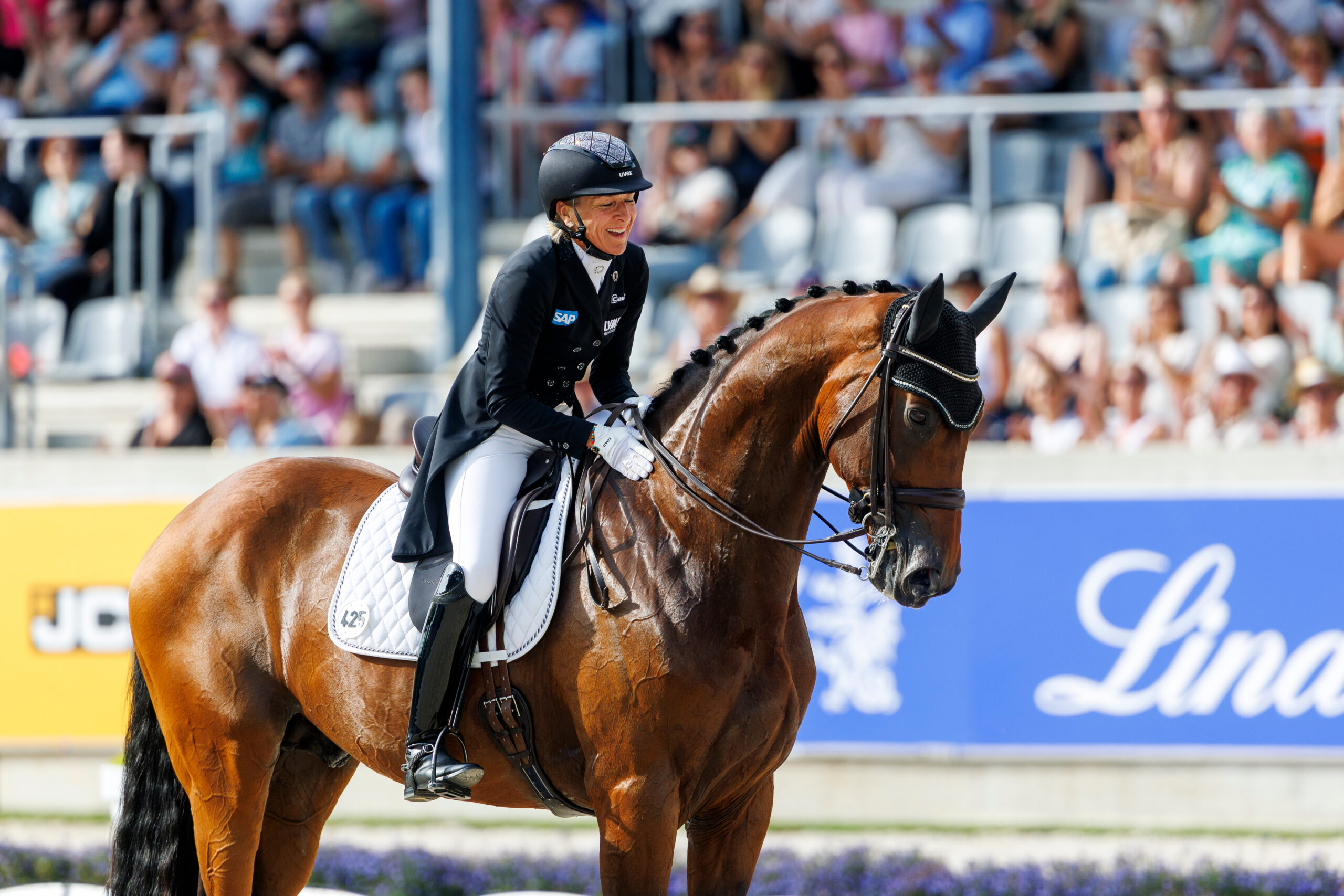
Ingrid Klimke. Photo: toffi-images.de
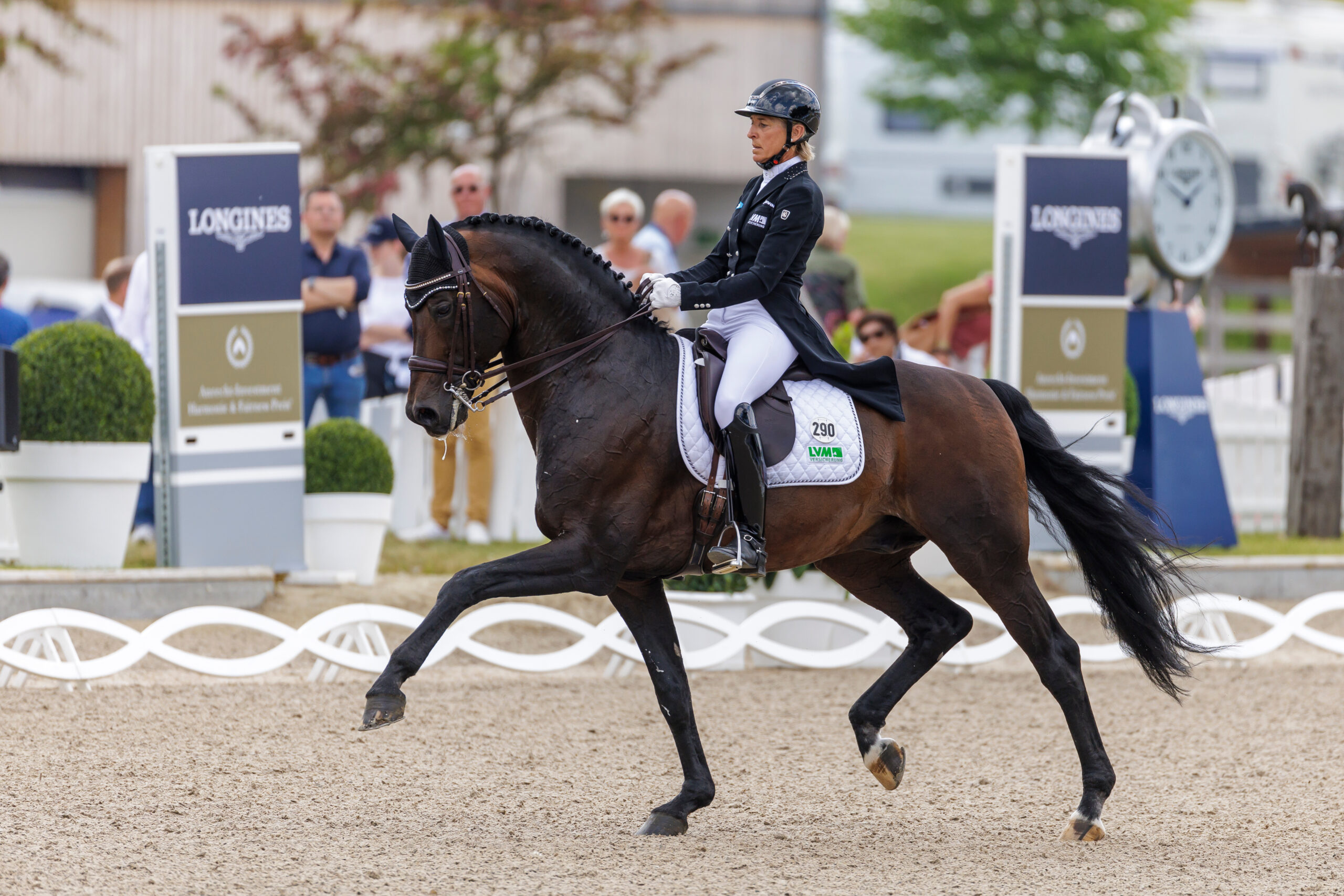
I for Icon, I for Ingrid Klimke. You can recognize a Klimke in the saddle from afar – by the correct, calm seat, the discreet action and the way the horses are ridden. This applies to Ingrid Klimke, but also to her daughter, Greta Busacker. She is now the third generation to enjoy watching her ride. Dr. Reiner Klimke made the Klimke name world-famous. His daughter and granddaughter are carrying on his legacy.
It must not have been a pleasant experience to start competing with this surname. Ingrid Klimke once revealed in an interview with the FEI:
“When I was young, people would say when things went well: ‘Oh, a typical Klimke result’. And if I made a mistake, they would say: ‘A Klimke should do better than that’. That’s why I always say to my daughters (Greta and Philippa), don’t worry, you can’t please other people. But you’re not doing it for others, you’re doing it for yourselves because you love the sport and the horses.”
When she has been successful, Ingrid Klimke never forgets to mention her father. He was always one of her role models. She has long since caught up with him in terms of popularity and almost in terms of success.
Dream job
The Münster native was born on April 1, 1968. Due to her family background, horses have been part of her everyday life since her earliest childhood. However, she initially took a different career path after leaving school, training as a bank clerk and studying primary school education up to her first state examination. But her true passion was horses. Unlike her father, who remained an amateur all his life and trained his horses in the morning before work, during his lunch break and in the evening after work at his law firm, the master of equine management turned her vocation into a profession – against the wishes of her father, who feared that her attitude towards horses might change if she was forced to sell them. But even though she usually followed a lot of her father’s advice, Ingrid Klimke didn’t listen to him here. She found her own way to realize her motto “Ride for your pleasure”.
Today, she runs a competition and training stable at Hof Jankord in Münster, which is home to horses of different talents, ages and training levels, from remonte to championship crack. It was here that Damon Hill first became a two-time world champion for young dressage horses and then a Grand Prix horse. Here, the inconspicuous half-breed Hale Bob OLD became a two-time European eventing champion. To name just two examples.
At home in all saddles
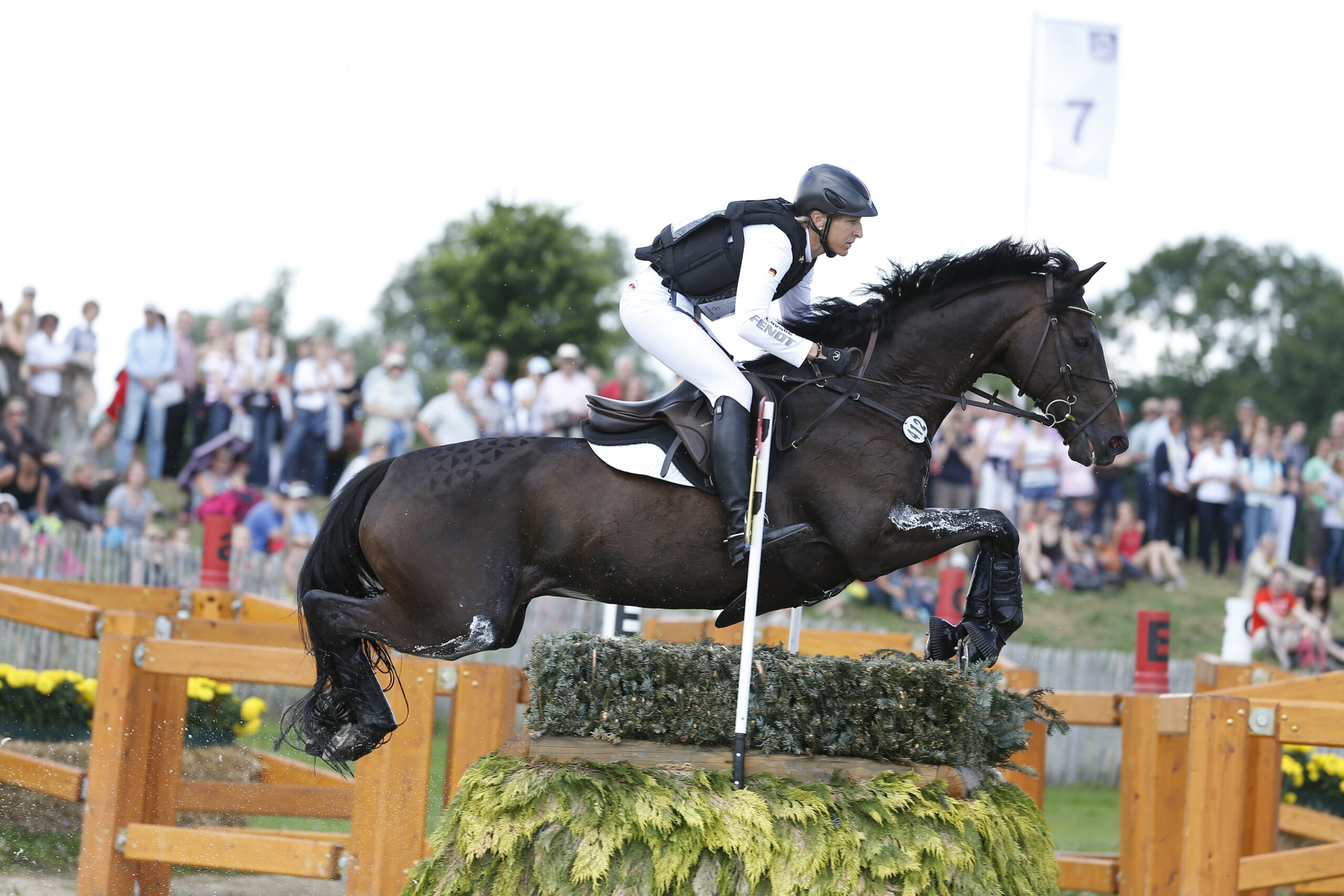
Ingrid Klimke also has a family history of versatility in the saddle. Before her father dedicated himself entirely to dressage, he was successful in eventing and represented the German colors at the 1960 Olympic Games in Rome, back then with the mare Winzerin. However, the distribution key is different for father and daughter. Father Klimke devoted perhaps 25 percent of his career to eventing, but by far the largest part to dressage, and then exclusively. Daughter Ingrid was a mainstay of the German eventing team for many years, but always rode dressage and show jumping at the same time.
In all three disciplines, Ingrid Klimke benefited from lessons from some of the best in her field. The people who shaped her riding were her father and later Paul Stecken in dressage, Chris Bartle and Hans Melzer in eventing and Fritz Ligges and Kurz Gravemeier in show jumping, as well as international greats such as Ian Millar and Anne Kursinski, with whom Klimke attended courses and completed internships.
The first companions
And she benefited from her four-legged teachers. To this day, Ingrid Klimke’s first own horse is one of her favorites. It was the Trakehner stallion Pinot. Klimke got the stallion under the saddle when she was 15. He was six years old at the time. The pair progressed from A-level dressage and A-level show jumping. The following year, they competed in elementary class. In 1985, they won their first ribbon in an elementary class dressage test. This was followed in 1989 by their first starts in advanced (S) level dressage tests and in an medium (M) level eventing competition. There was never a performance where the two of them did not win at least one ribbon. They also traveled abroad together and were placed in a large M-level eventing competition in Flyinge. In the dressage arena, they competed up to Intermédiaire I level. Pinot was neither a lamplighter nor blessed with boundless ability. For Klimke, he was first and foremost what most people look for in their horses: a friend. A horse with whom you could ride bareback, who would mount on command and with whom you could grow up together. Pinot succumbed to the consequences of colic at the age of 21. He was owned by Ingrid Klimke until his death.
Another great teacher was the Westphalian palace son Patriot. The chestnut with three white legs and a narrow blaze had not yet been broken in when Klimke’s father entrusted him to her for training, convinced that the time had come for her to train a horse herself. So Ingrid Klimke started Patriot, paid the price in the form of bruises for mistakes (too much lunging + too much oats = too much power = high bucking jumps), but didn’t give up. She turned Patriot into a winner both in the arena and on the course – right up to the highest classes. With Patriot, Ingrid Klimke rode (and won) her first Grand Prix competitions as well as her first advanced (S) level show jumping competitions. This sometimes led to confusion. She wanted to compete in dressage and show jumping at the Westphalian Championships, which are held at advanced (S) level for senior riders. This was new, it had never happened before. The registration office first had to clarify whether this was even permitted.
Career in the bush
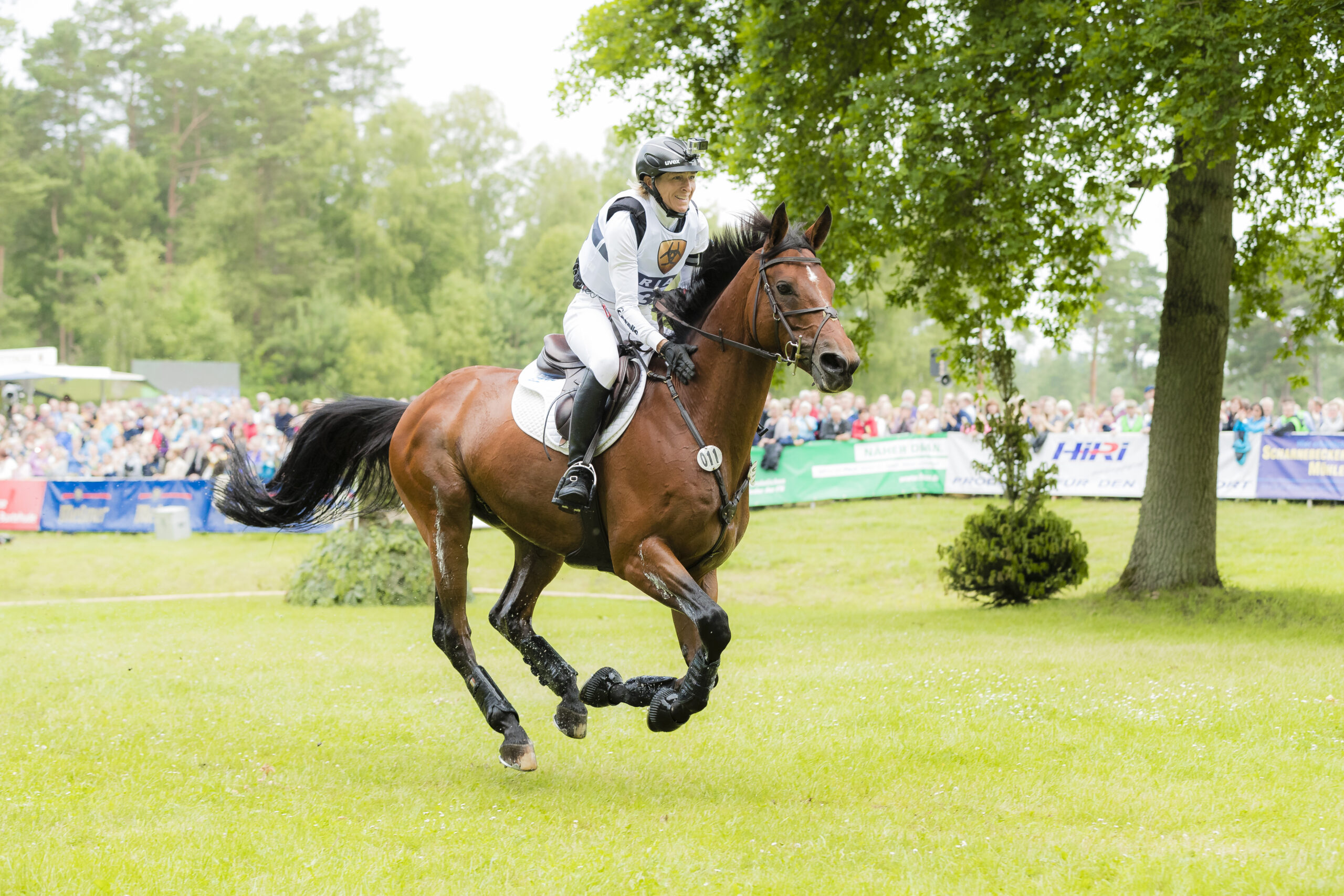
Klimke’s first championship horse was the thoroughbred Sleep Late. He was born in Great Britain in 1991, but did not become a racehorse, but came to Germany through the chairwoman of the DOKR Eventing Committee, Dr. Annette Wyrwoll. She had discovered the gray horse in Ireland and initially presented him in sport herself before he went to Ingrid Klimke at the age of seven. The two took off immediately. One year after they met, they became German champions – the first of a total of five DM titles for Klimke – and took part in the European Championships in Luhmühlen. In 2000, they were nominated for the Olympic Games in Sydney. It was not only Klimke’s first time at the Olympics, but also her first four-star competition. The tournament was a tragic one for her. Not because it went badly, quite the opposite. Contrary to what many would have expected in view of the challenges that were put in the couples’ way and the many falls that occurred, Ingrid Klimke and Sleep Late delivered such an outstanding performance that they came second. Problem: According to the regulations at the time, you could not ride for the team and the individual classification at the same time. Klimke was therefore left without a medal, although she would have mathematically won silver. But she didn’t need a medal to remember this tournament.
When asked by the FEI about cross-country rides she would never forget, the first one that came to mind was the one in Sydney, where she had followed her great idol Mark Todd in the hope of getting a few tips for this course, which was beyond anything she had ever seen before. Klimke:
“In Sydney, the cross-country course was so long – 13 minutes and five seconds with track and pathways and it was so hot. I really wasn’t sure if I would be ready for it. I had to ride at the very end and there were so many crashes in front of me and it hadn’t gone well for the German team either. When I went into the ten-minute box, I heard someone say: ‘I don’t think Ingrid will make it’ …
I said to Blue (Sleep Late) that we now have to do something we have never done before and that we will never forget and that he should show that he is a thoroughbred that can gallop forever! At the second water complex you had to jump onto a bank and then down low, followed by a bush obstacle. At the low jump I had leaned too far forward. But he just jumped everything in a straight line without paying attention to me trying to stay on his back. He cantered uphill for the last minute, kept his incredible rhythm and we were in time. I couldn’t believe it!”
Neither in Sydney nor at her next Olympic appearance in Athens – also with Sleep Late – did she win a medal. In 2004, as is well known, a form error meant that Germany did not win the gold medal. However, Team GER was unbeatable at the following Olympic Games – Ingrid Klimke was always there. In the saddle of the little speedster Butts Abraxxas, she was one of the golden riders who brought the Olympic title to Germany both in Hong Kong in 2008 and in London in 2012. It was a golden era of eventing with the coaching duo of Chris Bartle and Hans Melzer. Ingrid Klimke played a key role as a rider with her horses.
Sleep Late and Braxxi were followed by the Oldenburg Helikon xx son Hale Bob OLD, who nobody initially believed could actually be a comet in the bush one day, but who showed everyone. He carried Ingrid Klimke to the European Championship title twice in a row, in 2017 and 2019. The year in between was a World Championship year. At the World Equestrian Games in Tryon, Klimke and “Bobby” were at the head of the field until the last obstacle of the final jumping competition. But here the pole fell and the dream of victory came to nothing. Instead, they took bronze. And these are by no means all the successes the two have celebrated together.
Ingrid Klimke currently lacks a star like Blue, Braxxi or Bobby for the big bush sport. But she has some promising young horses in training. And she has a second mainstay. Her declared goal is to one day ride in two disciplines for Germany at the Olympics. In 2019, she already made the Olympic squad in both eventing and dressage. However, it was still a while before her first championship appearance in the dressage arena.
Dressage career
The horse that brought Ingrid Klimke into the Olympic squad was the stallion Franziskus. But she celebrated her first international successes in the dressage arena long before that. After the tragic and much too early death of her father in 1999, Ingrid Klimke rode his last great dressage horse, the Trakehner stallion Biotop, at several competitions. She rode her first dressage World Cup in 2002 on Nector vh Carelshof, a Belgian Randel Z son, with whom she came seventh in the final in ‘s-Hertogenbosch. The gelding later went on to compete for Great Britain under Fiona Bigwood.
Meanwhile, a completely different jewel was maturing in Ingrid Klimke’s stables: Damon Hill. Klimke accompanied the beautiful Donnerhall son from his first tests for young riding horses (which he won at the age of three) to double gold at the World Championships for Young Dressage Horses in 2005/2006 (once with Ingrid Klimke’s then trainee Helen Langehanenberg) and into Grand Prix sport. He then went to the already independent Helen Langehanenberg, with whom he then made a world career. For Ingrid Klimke, the loss of Damon Hill was a painful one. But she had a young hope for the dressage arena: Dresden Mann, who was also a horse that had come into her stable at a young age. She also brought him into top sport via the Bundeschampionat and World Championships for young dressage horses. However, the Dresemann son was injured and had to be taken out of the sport at the age of just eleven.
At this time, Ingrid Klimke was already training the Hanoverian stallion Franziskus for the Holkenbrink family. She got him under the saddle at the age of five. The son of Fidertanz had become Bundeschampion as a four-year-old and was one of the most sought-after sires in the country. In addition to the three very good basic gaits that had made him the winner in Warendorf, he was characterized by an extraordinarily strong will. The fact that he sometimes deviated from the rider’s wishes did not exactly make the training task easy for Klimke. However, she eventually managed to get him on her side. Gradually, “Franz” became the reliable horse that fulfilled Ingrid Klimke’s long-cherished dream of competing in the dressage arena in 2022. At the World Championships in Herning, the pair achieved a great moment in the Grand Prix. They achieved a personal best and played a major part in the German team’s bronze medal. The two were considered a potential Olympic pair for Paris. However, an injury to Franziskus put an end to this dream as well as his sporting career.
Where one door closes, another sometimes opens. Vayron came into Ingrid Klimke’s life through this other door. With the giant Westphalian stallion, she had already been part of the gold team at the European Championships in Crozet in 2025, and one thing is clear: this story is far from over.
Aktuelle Pferde
1/ 1
Ehemalige Pferde
-
Olympic Games
- Team ranking2x
 1x
0x
1x
0x
-
World Championships
- Team ranking2x
0x
1x
- Individual ranking0x
0x
1x
-
European Championships
- Team ranking5x
1x
0x
- Individual ranking2x
1x
1x
Latest News


EQUI PAGES & Cookies
Funktional
Always active
Die technische Speicherung oder der Zugriff ist für den legitimen Zweck, die Nutzung eines bestimmten, vom Teilnehmer oder Benutzer ausdrücklich angeforderten Dienstes zu ermöglichen, oder für den alleinigen Zweck der Durchführung der Übertragung einer Nachricht über ein elektronisches Kommunikationsnetz unbedingt erforderlich.
Preferences
The technical storage or access is necessary for the legitimate purpose of storing preferences that are not requested by the subscriber or user.
Statistiken
The technical storage or access that is used exclusively for statistical purposes.
Die technische Speicherung bzw. der Zugriff erfolgt ausschließlich zu anonymen statistischen Zwecken. Ohne Vorladung, freiwillige Zustimmung Ihres Internet-Service-Providers oder zusätzliche Aufzeichnungen Dritter können die zu diesem Zweck gespeicherten oder abgerufenen Informationen in der Regel nicht dazu verwendet werden, Sie zu identifizieren.
Marketing
The technical storage or access is required to create user profiles to send advertising, or to track the user on a website or across several websites for similar marketing purposes.