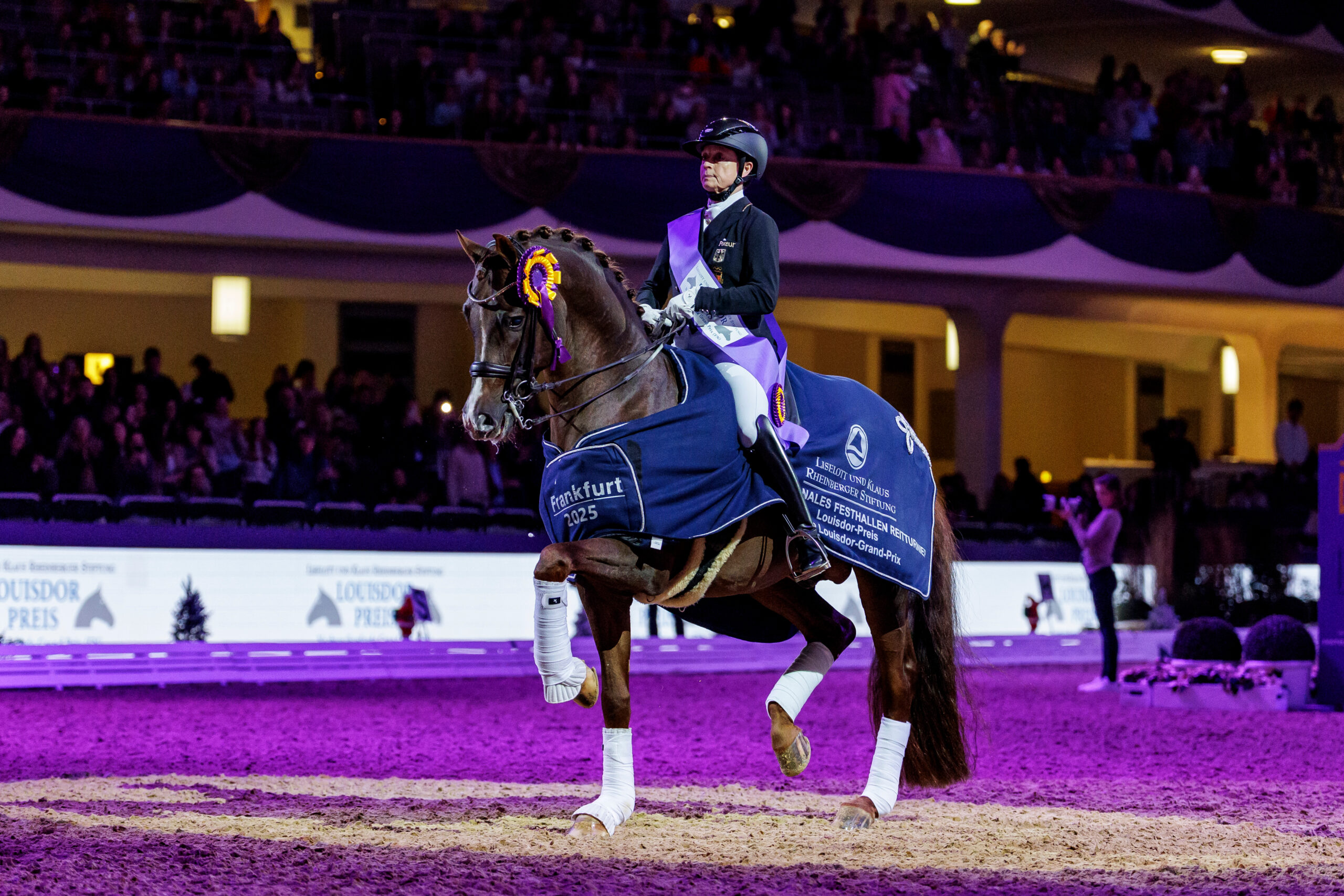
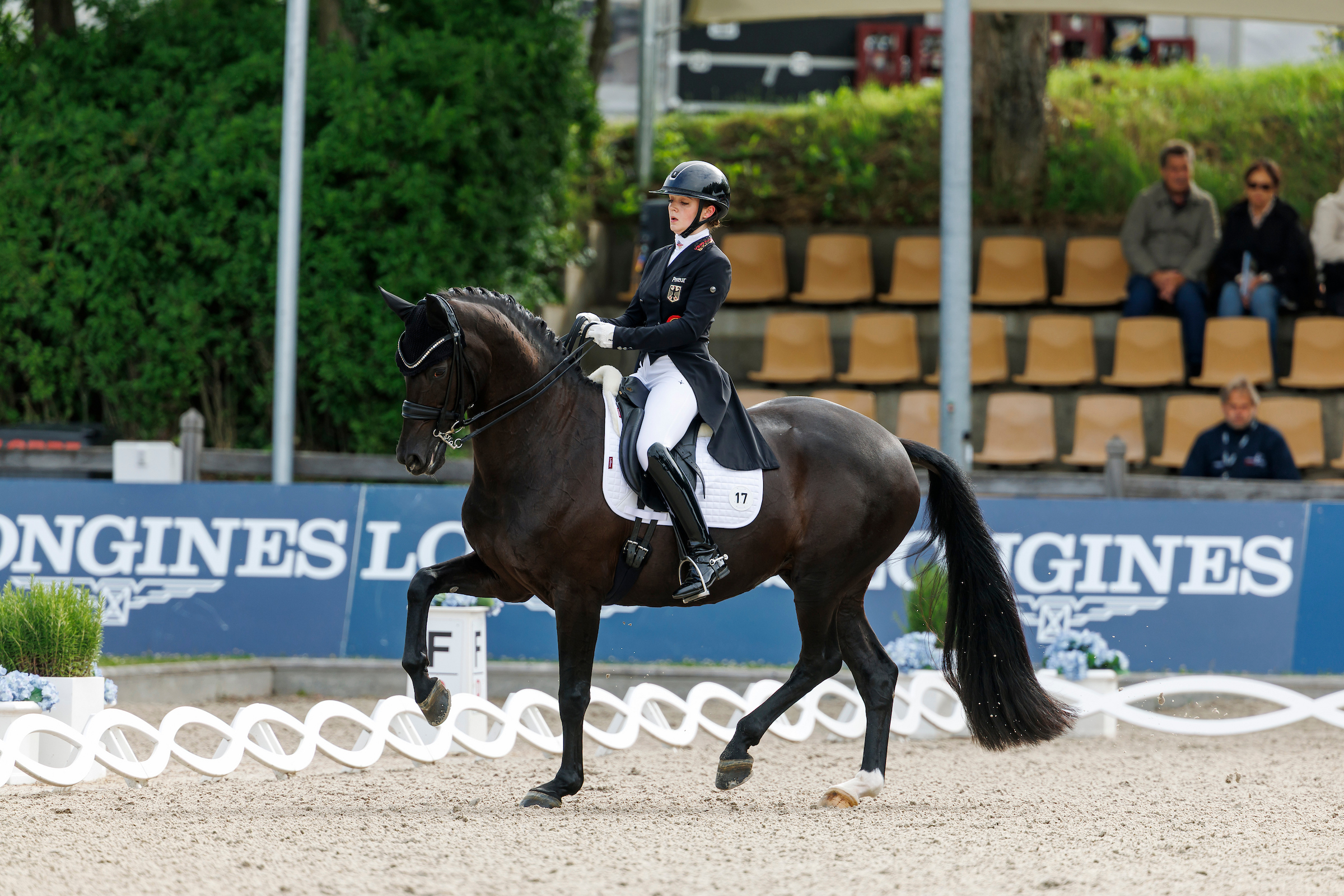
The new Louisdor Prize winner Viva Gold is a goosebump horse with all the potential. Whether he will one day follow in the footsteps of his granddam Weihegold, who led the lap of honor in Frankfurt in 2014 before becoming a world horse, is certainly not a question of talent.
Viva Gold won the Louisdor Prize Final 2025 with 75.620 percent under Isabell Werth. Second place went to last year’s Burg Cup runner-up, Escolar’s Emil with Thomas Wagner (72.380). Benjamin Werndl’s future hope Quick Decision (70.660) followed just ahead of Special Gold PCH under the saddle of Katharina Hemmer (70.360).
It is no coincidence that two horses have the word “Gold” in their names. Both go back to Isabell Werth’s three-time World Cup winner, Olympic team champion and European champion Weihegold OLD, who herself won the Louisdor Prize in Frankfurt in 2014. Special Gold is a direct son, Viva Gold a grandson. The breeder of both stallions is Christine Arns-Krogmann. This is a special achievement for both the mare Weihegold and the breeders behind this success, including Arns-Krogmann and those who have nurtured the Weissena line for generations.
“Wonderful, wonderful Viva Gold”
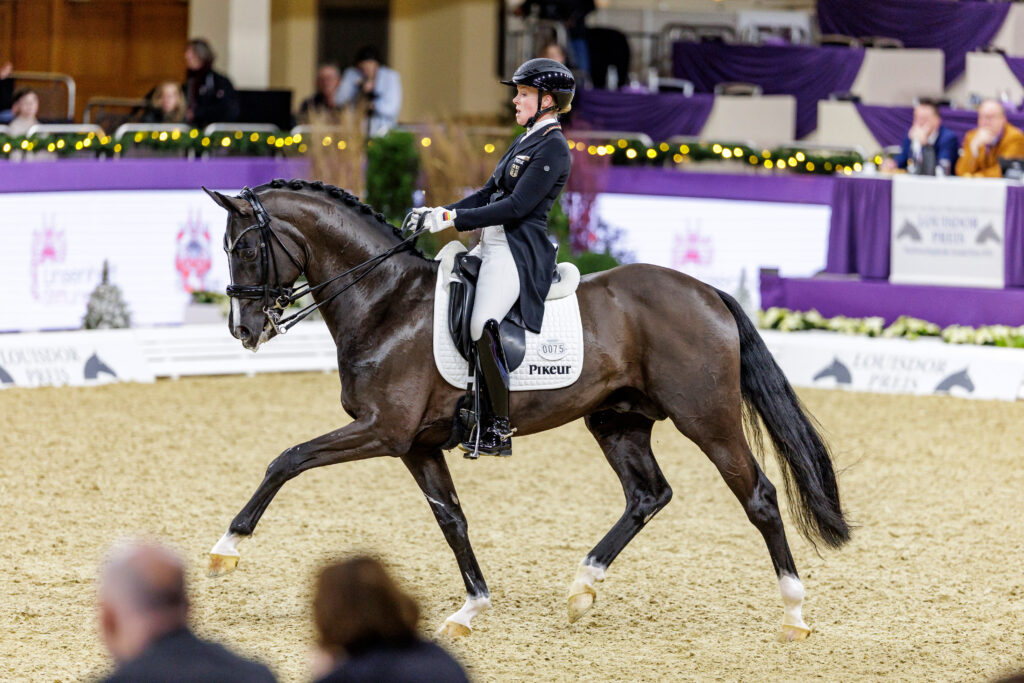
Alongside the piaffe and passage, the canter is an absolute highlight at Viva Gold. Photo: sportfotos-lafrentz.de
Since moving into his stall with Isabell Werth in Rheinberg in February 2025, Viva Gold, who was born in 2016, has competed in three shows – Hamburg, Münster and now Frankfurt. Each time he returned to his home stable undefeated. The Oldenburg stallion is a horse with all the potential, especially in the highest collection exercises. As Dr. Dietrich Plewa emphasized in his commentary:
“The really great thing about this horse is that he shows piaffe with incredible power, incredible rhythm and total balance, which are really school-like – with a lowered croup and very even, energetic footing.”
He called the beautiful chestnut a “model pupil”. Isabell Werth can only confirm this: “This horse is truly exceptional, a wonderful, wonderful horse! There is perhaps no other horse at the moment that has such a Hanken flexion. This horse really is a gift!”
His talent, especially in the difficult lessons, makes Viva Gold a championship candidate. The reason why the goosebump feeling that you got from Dalera BB in 2017 or Fendi in 2022 was still not there may be that Werth and Viva Gold have not yet achieved the fine-tuning that was already evident in the later four-time Olympic champion Dalera and Jessica von Bredow-Werndl.
Some “buts” in the exam
The stallion’s trot was not very supple through the body. There was a lack of lightness and dancing. The reinforcements were walked and not always in balance, especially when picking up. This was also true for the right traversal. The one to the left was better. Repeatedly, a clear hand influence disturbed the picture, which the stallion acknowledged by opening his mouth.
The canter seemed more harmonious. The zig-zag traversals were also quite safe, although Werth still clearly “helped” Viva Gold here with his hand. However, there was one problem in the series changes. Even in the two-in-hands, one would have liked the changes to the left to be more “jumped to the end” through the body. The change to the right was better. Werth gave very clear aids right at the beginning of the single changes and Viva Gold reacted by falling out briefly after jumping back and forth once and then taking a few jumps to get back into rhythm. A costly mistake. The pirouettes will achieve top marks one day. This time, Viva Gold was still struggling with his balance in both of them. The same applied to the last piaffe, where he needed a few steps to find his usual confident rhythm.
Light-footed powerhouse
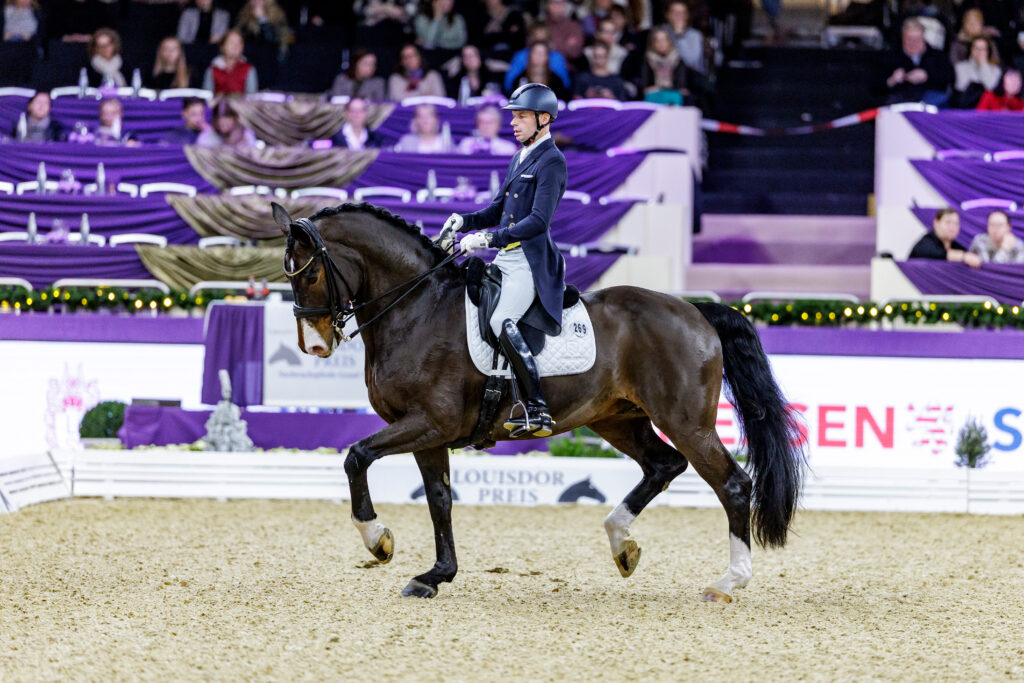
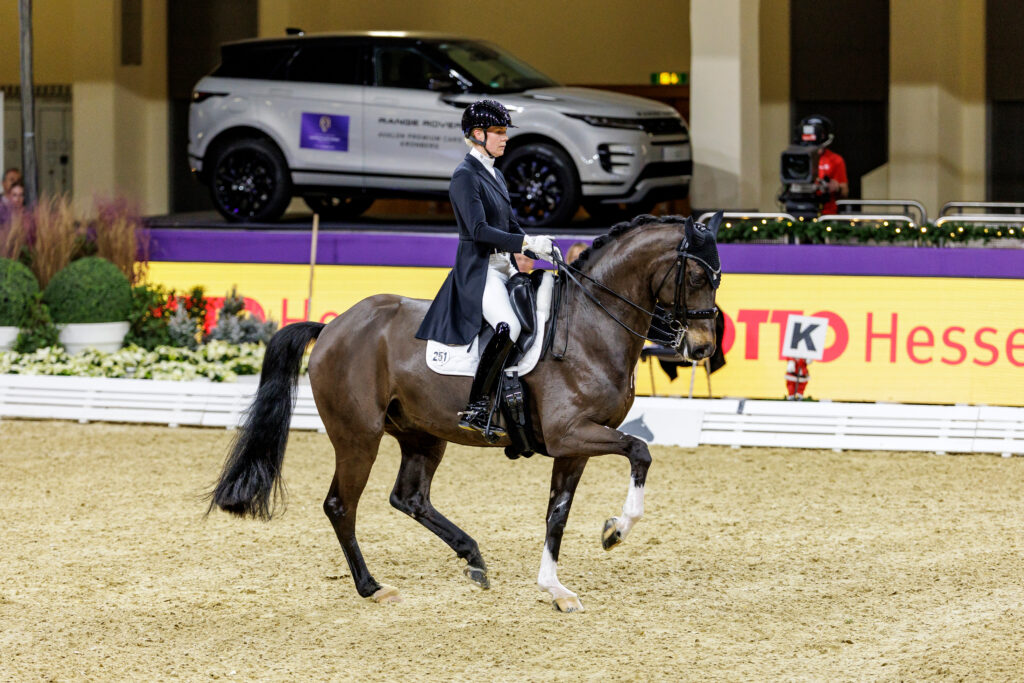
Despite his caliber, Thomas Wagner’s Escolar’s Emil is extremely light-footed and cadenced, especially in piaffe and passage. Photo: Sportfotos-lafrentz.de
Escolar’s Emil is pretty much the opposite of today’s modern dressage horse in a high rectangular format with a narrow chest and long legs. Last year’s Burg Cup fifth-place finisher has inherited an extremely strong foundation, a powerful back and a face that does not exactly signal Trakehner nobility, but a willingness to perform, from his ancestors (Escolar on the sire’s side and Contender on the dam’s sire’s side). Despite his caliber, the gelding presents himself with remarkable light-footedness in his three good basic gaits and also in the lessons.
After a successful salute, the pair began with an expressive, strong trot, although one would have wished for a wider frame. In general, the gelding’s neck became too narrow and short several times in the course of the test. However, the traversals were flowing and supple. The piaffe approach is classically good with lowered hindquarters, vertical forehand in the support phase and a clearly angled upper arm. There is still a slight lack of energy and extension. The forehand still needs to provide support and the transitions still need some fine-tuning, but that should be a question of time and strength.
The canter is the gelding’s great strength – actively springy, very ground covering, but at the same time with all possibilities for collection thanks to his clear suspension and relaxed back. Unfortunately, two single changes were missing at the end of the line, which was expensive and a shame, because the flying changes are actually a highlight. So, all in all, a great horse on the right track. No wonder his rider says that Escolar’s Emil is a “mega pleasure” to work with.
Benni’s new one
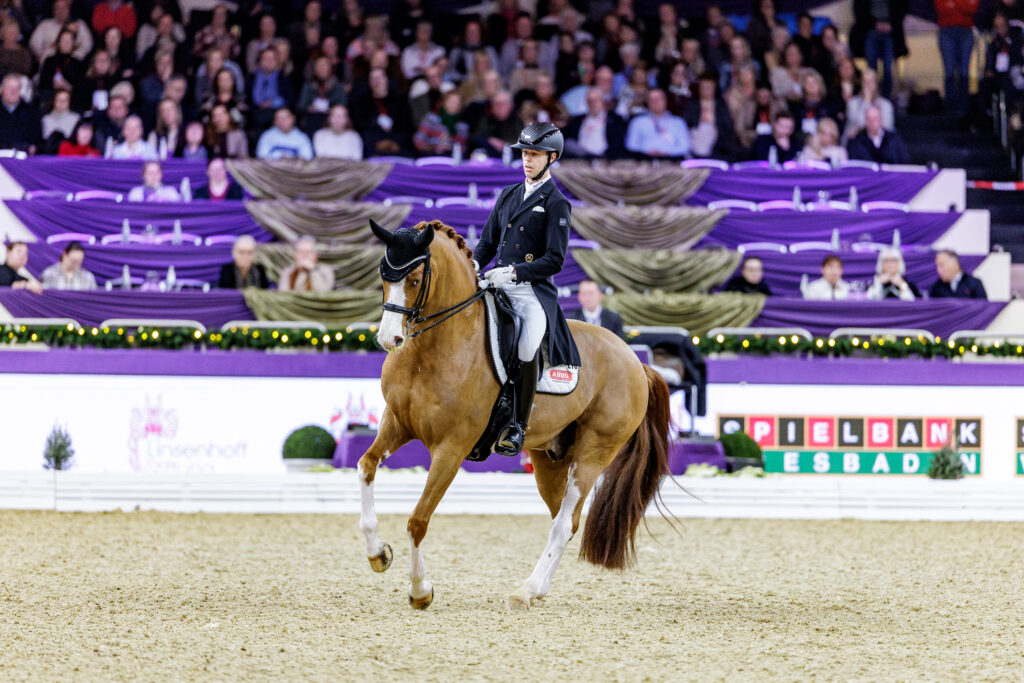
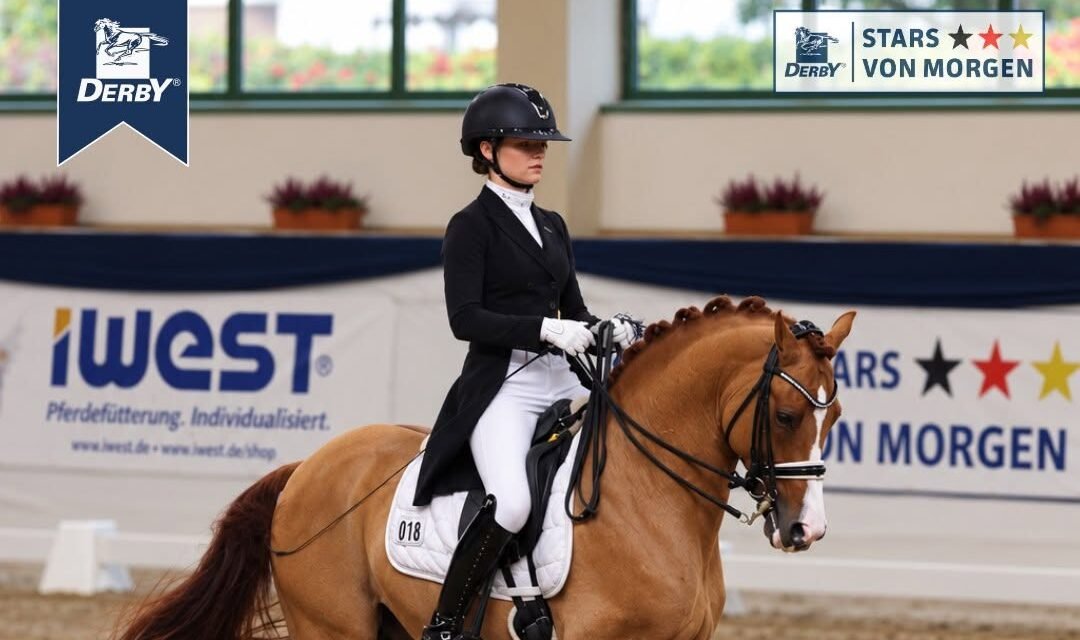
Not a horse that kicks the stars out of the sky, but one that enjoys his job and impresses with his real training: Benjamin Werndl’s Quick Decision. Photo: sportfotos-lafrentz.de
After the tragic death of his World Championship horse Famoso, Benjamin Werndl has another horse in which he has high hopes: the nine-year-old Hanoverian gelding Quick Decision, a colorful chestnut by Quaterhall. Like Famoso, Quick Decision is rather small in stature and not the kind of horse to step out into the limelight. But he also wins when he starts to move – which is largely due to the way he was trained by Uta Gräf and has been ridden by Werndl for the past year – consistently from back to front, so that the contact is light and stable, the movements flow through the body and the horse makes a satisfied impression. At least most of the time.
He lacked the final energy in the piaffe in the finale and Quick Decision did not find the beat, especially in the second piaffe. Werndl, who is usually so discreet, had to ask him energetically. The collected walk was fine until the second corner, where the gelding kicked short-long before the transition into the passage. In the canter, the two began with relaxed two-up changes. Here too, however, one would have liked to see the hindquarters repeat a little more actively.
The zig-zag traversals were well controlled and balanced, the one-tempi changes were faultless, but somewhat lacking in energy. The first pirouette to the left was a highlight. In the one to the right, the gelding then seemed to lose his energy and lost his balance. Werndl rode the last centerline with confidence, placed the piaffe forward and accordingly this was the most successful of all three.
Conclusion: there is still a lack of power, but not a lack of opportunities. And as Benni Werndl said after his ride: “The last centerline has been on my mind all year. The fact that it’s now so successful is the highlight of my weekend.” But resting on his laurels would not suit him. “Now I have to make sure that I can do the same in the other piaffe.”
The special “Spezi”
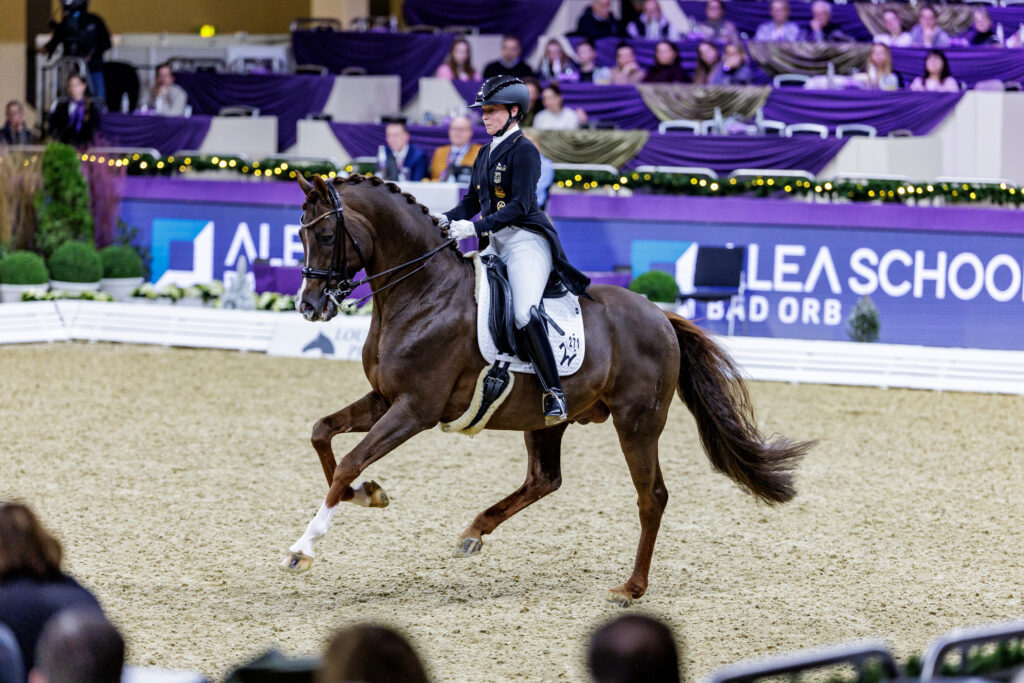
In the footsteps of Mama Weihegold: Special Gold PCH with Katharina Hemmer. Photo: sportfotos-lafrentz.de
Katharina Hemmer’s San Amour son Special Gold PCH is also a special horse in every respect. As his rider says: “He has an incredible zest for life and is always up for a laugh, even if he sometimes finds it funniest himself.” To really understand this characterization, you have to have watched the beautiful black horse when he picks up his toys (ball, cuddly toy) etc. in the paddock, in the box or wherever, flings them into the air with his teeth, kicks them with his front legs, spins around and obviously has the time of his life. But he can also be serious, as he showed in the Festhalle. “I’m convinced that a really great athlete is growing up,” says Hemmer. Her performance in the Louisdor Prize confirmed this.
Special Gold is a horse with three above-average basic gaits that is eager to go and willing to perform. Hemmer did not take any risks, for example he did not ride the stallion to his full potential in the extensions, but the principle of the pair is right. The piaffe-passage tour was already a success, with clear collection, lowered hindquarters, diagonal and in time. With increasing strength, she should be even more on the spot.
The canter tour began safely with beautiful two-up changes, well ridden reinforcement and easy collection. In the zig-zag traversals, the black horse got a little deep, but they worked without any mistakes. This happened in the single changes, which started well, but from X onwards Special Gold seemed to lose a little of his power. The pirouettes should also become smaller in the long run. But in the beginning everything is correct and good. In the passage before the last piaffe, Special Gold was briefly overzealous and lost his rhythm, but found it again in time to show perhaps the best piaffe of the test.
Katharina Hemmer has been riding the stallion since he was just five years old. And even though he was still several centimetres overbuilt back then and, as she said, “was still struggling with his body”, she immediately recognized the future Grand Prix horse in him. “I lunged him for the first time and then came into the arena with a beaming face. Hubertus (Schmidt, her trainer, editor’s note) looked at me and asked: ‘Katha, what did you see? And I said: Everything!”
How close the relationship between the two is became clear not only during the competition, but especially afterwards. In the Louisdor Prize, it is customary for the riders to dismount, for a commentator to classify the ride and for the riders themselves to describe how they feel in the saddle. Meanwhile, the horses are looked after by the grooms. Where other riders “passed on” their horses directly, Hemmer took the time to stroke “Spezi” extensively and thank him for his efforts. Meanwhile, the black horse stood visibly content in the arena and enjoyed being stroked. Every rider says that they love their horse. But not everyone shows it – Hemmer does.
The other winners
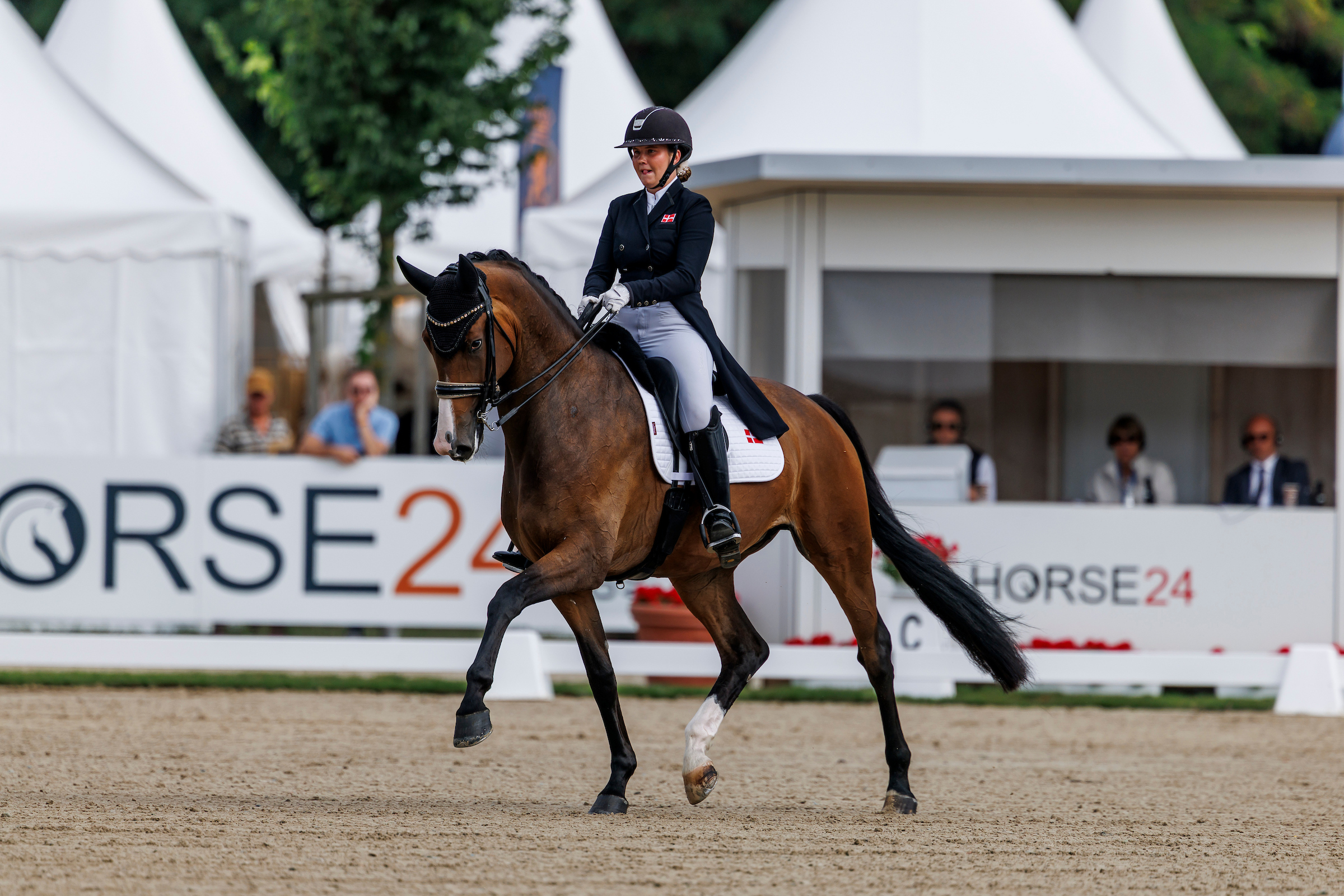
A horse with all the potential that just needs a little more time: Juliane Brunkhorst’s Diamante Negro. Photo: sportfotos-lafrentz.de
Global Power v. Grey Flannel
Evelyn Eger and Global Power moved up to the Louisdor Prize Final at the last minute, so to speak. The only eight-year-old Grey Flanell son was allowed to stand in for Charlott-Maria Schürmann’s Dante’s Pearl, who had contracted an infection. Global Power was a worthy replacement. It was the first long Grand Prix of his life for the Oldenburg, but he completed it with a naturalness that some of the older horses that came along lacked. He had also come to Evelyn Eger, rider at the Kasselmann stables, as a young horse. So the two of them know each other well and you could tell. Eger trotted him lightly for a short time and allowed him to stretch before tackling the task. Global Power followed her hand trustingly and then delivered a really beautiful test, which still lacked the highlights, but showed that a correctly ridden horse has the talent for all elements of the Grand Prix. With a score of 69.880 percent, he finished in fifth place this time.
Danny Cool v. Danciano
Helen Langehanenberg presented the ten-year-old DSP gelding Danny Cool by Danciano, owned by her long-time sponsors, the Eisner family. The slim, high-legged black stallion was already a silver medal winner at the Bundeschampionat as a five-year-old and took part in the World Championships for Young Dressage Horses as a six-year-old. At that time he was still ridden by Lisa Volpp, formerly known under her maiden name Lisa Horler. He then reappeared at the age of seven with Helen Langehanenberg in the saddle and achieved his first advanced (S) level successes. A year later, Danny Cool came third in the Burg Cup Final. In short, he knows the Festhalle and has already collected a lot of successes – no wonder, as he has three basic gaits that are well above average. The black stallion is a highly elastic horse with plenty of scope and light-footed piaffe-passage work. However, he remained very high and upright for large parts of the final without the croup lowering to a relative extent and the hind legs working more under the center of gravity. This resulted in 68.940 percent and sixth place for him in the Festhalle.
Chere Celine by Governor
Eight years is the minimum age for horses to be allowed to compete in the Louisdor Prize. In addition to Global Power (see above), there was only one other eight-year-old horse competing in this final: the Oldenburg mare Chere Celine with Lena Haßmann. The two had moved up at the last minute when Jessica von Bredow-Werndl withdrew her Got it because he was to be sold. This was the first “real” Grand Prix that Chere Celine had ridden in her life. The Totilas granddaughter has everything a Grand Prix horse needs, especially an active hind leg that always wants to get off the ground and under the center of gravity. She picks up weight just as well as she can become big and ground covering. What she still needs is time to mature. The passage should become even more accentuated in the long run, in the piaffe she did not always find her balance and therefore did not always have a secure diagonal beat. In addition, there were little things like mistakes in changes etc. In short, it was by no means a mature Grand Prix, but a performance that gives rise to great hopes.
Incidentally, this Governor daughter has also excelled at young horse championships, coming sixth in the final of the World Championships for Young Dressage Horses three times alone, i.e. as a five, six and seven-year-old. She also came seventh in the 2024 Burg Cup Final.
Diamante Negro by DeLorean
The nine-year-old DSP gelding Diamante Negro by DeLorean, owned by Juliane Brunkhorst, is a horse for whom the talent and time thing also applies. Last year, the pair came second in the final of the Nuremberg Burg Cup. That was no accident. This year, the elastic gelding once again presented himself in the Festhalle with a lot of impulsion, working well through the body – both in the reinforcement and in the highest collection exercises. Even if he still lacked the necessary strength and balance in the piaffe-passage work to be able to find and keep the beat safely. This led to costly mistakes, which will certainly be avoidable in the long term. Another homework assignment is the collected walk, which was clearly out of phase this time. After an appealing canter tour, Diamante Negro unfortunately also lost the diagonal beat in the final piaffe. It was nice to see how Juliane Brunkhorst then gave him time to collect himself, get back on his feet and finally show in a few paces that he even has the talent for an exceptionally good piaffe. The gelding was immediately praised for this and you could tell how much he needed it. Brunkhorst later confirmed that he was “incredibly eager to learn, motivated and willing to work”. That’s easy to imagine. The 66.30 percent with which Diamante Negro came eighth this time does not reflect the potential that lies dormant in this horse.
Forster by Finest
Tobias Nabben and the slender, light-footed Finest son Forster came third in the warm-up test. The black horse also has a natural talent for piaffe and passage. Unfortunately, however, the pair made so many costly mistakes in the final that they were unable to finish higher than ninth place this time with 65.780 percent.
Lord Europe by Lord Leatherdale
Leonie Richter and her Rhenish Lord Leatherdale son Lord Europe, runners-up in the 2023 Burg Cup, had to make do with tenth place. The start up to the first piaffe-passage tour went well. However, the black horse found it difficult to tilt his pelvis, pick up weight and work with his hind legs under the center of gravity in the highest collection exercises. This is particularly evident in the piaffe. When the expensive mistakes in the canter tour were added to this, the scores plummeted to 65.60 percent.
Otto Lörke Prize awarded twice
The Otto Lörke Prize for the team with the best young Grand Prix horse of the season is actually awarded at the Stuttgart German Masters. In 2025, Frankfurt was the festive setting. As has happened before, the prize was awarded twice, firstly for Isabell Werth’s Viva Gold and secondly for Jessica von Bredow-Werndl and Diallo BB.
Both horses are backed by other trainers in addition to their current riders. Viva Gold, who is owned by Antje Gehring from Gestüt Westfalenhof Gehring GbR and Madeleine Winter-Schulze, was previously ridden by Kathrin Sudhölter. Diallo BB, in which Annette Göbelsmann-Schweitzer continues to hold shares alongside Bredow-Werndl’s long-time patron Beatrice Bürchler-Keller, was trained up to Grand Prix level by Uta Gräf.
Viva Gold has competed in three tournaments this year and has never been beaten. Although Diallo BB is only ten years old, Jessica von Bredow-Werndl put him straight into the big tour and the results showed that the Dancier son was ready for it. He won the Grand Prix Special in Hagen, the Grand Prix in Munich and Wiener Neustadt and the Grand Prix and Freestyle at the World Cup tournament in Stuttgart.
Um Ihnen optimale Erlebnisse zu bieten, verwenden wir Technologien wie Cookies, um Geräteinformationen zu speichern und/oder darauf zuzugreifen. Die Zustimmung zu diesen Technologien ermöglicht uns die Verarbeitung von Daten wie Surfverhalten oder eindeutigen IDs auf dieser Website. Die Nichteinwilligung oder der Widerruf der Einwilligung kann bestimmte Funktionen beeinträchtigen.
Funktional
Always active
Die technische Speicherung oder der Zugriff ist für den legitimen Zweck, die Nutzung eines bestimmten, vom Teilnehmer oder Benutzer ausdrücklich angeforderten Dienstes zu ermöglichen, oder für den alleinigen Zweck der Durchführung der Übertragung einer Nachricht über ein elektronisches Kommunikationsnetz unbedingt erforderlich.
Preferences
The technical storage or access is necessary for the legitimate purpose of storing preferences that are not requested by the subscriber or user.
Statistiken
The technical storage or access that is used exclusively for statistical purposes.Die technische Speicherung bzw. der Zugriff erfolgt ausschließlich zu anonymen statistischen Zwecken. Ohne Vorladung, freiwillige Zustimmung Ihres Internet-Service-Providers oder zusätzliche Aufzeichnungen Dritter können die zu diesem Zweck gespeicherten oder abgerufenen Informationen in der Regel nicht dazu verwendet werden, Sie zu identifizieren.
Marketing
The technical storage or access is required to create user profiles to send advertising, or to track the user on a website or across several websites for similar marketing purposes.